Decades Blogathon – Back To The Future (1985)

Decades Blogathon Banner

1985

So here we are; the final day of what has been being a fantastic Decades Blogathon. Thank you to everyone who took the time to help make this such a great event, but thanks most of all to the one and only Tom from Digital Shortbread. Tom has been the perfect blogathon compatriot and I hope to be able to run another one with him again soon. The Decades Blogathon focuses on movies that were released in the fifth year of the decade and this one is written by yours truly. Thanks again and see you next time!

For a film in which time plays such a central theme, there’s something magically timeless to Robert Zemeckis’ almost perfect summer blockbuster.

Great movies have the power to transcend the movie theatres in which they were projected and instead become a cultural anchor that can help to define not only a time and place but, in the most influential cases, also do their bit to shape our lives.

Back To The Future Poster

Back To The Future was one such cinematic touchstone for me. I vividly recall exactly when and where I was when I first watched it on the big screen as an impressionable 10-year-old and remember exiting the cinema thinking it was the best film I had ever seen.

That it remains an all-time classic and still on my shortlist of favourite movies is a testament to the immortality of a film whose sequel is partly set only a few months from now (a scary thought I know).

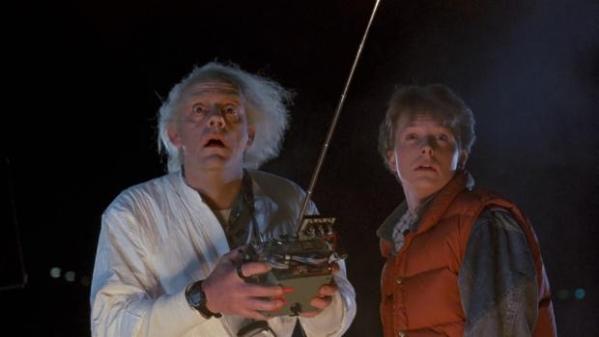
Back To The Future offers something new with each viewing; whether it be the fact Twin Pines Mall where Marty McFly (Michael J. Fox) meets Doc Brown (Christopher Lloyd) at the start of the film changes to Lone Pine Mall as a result of Marty having run over one of Old Man Peabody’s pines back when he first finds himself back in 1955; or on this latest occasion noticing the figure of Harold Lloyd hanging off the minute hand of one of the many clocks in Doc’s lab (a reference to Lloyd’s 1923 movie Safety Last!) in the opening credits – a stunt mirrored by Lloyd (Christopher) during the final nail-biting Clock Tower set-piece.
Back To The Future

Zemeckis and co-writer Bob Gale envisioned the idea of ‘what would it be like to meet your parents at the same age youare?’, from which they penned a screenplay that would’ve given Freud plenty to chew on.

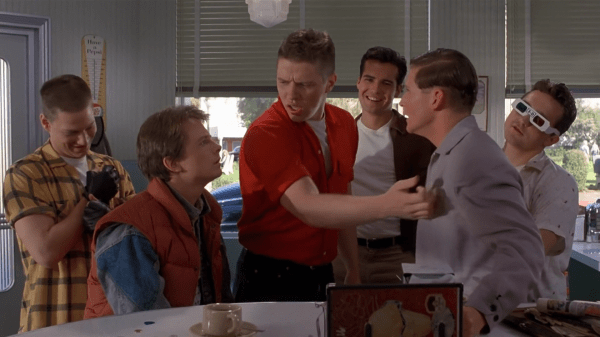
Skateboarding teen Marty is summoned by his good friend Doc to bear witness to the birth of time travel, but finds himself whisked back to 1955 courtesy of the mad professor’s DeLorean (Zemeckis originally thought his time machine would be a fridge). After inadvertently interfering in the course of events that brought his mother Lorraine (Lea Thompson) and father George (Crispin Glover) together, Marty must rewrite history, avoid school bully Biff (Thomas F. Wilson) and find a way to get back to 1985 with the help of a younger Doc.
Back To The Future

Whilst hardly original (Mark Twain’s novel A Connecticut Yankee In King Arthur’s Court had covered similar ground almost 100 years earlier), having an ’80s high school kid travel back to the 1950s was nevertheless a stroke of genius on the part of Zemeckis and Gale, as the fish-out-of-water premise allowed both Marty – and us – to observe a time when teenagers were finally finding their voice; a voice that 30 years later was starting to dominate the box office with the likes of Fast Times At Ridgemont High (1982) and Sixteen Candles (1984).

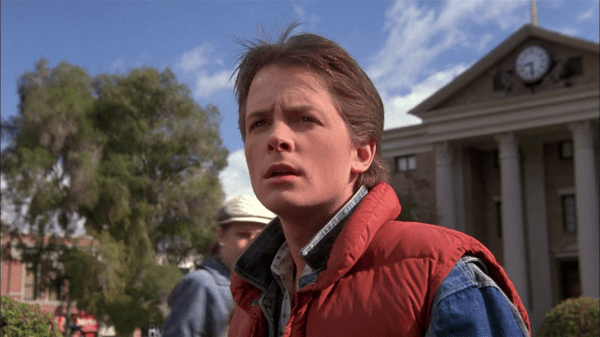
The film’s production design remains astonishing. Hill Valley feels like a living, breathing town and the small changes between 1955 and 1985 are fun to spot, in particular the fact the porno theatre showing Orgy American Style in 1985 was a movie house screening a Ronald Reagan movie 30 years earlier.
Back To The Future

There are plenty of other lovely touches, including when Marty inadvertently invents rock’n’roll while playing Chuck Berry’s Johnny B Goode at the Enchantment Under the Sea dance in front of a dumbstruck Marvin Berry, who immediately phones his cousin to update him on “the new sound [he’s] been looking for”.

Fox inhabits the role so completely, you simply cannot imagine another actor in the role, although that’s what very nearly happened when Eric Stoltz was originally cast as Marty. It’s fascinating to imagine a parallel universe in which Stoltz rather than Fox got to wear the “life-preserver” – maybe such a thing could have existed in the alternate 2015 as seen in Back To The Future II (1990).

Back To The Future

Whilst Back To The Future is sublime, it’s not perfect as there are a few moments that leave you scratching your head, most notably how come Marty’s parents don’t freak out when they come to realise their son looks and sounds exactly like the guy who helped get them together back in 1955? That one’s always bugged me.

One of the all-time great summer blockbusters, Back To The Future will remain just as joyously entertaining 30 years from now. Great Scott!

Review – X-Men: Days Of Future Past

Marvel’s most well-worn franchise is back to the future and back to its best in this exhilarating time travelling romp that resolutely refuses to take itself too seriously.

Setting aside the slightly needless set piece involving Magneto raising the Robert F Kennedy Memorial Stadium and chucking it over the White House like a giant donut, X-Men: Days Of Future Past is a genuine contender for blockbuster of the year

Setting aside the slightly needless set piece involving Magneto raising the Robert F Kennedy Memorial Stadium and chucking it over the White House like a giant donut, X-Men: Days Of Future Past is a genuine contender for blockbuster of the year

It’s been 14 years since X-Men arrived like a juggernaut into cinemas and ushered in a new paradigm in Hollywood that shows no signs of abating.

The franchise’s high water mark X2 (2003) still remains one of the most fully realised comic book movies. The same, however, could not be said of its sequel The Last Stand (2006) and the two standalone films featuring the evergreen Wolverine – all of which validated the law of diminishing returns.

1970s era Professor Xavier (James McAvoy) re-enters cerebro with Beast (Nicholas Hoult) and Wolverine (Hugh Jackman) in X-Men: Days of Future Past

1970s era Professor Xavier (James McAvoy) re-enters cerebro with Beast (Nicholas Hoult) and Wolverine (Hugh Jackman) in X-Men: Days of Future Past

As seems to happen with most money-spinning comic book series these days, the clocks were turned back and the reboot switch was flipped with X-Men: First Class (2011), an effective superhero flick that used recent history (the 1962 Cuban Missile Crisis) to posit an alternative reality in which mutants played a significant part.

The golden thread that linked First Class and X-Men 1.0 was Hugh Jackman’s pithy cameo as Wolverine and the character inevitably plays a crucial role in bridging the two time periods for Days Of Future Past.

Military scientist and businessman Bolivar Trask (Peter Dinklage) in X-Men: Days of Future Past

Military scientist and businessman Bolivar Trask (Peter Dinklage) in X-Men: Days of Future Past

The other golden thread is director Bryan Singer, who has come home after a patchy recent run that included Superman Returns (2006), Valkyrie (2008) and Jack The Giant Slayer (2013) and in the process delivered the best film in the franchise since his last turn in the big chair with X2.

Wolverine is zapped back in time to 1973 by Kitty Pryde (Ellen Page) to avert a future wherein seemingly invincible man-made robots called Sentinels are within a hair’s breadth of wiping out mutant kind. The situation is so grim that friends-turned-enemies Professor Xavier (Patrick Stewart) and Magneto (Ian McKellen) have joined forces to make a last stand (not that one) against the metallic beasts.

Mystique (Jennifer Lawrence) sets her sights in X-Men: Days of Future Past

Mystique (Jennifer Lawrence) sets her sights in X-Men: Days of Future Past

Meanwhile, back in ’73, Wolverine must convince a younger, more disillusioned Xavier (James McAvoy) to break Magneto (Michael Fassbender) out of the Pentagon in order for him to help them stop the shape-shifting Mystique (Jennifer Lawrence) from killing military scientist Bolivar Trask (Peter Dinklage), whose murder convinces President Nixon’s government to implement Trask’s Sentinel programme.

Using time travel to change an event in the past in order to alter the future invariably brings to mind the likes of The Terminator and Days Of Future Past doesn’t try particularly hard in hiding its obvious debt to that film as the Sentinels turn the planet into a mass graveyard in its dystopian opening reel.

1970s era Magneto (Michael Fassbender) tries to stop traffic in X-Men: Days of Future Past

1970s era Magneto (Michael Fassbender) tries to stop traffic in X-Men: Days of Future Past

The film also owes a debt to Star Trek, specifically First Contact and The Voyage Home in its ambition to strike a tone between serious and light-hearted. It’s a tough balance to strike, but one the film carries off with aplomb.

The scenes involving a young Peter Maximoff, aka Quicksilver, are great fun and Evan Peters has a blast in the part of the mutant who’s faster than a speeding bullet. The slo-mo Pentagon kitchen sequence involving a gleeful Quicksilver concocting an elaborate way of getting past the gun-toting guards is an ingenious fusion of special effects, balletic choreography and music (Jim Croce’s Time In A Bottle) that pays off to highly satisfying effect.

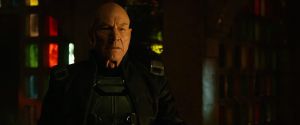
A future Professor Charles Xavier (Patrick Stewart) in X-Men: Days of Future Past

A future Professor Charles Xavier (Patrick Stewart) in X-Men: Days of Future Past

Singer just about manages to avoid things slipping into Village People ridiculousness, although Simon Kinberg’s script slips into over-exposition and needless anachronisms, to the extent you half expect Jackman to break the fourth wall and ask ‘are you keeping up?’.

A strength of the film, aside from John Ottman’s nicely judged score, is its ability to juggle a sizeable cast. With the exception of Halle Berry’s increasingly redundant Storm and Anna Paquin’s much-discussed reduction in screen time, pretty much everyone gets their moment to shine, in particular Nicholas Hoult, who continues the good work he put in during First Class as Hank McCoy, aka Beast.

Future Magneto (Ian McKellen) and Iceman (Shawn Ashmore) in X-Men: Days of Future Past

Future Magneto (Ian McKellen) and Iceman (Shawn Ashmore) in X-Men: Days of Future Past

Jackman, Stewart and McKellen slip into their respective roles as they would an old pair of shoes, while Lawrence gives Mystique a very human dimension and McAvoy expands greatly on what he did in First Class.

The biggest plaudits must go to the excellent Dinklage, who offers up a different sort of villain from the ones we’re used to seeing. Even the very worst of humanity think they’re doing the right thing and Trask is no different. Singer wisely cast Dinklage, whose diminutive size suggests a harmless industrialist, but whose character exbibits ambitions that are world-changing indeed.

Setting aside the slightly needless set piece involving Magneto raising the Robert F Kennedy Memorial Stadium and chucking it over the White House like a giant donut, X-Men: Days Of Future Past is a genuine contender for blockbuster of the year.