Review – The Great Gatsby
A great adaptation of what’s considered the Great American Novel has proven as elusive as the symbolic green light the obsessed Gatsby is desperately reaching for.
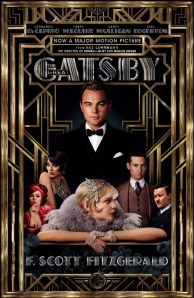
Baz Luhrmann’s The Great Gatsby – “a beautifully designed but ultimately hollow movie which, much like Gatsby, would rather you didn’t scratch beneath the veneer”
It’s been almost 40 years since the Robert Redford-starring misfire and now it’s the turn of Australian director Baz Luhrmann to see if he can capture the essence of F. Scott Fitzgerald’s most celebrated work.
Luhrmann certainly has some pedigree bringing iconic literature to the big screen; his unconventional modern-day version of Shakespeare’s most famous romantic tragedy (Romeo + Juliet) was a big hit and introduced the Bard to a whole new audience. His Oscar-nominated 2001 smash Moulin Rouge! also proved he’s no stranger when it comes to visual excess. That his 3-D take on The Great Gatsby is a failure, therefore, is a shame; all be it one with enough to save it from being labelled a disaster.

Nick Carraway (Tobey Maguire), sandwiched between dodgy businessman Meyer Wolfsheim (Bollywood star Amitabh Bachchan) and Jay Gatsby (Leonardo DiCaprio) in The Great Gatsby
The source of the problem lies with Luhrmann himself, specifically his inability to both construct a well-paced scene and find the soul of the book. To borrow that great line from Shakespeare’s Macbeth, Luhrmann’s Gatsby is full of sound and fury, signifying nothing.
Set in New York at the height of the Roaring Twenties, our way into the story is through Nick Carraway (Tobey Maguire), an aspiring writer working in the city selling bonds, who rents a modest property next to the opulent mansion owned by the enigmatic and secretive Jay Gatsby (Leonardo DiCaprio). Carraway befriends Gatsby, whose decadent parties are the talk of the town, but can never pin down his true character. All he knows is that Gatsby is obsessed with Carraway’s cousin Daisy (Carey Mulligan), who’s unhappily married to two-timing millionaire Tom Buchanan (Joel Edgerton).

Unhappily married couple Daisy (Carey Mulligan) and Tom Buchanan (Joel Edgerton) in The Great Gatsby
Films generally succeed or fail with their audience within the first 20 minutes. Luhrmann’s approach to winning us over in the first two reels is to burn a hole in the retina with a kinetic explosion of colour, razzmatazz, CGI and stomach-churning, epileptic camerawork – all accompanied by Jay-Z’s scattershot soundtrack taking in hip hop, George Gershwin and plenty more besides – that tries to batter you into submission but just ends up coming off as a mess.
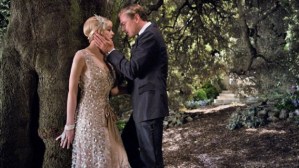
Daisy (Carey Mulligan) and Gatsby (Leonardo DiCaprio) steal a kiss in The Great Gatsby
While Luhrmann’s at his most comfortable and confident during the myriad party scenes, where his supersonic style of direction suits the frenzied action on screen, when the story demands restraint to allow the narrative to flow and the characters to develop the film badly loses its way. The whole middle section is listless, with scenes that should be gripping (in particular the pivotal hotel room showdown that drives the final act) feeling unengaging and oddly lifeless.

The one truly great shot of Baz Luhrmann’s The Great Gatsby
Luhrmann and co-writer Craig Pearce invent scenes of Carraway writing about his experiences with Gatsby while being treated in a sanatorium for “morbid alcoholism” as a way of explaining the narration, but get bogged down by continually returning to the washed-up wannabe writer pouring his tortured soul onto the page, even going so far as to etch choice bits of prose onto the screen.
Maguire’s lost puppy look soon grates and doesn’t work. Carraway may feel “within and without” of the world he stumbles into, but Maguire’s performance suggests he’s far happier observing than getting his hands dirty. Mulligan’s scared and inert southern belle is more believable, however, while Edgerton chews the scenery as the self-entitled Buchanan.

Nick Carraway (Tobey Maguire) and Jordan Baker (Elizabeth Debicki) in The Great Gatsby
DiCaprio stands head and shoulders above everyone else (with the exception of Elizabeth Debicki’s cynical Jordan, a friend of Daisy), giving a performance far more understated and nuanced than anything else in the movie. His introduction – stood in front of a volley of fireworks, glass raised – is the one moment the film lives up to the title. DiCaprio has matured significantly as an actor in the past few years and delivers an engaging mix of charisma, mystery, sadness and unnerving obsession that saves the film from falling flat on its face.
At one moment Carraway compares what he’s witnessing to an “amusement park”. It’s a fitting description of this beautifully designed but ultimately hollow experience which, much like Gatsby, would rather you didn’t scratch beneath the veneer.

 three rows back