Decades Blogathon – Back To The Future (1985)


So here we are; the final day of what has been being a fantastic Decades Blogathon. Thank you to everyone who took the time to help make this such a great event, but thanks most of all to the one and only Tom from Digital Shortbread. Tom has been the perfect blogathon compatriot and I hope to be able to run another one with him again soon. The Decades Blogathon focuses on movies that were released in the fifth year of the decade and this one is written by yours truly. Thanks again and see you next time!
For a film in which time plays such a central theme, there’s something magically timeless to Robert Zemeckis’ almost perfect summer blockbuster.
Great movies have the power to transcend the movie theatres in which they were projected and instead become a cultural anchor that can help to define not only a time and place but, in the most influential cases, also do their bit to shape our lives.

Back To The Future was one such cinematic touchstone for me. I vividly recall exactly when and where I was when I first watched it on the big screen as an impressionable 10-year-old and remember exiting the cinema thinking it was the best film I had ever seen.
That it remains an all-time classic and still on my shortlist of favourite movies is a testament to the immortality of a film whose sequel is partly set only a few months from now (a scary thought I know).
Back To The Future offers something new with each viewing; whether it be the fact Twin Pines Mall where Marty McFly (Michael J. Fox) meets Doc Brown (Christopher Lloyd) at the start of the film changes to Lone Pine Mall as a result of Marty having run over one of Old Man Peabody’s pines back when he first finds himself back in 1955; or on this latest occasion noticing the figure of Harold Lloyd hanging off the minute hand of one of the many clocks in Doc’s lab (a reference to Lloyd’s 1923 movie Safety Last!) in the opening credits – a stunt mirrored by Lloyd (Christopher) during the final nail-biting Clock Tower set-piece.
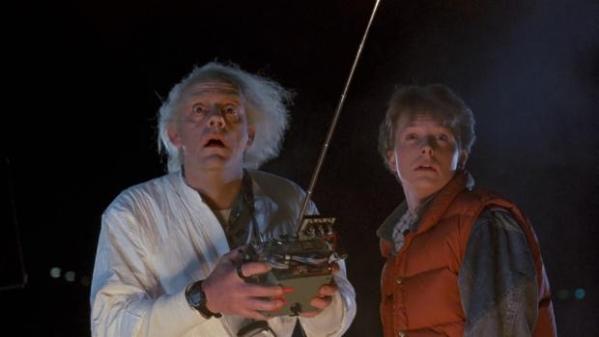
Zemeckis and co-writer Bob Gale envisioned the idea of ‘what would it be like to meet your parents at the same age youare?’, from which they penned a screenplay that would’ve given Freud plenty to chew on.
Skateboarding teen Marty is summoned by his good friend Doc to bear witness to the birth of time travel, but finds himself whisked back to 1955 courtesy of the mad professor’s DeLorean (Zemeckis originally thought his time machine would be a fridge). After inadvertently interfering in the course of events that brought his mother Lorraine (Lea Thompson) and father George (Crispin Glover) together, Marty must rewrite history, avoid school bully Biff (Thomas F. Wilson) and find a way to get back to 1985 with the help of a younger Doc.
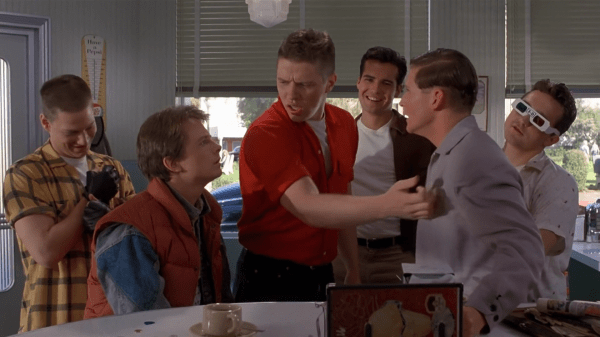
Whilst hardly original (Mark Twain’s novel A Connecticut Yankee In King Arthur’s Court had covered similar ground almost 100 years earlier), having an ’80s high school kid travel back to the 1950s was nevertheless a stroke of genius on the part of Zemeckis and Gale, as the fish-out-of-water premise allowed both Marty – and us – to observe a time when teenagers were finally finding their voice; a voice that 30 years later was starting to dominate the box office with the likes of Fast Times At Ridgemont High (1982) and Sixteen Candles (1984).
The film’s production design remains astonishing. Hill Valley feels like a living, breathing town and the small changes between 1955 and 1985 are fun to spot, in particular the fact the porno theatre showing Orgy American Style in 1985 was a movie house screening a Ronald Reagan movie 30 years earlier.
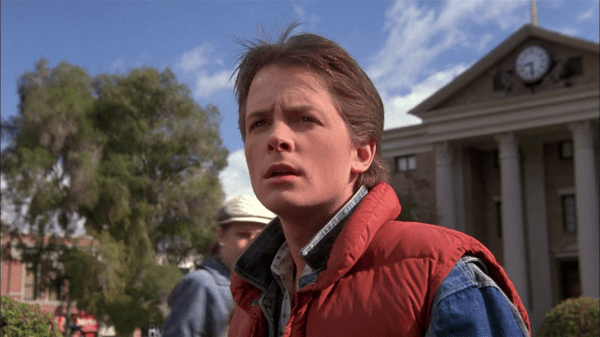
There are plenty of other lovely touches, including when Marty inadvertently invents rock’n’roll while playing Chuck Berry’s Johnny B Goode at the Enchantment Under the Sea dance in front of a dumbstruck Marvin Berry, who immediately phones his cousin to update him on “the new sound [he’s] been looking for”.
Fox inhabits the role so completely, you simply cannot imagine another actor in the role, although that’s what very nearly happened when Eric Stoltz was originally cast as Marty. It’s fascinating to imagine a parallel universe in which Stoltz rather than Fox got to wear the “life-preserver” – maybe such a thing could have existed in the alternate 2015 as seen in Back To The Future II (1990).

Whilst Back To The Future is sublime, it’s not perfect as there are a few moments that leave you scratching your head, most notably how come Marty’s parents don’t freak out when they come to realise their son looks and sounds exactly like the guy who helped get them together back in 1955? That one’s always bugged me.
One of the all-time great summer blockbusters, Back To The Future will remain just as joyously entertaining 30 years from now. Great Scott!





 three rows back