Great Films You Need To See – The Rutles: All You Need Is Cash (1978)

This is my latest contribution to The Big Picture, the internationally recognised website that shows film in a wider context. The Big Picture is running a series of features and reviews with the theme of ‘satire’. This piece is part of the site’s Lost Classics section (featuring in my list of Great Films You Need To See), in this case ex-Python Eric Idle’s music mockumentary The Rutles: All You Need Is Cash.

Hardly ones to take themselves too seriously, the Fab Four nevertheless provided the perfect foils for the grandfather of music mockumentaries.

While Spinal Tap took the formula to unparalleled heights, The Rutles set the ball rolling and remains an amusingly ramshackle spoof

While Spinal Tap took the formula to unparalleled heights, The Rutles set the ball rolling and remains an amusingly ramshackle spoof

Before This Is Spinal Tap (1984) there was The Rutles: All You Need Is Cash (1978), a Beatles parody given form partly thanks to its lead guitarist George Harrison.

Originally conceived as a throwaway sketch on Eric Idle’s post-Python BBC comedy series Rutland Weekend Television (1975-76), the skit took on a life of its own when it was shown on an episode of the long-running gag show Saturday Night Live that Idle was hosting.

Eric Idle's presenter in deep water in The Rutles

Eric Idle’s presenter in deep water in The Rutles

With Harrison’s encouragement, Idle’s partner-in-crime on Rutland Weekend Television Neil Innes knuckled down to turn what was an affectionate parody of A Hard Day’s Night into an alternative history of the world’s most successful and beloved band that spawned a whole new cinematic sub-genre.

Written by Idle and Innes, The Rutles charts the story of the Prefab Four – Dirk McQuickly (Idle), Ron Nasty (Innes), Stig O’Hara (Ricky Fataar) and Barry Wom (John Halsey) – from their humble Rutland roots to becoming “bigger than Rod [Stewart]” and creating “a musical legend that will last a lunchtime”.

The Rutles' take on I Am The Walrus, Piggy In The Middle

The Rutles’ take on I Am The Walrus, Piggy In The Middle

Modelled on the traditional to-camera documentary presenter style (Idle again), the film’s less-than-serious approach is apparent from the get go, with the former Python’s walk and talk becoming a sprint and gasp as the vehicle he’s following decides to hit the gas.

The presenter follows in the tight-trousered band’s footsteps from Der Rat Keller in Hamburg to the Ed Sullivan Show, Che Stadium (“named after the Cuban guerilla leader Che Stadium”), their spiritual quest to Bognor to meet Surrey mystic Arthur Sultan and Ron’s sit in the shower for peace with his soul mate Chastity (played by Gwen Taylor in a Nazi outfit in a hilariously near-the-knuckle mickey take of Yoko Ono).
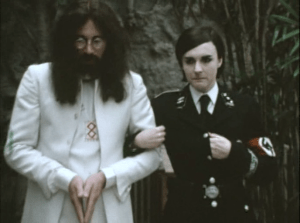
Ron Nasty (Neil Innes) and partner Chastity (Gwen Taylor), aka Yoko Ono in The Rutles

Ron Nasty (Neil Innes) and partner Chastity (Gwen Taylor), aka Yoko Ono in The Rutles

The Beatles’ musical evolution is playfully parodied (Doubleback Alley is a take on Penny Lane; I Am The Walrus becomes the equally nonsensical Piggy In The Middle, among many others), while the band’s foray into the world of movies is also lampooned, with Ouch! a send-up of Help!; Yellow Submarine Sandwich (complete with surreal animation) and The Tragical History Tour, in which the Prefab Four play Oxford history professors going on a hitchhiking tour of tea shops in the Rutland area.

The SNL connection led to cameos from Bill Murray, Dan Aykroyd, Gilda Radner and John Belushi, while Michael Palin appears in one the film’s most amusing scenes playing opposite Harrison’s silver-haired interviewer as Rutle Corps’ headquarters is plundered.

Ex-Beatle George Harrison interviews Rutle Corp press agent Eric Manchester (Michael Palin) in The Rutles

Ex-Beatle George Harrison interviews Rutle Corp press agent Eric Manchester (Michael Palin) in The Rutles

Roped in to give the film some extra fizz by Harrison, a game Mick Jagger and Paul Simon deliver old Rutles tales with admirable brio, probably because most of the stories they were telling were actually true and involved the Fab, rather than the Prefab, Four.

The Rutles adheres to the most important rule of mockumentaries, in that everyone plays it straight despite the silliness going on around them. It also helps that Innes’ songs are catchy in their own right and different enough from the originals so as not to sound like a carbon copy.
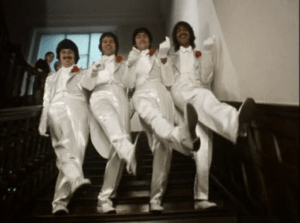
The Rutles go all showbiz

The Rutles go all showbiz

It’s a testament to the film’s legacy that not only did it influence Rob Reiner and Christopher Guest when approaching This Is Spinal Tap, but also remains both a cult favourite among as many Beatles fans as those who still follow The Rutles on their sporadic live tours.

While Spinal Tap took the formula to unparalleled heights, The Rutles set the ball rolling and remains an amusingly ramshackle spoof.

Great Films You Need To See – Bob Roberts (1992)

When the Tea Party movement was being formed following Barack Obama’s 2008 presidential victory, it wouldn’t have been a surprise if its founders hadn’t gotten some twisted inspiration from Bob Roberts.

Although 20 years old, Tim Robbins’ scaborously satirical mock-umentary is arguably more prescient now than it was when it was released shortly before the 1992 election involving Bill Clinton and George Bush.

The themes explored in Bob Roberts are, alas, all too pertinent to what has played out before our eyes in each and every political race, where the politics of personality, fear, image and ignorance take precedence over reality and the issues that should really matter to the electorate.

Bob Roberts is “a bold, frightening and blackly satirical warning to a sleepwalking nation of the power of style over substance”

The film follows the campaign of Repubican senatorial hopeful Bob Roberts, a folk-singing self-made millionaire-turned “man of the people” and “leader of a generation”, according to his fanatical band of acolytes (including a young Jack Black in his feature debut as a Hitler youth-alike).

Roberts and his campaign team use a sympathetic media machine to push his rabidly right-wing agenda at the expense of the principled Democratic incumbent Senator Brickley Paiste (the late Gore Vidal), who “doesn’t see anybody at home” when looking into his opponent’s soul, but is unprepared for his opponent and, when tainted by a fabricated sex scandal naively proclaims that “this is America. Virtue always prevails”.

Roberts is hounded by an investigative reporter, Bugs Raplin (Giancarlo Esposito), who pertains to have evidence that the senatorial hopeful and his campaign chairman Lukas Hart (Alan Rickman) are involved in crooked deals and drugs despite peddling an anti-drugs message as part of his campaign.

As election day draws near, a seemingly tragic incident dramatically alters the public mood, but is everything as it appears?

Although there can be little doubt as to which side of the political fence Robbins sits, the vitriol of Bob Roberts is aimed more squarely at the political system as a whole. When the system is little more than the mouthpiece of big money and lobbyists, Robbins appears to argue, then it’s hardly surprising a figure as rotten as Roberts could rise up Omen-style from its darkest recesses.

The iconography of the 60s runs through the film like a stick of rock, most notably the work of  Bob Dylan. While Robbins clearly seems to pine for the ideals of that lost decade, he is shrewd enough to observe how what’s ‘cool’ from the 60s has been perverted and monetised by the morally and intellectually bankrupt, such as Roberts, for personal gain.

While declaring that “the 60s are, let’s face it, a dark stain on American history” during an interview on a morning chat show, Roberts churns out hate-filled folk records with such Dylan-aping titles as “The Freewheelin’ Bob Roberts”, “Times Are Changin’ Back” and “Bob on Bob”. He even reinvents Dylan’s iconic video to “Subterranean Homesick Blues” as “The Wall Street Rap”, his paean to the pursuit of money.

Bob Dylan pastiche #1 in Bob Roberts

Bob Dylan pastiche #2 in Bob Roberts

Robbins takes the Dylan reference further by adopting the same verite-style of the classic 1967 documentary about the singer Don’t Look Back, while in one scene Roberts, who rides ahead of his campaign bus on a motorbike, falls off, aping a similar incident suffered by the folk legend in 1966.

The corporatisation of politics and its leaders is hardly a new phenomenon, but Robbins turns it all the way up to 11 here. When his campaign staff aren’t manning the phones pushing Roberts the politician from the confines of their battle bus, they’re pushing Roberts the businessman by trading stocks and shares.

Bob Roberts – the Tea Party’s wet dream come to life in Tim Robbins’ searing satire

While Robbins can get bogged down hammering home the point that politics and society at large has regressed from the idealism of the 60s to a more reactionary, less tolerant state, his debut film has become ever more pertinent and timely over the years. His portrayal of a media machine that wallows in trivia and allows subjectivity to superseed objectivty foretells the world of 24-hour rolling news and the likes of Fox News. Robbins also attacks the deliberate erosion of the divide between church and state, something that has now become de rigueur in politics since George W Bush and the advent of the Tea Party.

Robbins exudes an oily charisma as the titular firebrand, capturing the dead-eyed smile we’ve seen from so many politicians. Equally great is Rickman as the not-quite-human Hart and Ray Wise as Roberts’ svengali-esque campaign manager Chet MacGregor.

Bob Roberts is a bold, frightening and blackly satirical warning to a sleepwalking nation of the power of style over substance and the sobering observation that you often get the leaders you deserve.