Review – Dawn Of The Planet Of The Apes
You absolutely know you’ve bought into this hugely ambitious blockbuster sequel when the sight of an ape riding a horse while firing machine guns with each hand makes perfect sense rather than looking ridiculous.
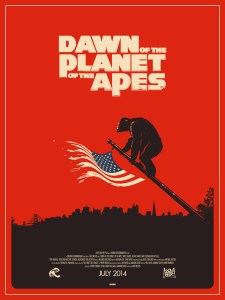
In a year of mostly superior blockbuster fare, Dawn Of The Planet Of The Apes could just be the most genetically superior of the lot
The world built by Rupert Wyatt’s Rise Of The Planet Of The Apes (2011) is impressively expanded upon here, while the astonishing visual effects service, rather than drive an engaging story of Shakespearean proportions.
The fact that the lead ape is called Caesar is entirely fitting to a tale of brotherhood, betrayal and tragedy that beats its chest in appreciation of the Bard’s Julius Caesar, just as Rise… took elements of Henry V in its depiction of Caesar’s ascent to leadership. Although Dawn‘s lofty aspirations don’t always hit the mark, the zeal in which it goes about it is something to applaud.

Caesar (Andy Serkis) in battle mode in Dawn Of The Planet Of The Apes
It’s been 10 years since the so-called Simian Flu has reduced the human race to the point of extinction and, inversely, led to a growing utopian society of genetically evolved apes, led by Caesar (Andy Serkis). This idyll is turned upside down by the sudden and unexpected arrival of a group of humans, including Malcolm (Jason Clarke), his son Alexander (Kodi Smit-McPhee, who’s making a habit of appearing in apocalyptic dramas following The Road) and Ellie (Keri Russell).
The encounter reignites old enmities in Caesar’s second-in-command Koba (Toby Kebbell), who believes the humans pose a direct threat, while in the human colony this mutual suspicion is shared by uneasy leader Dreyfus (Gary Oldman). Caesar and Malcolm, meanwhile, try to build a shaky détente in the hope that war can be averted.
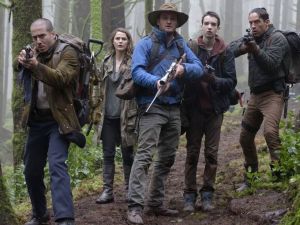
The human survivors, including Malcolm (Jason Clarke), Ellie (Keri Russell) and Alexander (Kodi Smit-McPhee) are told to “Goooooooo!!!” in Dawn Of The Planet Of The Apes
The devastating effect of the Simian Flu, introduced during Rise‘s post-credits sequence is dealt with in the film’s efficient opening credits, which skilfully weave in real life news footage to establish how Charlton Heston’s astronaut could come to his horrific realisation at the end of Planet Of The Apes (1968).
The 10 years separating the two films are written on the faces of the protagonists. Caesar has grown into a responsible, benevolent leader; a husband and father who espouses the central rule of an orderly society: ‘ape do not harm ape’. On the other side of the divide, desperation is etched on the human survivors, who unwittingly traverse into ape territory in the search of a much-needed power source.

The human survivors seriously underestimate Koba (Toby Kebbell) in Dawn Of The Planet Of The Apes
As soon as humans and apes come into contact, we know that war is inevitable, but the journey to get there is effectively handled by director Matt Reeves and scriptwriters Rick Jaffa, Amanda Silver and Mark Bomback, who get us to empathise with each character’s motives.
Dawn… has been criticised for too neatly presenting the different factions as mirror images of each other – Koba and Dreyfus represent the hawkish shoot-first-ask-questions-later approach bred by a combination of antipathy and fear; while Caesar and Malcolm are the peacemakers who see diplomacy as the way forward rather than conflict.
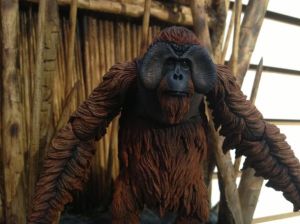
The benevolent Maurice (Karin Konoval) in Dawn Of The Planet Of The Apes
Watch the film, however, and this approach makes perfect sense; the apes and humans are far more alike than either might wish to admit, something acknowledged in a wry observation by Caesar late in the film to his conflicted son Blue Eyes (Nick Thurston). This is a direct nod to the original Apes series and underlines how this most unique of franchises is forever adaptable to the times in which we live.
With so many apes on screen, the action scenes could easily have descended into disengaged confusion; however, we’re never left high and dry and there is even room for a number of bravura shots, including one in which the camera positioned on a slowly revolving tank turret shows us the full-scale of the battle and a startling shot (achieved on the spur of the moment, apparently) of Koba perched atop a battered American flagpole staring at his enemy.
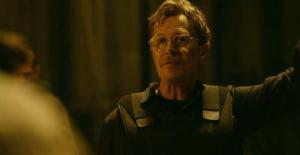
Human leader Dreyfus (Gary Oldman) in Dawn Of The Planet Of The Apes
Serkis further rubber stamps his standing as cinema’s motion capture godfather with a sublime turn as Caesar, while Kebbell is equally expressive as the tortured Koba. On the other side, Oldman invests Dreyfus with an all-too-human frailty and Clarke is efficient without setting off too many fireworks. Meanwhile, Russell’s thankless turn only serves to underline the dearth of decent female parts.
In a year of mostly superior blockbuster fare, Dawn Of The Planet Of The Apes could just be the most genetically superior of the lot.

 three rows back