Review – Pompeii
If imitation is the sincerest form of flattery, then Paul W.S. Anderson’s CGI-fuelled swords and sandals disaster flick really ain’t fooling around in its obsequiousness.
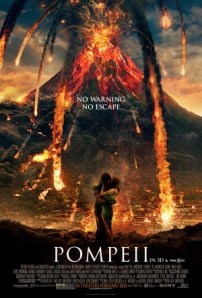
There’s a potentially exciting and engaging film to be made about the tragic events that befell the city of Pompeii in AD79. This isn’t it
Although written by human beings, Pompeii‘s script and narrative structure could just as easily have been the product of a computer algorithm generated from the storylines of Gladiator, Spartacus, Quo Vadis and about a dozen other Roman epics, as well as Titanic and Romeo and Juliet (and a raft of others no doubt).
That in itself isn’t necessarily a death sentence, but when you’ve got Kiefer Sutherland putting on the worst English accent since Kevin Costner gave a stab in Robin Hood: Prince Of Thieves then it’s time to pour molten lava on proceedings.
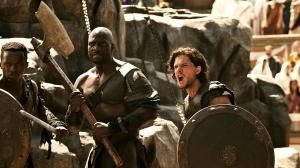
Milo, aka The Celt (Kit Harrington) forms a firm friendship with fellow slave Atticus (Adewale Akinnuoye-Agbaje) in Pompeii
In fact, it says rather too much about Pompeii that the most convincing character in the movie is angry old Mt Vesuvius, which can’t blow its top quickly enough, frankly.
The film follow Milo, aka ‘The Celt’ (Kit Harrington), who as a young lad witnessed the murder of his parents and fellow villagers by Roman General Corvus (Sutherland) before being kidnapped by slave traders and transported years later from Britannia (where it’s always raining – how original) to Pompeii.

Slave Milo (Kit Harrington) embarks on a forbidden romance with Roman girl Cassia (Emily Browning) in Pompeii
There he befriends fellow slave Atticus (Adewale Akinnuoye-Agbaje) and catches the eye of the rebellious Cassia (Emily Browning), daughter of city ruler Severus (Jared Harris) and his wife Aurelia (Carrie-Anne Moss). When Corvus – now a Roman Senator – sails into Pompeii, Milo senses an opportunity to finally realise his long held desire for revenge. However, the small matter of an erupting volcano threatens to spoil everything.
Anderson is best known for directing the Resident Evil franchise, which is appropriate because Pompeii effectively turns into a computer game once Vesuvius erupts. The film could hardly be credited with depth, but it truly jumps the shark during a ridiculous chase scene involving a horse and chariot that would have had Charlton Heston spinning in his gun-lined coffin.

Pantomime villain Corvus (Kiefer Sutherland) in Pompeii
The romance between Milo and Cassia simply doesn’t work, which is a shame as Harrington and Browning at least try to inject some chemistry. A better bond is created between Milo and Atticus, whose initial rivalry and subsequent friendship is the best part of the film, especially during the gladiatorial scenes which allow Milo the opportunity to exact some humiliation on the evil Corvus.
Much like any other disaster film, you’re left twiddling your thumbs before the money shot finally arrives (just in case we’ve forgotten it’s coming, we have Atticus to helpfully point out that the regular pre-eruption tremors are just “the mountain” and nothing to worry about).

Mt Vesuvius gets angry in Pompeii
When Vesuvius finally does erupt, it at least does so with impressive style, but it doesn’t take long before boredom sets in once again and you’re hoping a fireball will take out most of the cast. Besides, anyone who’s seen the overly extended trailer will know exactly what to expect.
One suspects that Anderson’s tongue was wedged firmly in his cheek judging by the film’s histrionic tone and Sutherland’s pantomime performance, but that doesn’t forgive the sheer tedium of what’s on display here.
There’s a potentially exciting and engaging film to be made about the tragic events that befell the city of Pompeii in AD79. This isn’t it.

 three rows back