Review – Behind The Candelabra
It’s an unfortunate twist of fate that a film featuring an outrageously flamboyant central figure who was one of the world’s biggest stars ended up being relegated to the small screen in the United States.
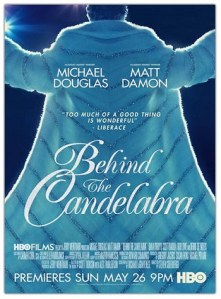
Behind The Candelabra may be a relatively low key film for Soderbergh to bow out on, but it is consumate filmmaking nonetheless and fully advocates Liberace’s motto that “too much of a good thing is wonderful”.
Despite starring Michael Douglas and Matt Damon and featuring Steven Soderbergh behind he camera for what is supposedly his final film, the Hollywood studio system shamed itself by refusing to back Behind The Candelabra for being ‘too gay’.
In the end, it took HBO to fund the picture and remind those who had forgotten that we’re living in the 21st century. This meant the movie only saw the light of day in America via the cable TV giant, a bittersweet irony considering it played in competition at this year’s Cannes Film Festival and made it into cinemas outside of the States.

‘Mr Showmanship’ Liberace (Michael Douglas) in action in Behind the Candelabra
Best known for overtly masculine roles in the likes of Basic Instinct, Wall Street and Fatal Attraction, Douglas plays seriously against type as Walter ‘Lee’ Liberace, the world-famous pianist extraordinaire who became the highest-paid entertainer on the planet and the epitome of Las Vegas excess.
Behind The Candelabra chronicles the last 10 years of Liberace’s life, focussing in particular on the covert affair he had with the much younger Scott Thorson (Damon), on whose eponymous memoir the film is based. An animal trainer for movies, Scott is introduced to Liberace through Bob Black (Scott Bakula), a Hollywood producer who he meets in a gay bar. Scott is dazzled by Liberace’s piano skills, while Lee is instantly taken with the handsome younger man.

Liberace (Michael Douglas) tells Scott (Matt Damon) how he feels in Behind the Candelabra
While’s Liberace’s carefully managed public persona portrays him as being straight, in real life he and Scott become lovers and behind the candelabra embark on a passionate relationship that takes a turn for the surreal before finally ending up in acrimony.
The slightly fuzzy lens reflects the affection Soderbergh clearly has with his subject matter. There are similarities to Paul Thomas Anderson’s Boogie Nights, both in the late 70s and early 80s setting and Damon’s beautifully observed portrayal of Thorson, whose journey from eager-to-please greenhorn to a hurt and embittered shadow of his former self calls to mind Mark Wahlberg’s Dirk Diggler.

Scott Thorson (Matt Damon) all dolled-up in Behind the Candelabra
When the story takes a painful turn, Soderbergh is careful not to trade in black and whites and place the blame on any one person’s doorstep. Liberace and Scott are essentially two sides of the same coin, both lonely and desperate to be loved. In Scott’s case this stems from his time as a foster child, in Lee’s it’s from his mother Frances (played by Debbie Reynolds), whom he feels stiffled by. In a telling scene, Frances wins the jackpot on a slot machine she’s playing in Lee’s home, but no money comes out. Lee offers her whatever money he can find, but she refuses and demands a cheque instead.
Being two such lonely souls looking for companionship, it’s of little surprise their relationship is so intense, although things start to get very odd when Lee brings in plastic surgeon Dr Jack Startz (Rob Lowe) to perform some off-kilter work on Scott.
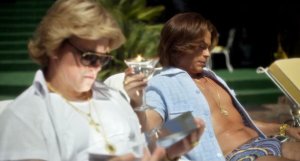
Scott (Matt Damon) and half-baked plastic surgeon Dr Jack Startz (Rob Lowe) in Behind the Candelabra
Watching Behind The Candelabra, it’s remarkable to think no-one publicly questioned Liberace’s sexuality when he minced about on stage in all manner of camp and ostentatious costumes because it naturally formed part of his self-styled ‘Mr Showmanship’ image. Even Scott looks taken aback when, after watching Liberace on stage for the first time and suggesting to Bob “it’s funny the crowd would like something this gay”, Bob tells him: “They have no idea he’s gay.”
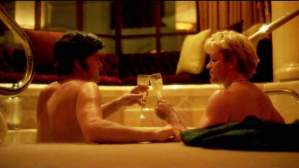
A scene that’s probably ‘too gay’ for the studios in Behind the Candelabra
Although ironically one of Soderbergh’s least flashy films considerig the subject matter, he still includes a number of clever touches, not least of which when a surly Scott is eating a meal while Lee is flirting with a group of younger men which subtly parallels a scene earlier in the film when Lee’s piano protegé Billy (Cheyenne Jackson) is sat in the same seat dourly eating food while Lee is first chatting to Scott. It’s a nicely observed moment of how disposable things are in Liberace’s world.
While Damon is superb, Douglas is just as good, showing a pain behind the eyes and the showman’s smile that looks decades old. He tells Scott he wants to be his “father, brother, lover and best friend”, but doesn’t know how to be any of them. Lowe, meanwhile, is hilarious as the half-baked nip/tuck doc who’s hardly the greatest advert for plastic surgery.
Behind The Candelabra may be a relatively low key film for Soderbergh to bow out on, but it is consumate filmmaking nonetheless and fully advocates Liberace’s motto that “too much of a good thing is wonderful”.

 three rows back