Review – The Sessions

The human spirit is a quite remarkable thing; our innate ability to overcome great obstacles and keep smiling in the face of tragedy sets us apart.

Our greatest inspiration is often found from those with disabilities who overcome significant obstacles to achieve things they and we never thought possible.

The Sessions – “uplifting cinema without the schmaltz”

Acclaimed poet and journalist Mark O’Brien was paralyzed from the neck down as a child after contracting polio and as a result was forced to spend the vast majority of each day confined to an iron lung to help with his breathing. Whilst interviewing other disabled people about how they found having and enjoying sex, Mark came to fervently envy them and became determined to lose his virginity.

This is the set-up for Ben Lewin’s warmly touching true-life drama based on Mark’s physical and spiritual adventure and the impact it and he had on those around him. A committed Catholic, Mark (played by John Hawkes) first consults Father Brendan (William H. Macy) about the theological quandary this poses. Taking into account Mark’s circumstances, he concludes the Almighty would in all likelihood give him “a free pass on this one”.

The stage is set for Mark to hire professional sex surrogate Cheryl Cohen-Greene (Helen Hunt). At first his fear and awkwardness is palpable, but as their sessions continue a tender bond develops between the two.

It’s a stone-cold fact that disability sells when it comes to awards season and it’s likely The Sessions will be recognised in the same way as The Diving Bell and the Butterfly, A Beautiful Mind and Forrest Gump before it.

Mark O’Brien (John Hawkes) employs the services of sex surrogate Cheryl Cohen-Greene (Helen Hunt) in Ben Lewin’s The Sessions

That being said, not a cynical bone exists in the picture’s body. The largely excellent cast see to that, pulling back when histrionics could be reached for or emotional heartstrings pulled.

Given her strongest role in years, Hunt excels. It’s a brave, utterly believable performance of a person who comes to re-evaluate herself the closer she gets to Mark, whose article On Seeing a Sex Surrogate the film is based on.

After scaring the bejesus out of us with quietly menacing portraits of a drug-addicted killer and cult leader in Winter’s Bone and Martha Marcy May Marlene respectively, Hawkes pulls a complete about-turn here as a man who gradually realises there’s nothing to be gained from punishing yourself for reasons beyond your control. His bright optimism hides a what-would-Jesus-say guilt and fear that erodes over time as he becomes more comfortable in his own skin.
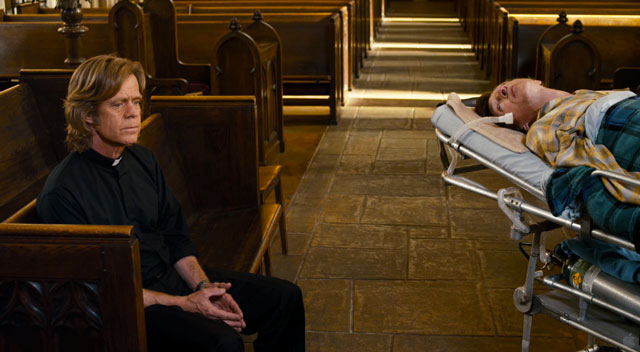
Father (William H Macy) conducts an unusual confessional with Mark O'Brien (John Hawkes) in The Sessions

Father Brendan (William H. Macy) conducts an unusual confessional with Mark O’Brien (John Hawkes) in The Sessions

In addition, Macy is on fine form as the sincere priest who forms a genuine friendship with Mark, while Moon Bloodgood’s poker face portrayal of Mark’s carer Vera nicely contrasts his heart-on-sleeve demeanour.

The warm hues used by Lewin (a polio survivor himself) reflect the cosy nature of the film, while Marco Beltrami’s soundtrack stays the right side of manipulative.

In many ways Mark’s preoccupations with sex, fear and religion are no different to many sections of American society, and while Lewin ultimately sides with the sexually liberated Cheryl’s mantra that we should “stop thinking about it so much” he never once pokes fun at Mark’s hang-ups.

The kind of film where a smile and a tear are never too far away from each other, The Sessions is uplifting cinema without the schmaltz and for that it should be congratulated.

Review – Argo

It’s frankly remarkable Argo has taken this long to reach the big screen – a film with a you-just-couldn’t-make-it-up storyline in which Hollywood comes out smelling of roses.

More than 50 Americans were held hostage for 444 days after Islamist protestors and militants stormed the US embassy in Tehran, Iran, in 1979.

Argo is the kind of superior political thriller that all-too-rarely gets made these days

The story of their long ordeal has been well documented. What isn’t as well-known is the plight of six Americans who made it out of the country as a result of an extraordinary CIA plot led by operative Tony Mendez in which an elaborate cover story was hatched to pass the group off as a Canadian film crew scouting locations for a sci-fi movie called Argo.

It wasn’t until 1997 when President Bill Clinton declassified the CIA files that the story officially came to light and only now do we have the movie ‘based’ on Mendez’s historical account courtesy of actor/director Ben Affleck.

Much like Steven Spielberg’s Munich (2005), Argo adopts the look and feel of such classic 1970s nail-biters as Dog Day Afternoon (1975) and The Taking of Pelham 123 (1974), right down to the old Warner Bros logo at the front end of the movie and the use of old film stock to provide a suitably grainy look. Affleck also mixes things up with fast zooms, long lens shots and close-ups to crank up the tension.

The use of handheld cameras during the scenes in Iran give the action a confused, panicked quality that is effectively handled and works as a parallel to the comical exchanges between Mendez (Affleck), make-up artist and CIA contact John Chambers (John Goodman) and veteran producer Lester Siegel (Alan Arkin) as they work against the clock to put flesh on Argo‘s bones.

This is most powerfully demonstrated during the scene when a speech given by a spokeswoman for the militants outlining to the world’s media their political position is intercut with a script reading of Argo featuring actors in ridiculous costumes.

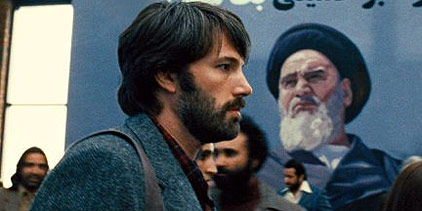
CIA agent hatches a so-crazy-it=might-just-work scheme to save a group of Americans in Ben Affleck's Argo

CIA agent Tony Mendez endeavours to save a group of Americans in Ben Affleck’s Argo

In lesser hands you would have heard someone dramatically declare “it’s crazy, but it might … just … work”. However, Affleck has matured as a director since his admirable 2007 debut Gone Baby Gone and shown he can helm claustrophobic action in his follow-up The Town (2010).

Affleck makes emphatically clear the life or death stakes facing the group and the paranoia and queasiness that fear can exert. You get a very real sense that one false step by any of them will mean the game’s up for all.

That being said, the wheels begin to fall off somewhat in the film’s final third. Lest we forget, this is a Hollywood picture, and as the embassy staff and Mendez make their tortuous way through Tehran Airport it’s difficult not to feel like you’re being deceived just as much as the security guards.

"It's so crazy it might just work". CIA agent Tony Mendez (Ben Affleck) teams up with Hollywood producer Lester Siegel (Alan Arkin) and make-up artist John Chambers (John Goodman)

“It’s so crazy it might just work”. CIA agent Tony Mendez (Ben Affleck) teams up with Hollywood producer Lester Siegel (Alan Arkin) and make-up artist John Chambers (John Goodman)

That’s not to say Affleck doesn’t handle the group’s final escape well – it’s a masterful, pulse-quickening action sequence that pushes all the right buttons. But the contrivances of the plot (plane tickets being confirmed with seconds to spare and other moments I won’t spoil) are hard to swallow (in fact they’re plain inaccurate) and bring to mind the over-the-top denouement to the otherwise enjoyable The Last King of Scotland (2006).

With Iran having rarely been out of the news for the past few years, Argo‘s politics are inevitably going to be put under the spotlight. Affleck doesn’t let himself down here. While we’re under no illusion who the heroes of this tale are, from the opening sequence (filmed as a movie storyboard) where we get a short history lesson on the brutality of the Shah’s rule and the subsequent revolution that saw the birth of an Islamic republic, we are asked to  understand the anger of the Iranian people and why the embassy was stormed. This is no Black Hawk Down (2001) with an implacable, faceless and one-dimensional enemy.

While Affleck won’t win any prizes for historical accuracy (what Hollywood film does?), Argo nevertheless stands on its feet as the kind of superior political thriller that all-too-rarely gets made in Tinseltown these days.

Review – Killing Them Softly

The dreams and promises of politicians are almost invariably exposed as nothing more than venal sales pitches when the cold light of day of reality smacks us round the face.

Andrew Dominik's deeply cynical Killing Them Softly

Andrew Dominik’s deeply cynical Killing Them Softly

This has so rarely been the case than in 2008 when hope and change were being promised while the biggest economic collapse since the Great Depression was unfolding before our eyes.

This particularly grim period of recent history serves as a running backdrop to Andrew Dominik’s deeply cynical third feature Killing Them Softly.

Gutter-level thieves Frankie and Russell (Scoot McNairy and Ben Mendelsohn) are hired to rob a mob-protected poker game run by low-life gangster Markie Trattman (Ray Liotta). Although Trattman is the prime suspect, having previously ripped off his own game, enforcer Jackie Cogan (Brad Pitt) is drafted in to find who is responsible and set things right.

Adapted from George V Higgins’ 1974 novel Cogan’s Trade, Killing Them Softly, as well as being a highly satisfying genre film is also a none-to-subtle metaphor for an America that, according to Cogan isn’t “a country; it’s just a business”.

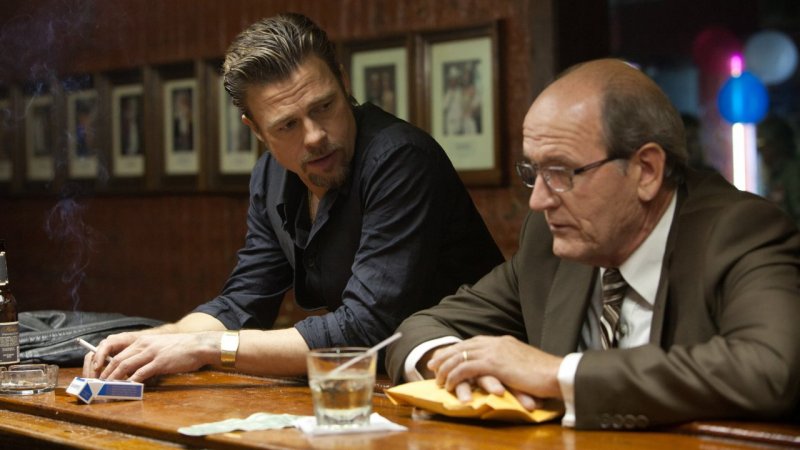
Enforcer Jacki Cogan (Brad Pitt) and mob bean-counter (Richard Jenkins) in Killing Them Softly

Enforcer Jacki Cogan (Brad Pitt) and mob bean-counter (Richard Jenkins) in Killing Them Softly

Although never seen, the mob’s prescence is felt throughout like a corporate version of Big Brother. They are represented by ‘Driver’ (Richard Jenkins), a cheap-suited lackey and glorified accountant who hires Cogan to do their dirty work. The financial cost is paramount, while the human cost is irrelevant as time and again the discussions between Driver and Cogan over what needs to be done (usually killing someone) are reduced to nothing more than dollars and cents.

The social commentary is difficult to chew at times. The opening sequence with Frankie walking through a tunnel filled with newspapers being blown about in the wind intercut with a hope-filled campaign speech by Barack Obama sets out the stall, while George W Bush’s panic-averting presidential address and the subsequent global financial collapse, heard on the radio or seen on TV play throughout like some perverted Greek chorus. Just to underline it all, the movie was shot and set in post-Katrina New Orleans, a city that knows a thing or two about broken promises.

Gutter-level thieves Frankie and Russell (Scoot McNairy and Ben Mendelsohn) in Killing Them Softly

Gutter-level thieves Frankie and Russell (Scoot McNairy and Ben Mendelsohn) in Killing Them Softly

The down and dirty dialogue is a graduate of the David Mamet School of Vicious Language, while the visual flourishes adopted by Dominik lend the film an ugly beauty, most notably in a uncomfortably long scene when one poor schmuck gets an horrendous beating.

Killing Them Softly gives its entirely male cast many a memorable line and the stellar line-up lap up every one. Mendelsohn adds layers to what on paper could have been just another junkie part; Liotta’s Markie Trattman might as well be related to Henry Hill, the part he played in Goodfellas; while James Gandolfini is terrific as a down-at-heels hitman brought in by Cogan to assist with the job but who is unable to get past his own self-pity and the next drink. However, it’s Pitt who stands out, giving a superbly nuanced portrayal of a hitman who has the tools and the pithy conversation to match, but ultimately is in thrall to his paymasters and knows it.

Dominik is clearly fascinated with criminals in all their forms, whether they be the charismatic Australian murderer Mark Read in his debut feature Chopper (2000), or the enigmatic gun-slinger Jesse James is his masterful sophmore film The Assassination of Jesse James by The Coward Robert Ford (2007). Here, they are nothing more than self-serving reprobates, existing in a hellish America where hope and change are nothing more than words on bumper stickers.