Review – Killing Them Softly

The dreams and promises of politicians are almost invariably exposed as nothing more than venal sales pitches when the cold light of day of reality smacks us round the face.

Andrew Dominik's deeply cynical Killing Them Softly

Andrew Dominik’s deeply cynical Killing Them Softly

This has so rarely been the case than in 2008 when hope and change were being promised while the biggest economic collapse since the Great Depression was unfolding before our eyes.

This particularly grim period of recent history serves as a running backdrop to Andrew Dominik’s deeply cynical third feature Killing Them Softly.

Gutter-level thieves Frankie and Russell (Scoot McNairy and Ben Mendelsohn) are hired to rob a mob-protected poker game run by low-life gangster Markie Trattman (Ray Liotta). Although Trattman is the prime suspect, having previously ripped off his own game, enforcer Jackie Cogan (Brad Pitt) is drafted in to find who is responsible and set things right.

Adapted from George V Higgins’ 1974 novel Cogan’s Trade, Killing Them Softly, as well as being a highly satisfying genre film is also a none-to-subtle metaphor for an America that, according to Cogan isn’t “a country; it’s just a business”.
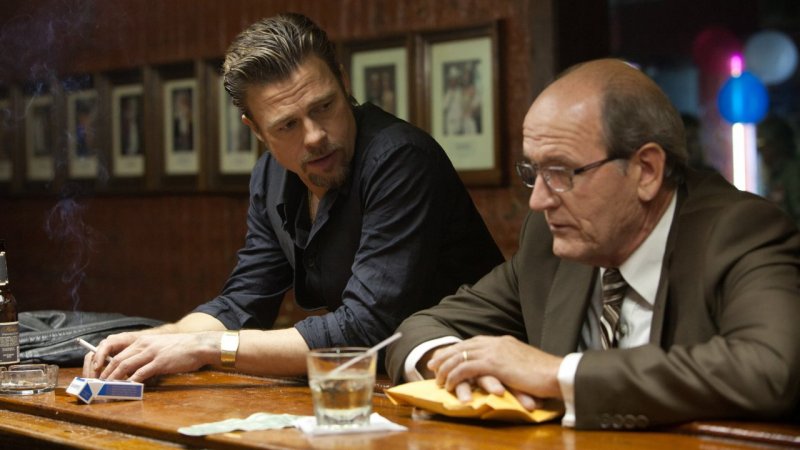
Enforcer Jacki Cogan (Brad Pitt) and mob bean-counter (Richard Jenkins) in Killing Them Softly

Enforcer Jacki Cogan (Brad Pitt) and mob bean-counter (Richard Jenkins) in Killing Them Softly

Although never seen, the mob’s prescence is felt throughout like a corporate version of Big Brother. They are represented by ‘Driver’ (Richard Jenkins), a cheap-suited lackey and glorified accountant who hires Cogan to do their dirty work. The financial cost is paramount, while the human cost is irrelevant as time and again the discussions between Driver and Cogan over what needs to be done (usually killing someone) are reduced to nothing more than dollars and cents.

The social commentary is difficult to chew at times. The opening sequence with Frankie walking through a tunnel filled with newspapers being blown about in the wind intercut with a hope-filled campaign speech by Barack Obama sets out the stall, while George W Bush’s panic-averting presidential address and the subsequent global financial collapse, heard on the radio or seen on TV play throughout like some perverted Greek chorus. Just to underline it all, the movie was shot and set in post-Katrina New Orleans, a city that knows a thing or two about broken promises.

Gutter-level thieves Frankie and Russell (Scoot McNairy and Ben Mendelsohn) in Killing Them Softly

Gutter-level thieves Frankie and Russell (Scoot McNairy and Ben Mendelsohn) in Killing Them Softly

The down and dirty dialogue is a graduate of the David Mamet School of Vicious Language, while the visual flourishes adopted by Dominik lend the film an ugly beauty, most notably in a uncomfortably long scene when one poor schmuck gets an horrendous beating.

Killing Them Softly gives its entirely male cast many a memorable line and the stellar line-up lap up every one. Mendelsohn adds layers to what on paper could have been just another junkie part; Liotta’s Markie Trattman might as well be related to Henry Hill, the part he played in Goodfellas; while James Gandolfini is terrific as a down-at-heels hitman brought in by Cogan to assist with the job but who is unable to get past his own self-pity and the next drink. However, it’s Pitt who stands out, giving a superbly nuanced portrayal of a hitman who has the tools and the pithy conversation to match, but ultimately is in thrall to his paymasters and knows it.

Dominik is clearly fascinated with criminals in all their forms, whether they be the charismatic Australian murderer Mark Read in his debut feature Chopper (2000), or the enigmatic gun-slinger Jesse James is his masterful sophmore film The Assassination of Jesse James by The Coward Robert Ford (2007). Here, they are nothing more than self-serving reprobates, existing in a hellish America where hope and change are nothing more than words on bumper stickers.

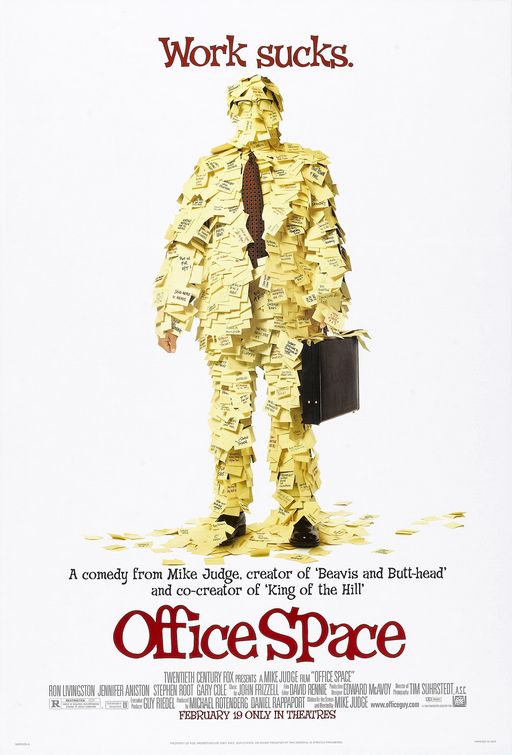
Great Films You Need To See – Office Space (1999)

It’s safe to say that only a fortunate minority are truly happy in their place of employment. Despite thousands of years of evolution and countless technological leaps forward many of us still feel trapped working in dead-end jobs which require about as much brain power as a goldfish needs to swim in a circle.

No place of work is more ripe for satire than the office, something Ricky Gervais milked for all its worth in his quite brilliant TV series The Office.

However, a full two years before Gervais’ landmark show hit the small screen in 2001, director Mike Judge gave us one of the greatest comedies to have come out of America in years in Office Space.

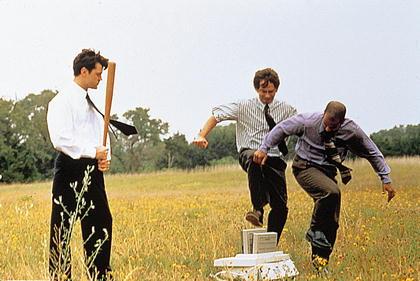
The “high watermark in American comedy” Office Space

Before Office Space, Judge was best known as the creator and star of the hit animated series Beavis and Butt-head. Animation was Judge’s forte (he went on to create the classic long-running series King of the Hill) and the live action Office Space originated as a series of short animated films centred around the chronically frustrated office drone Milton, an inspired comic creation who would become one of the central figures of the movie.

Peter (Ron Livingstone) is a programmer for software firm Initech. Like many others at the company, he is deeply frustrated with his lot in life (“sounds like somebody’s got a case of the Mondays”, his colleague points out, unhelpfully), but cannot see beyond the next humpday. In an effort to save his relationship with the uptight Anne, he agrees to see an ‘occupational hypnotherapist’. Under hypnotherapy, Peter is told to completely relax and forget about all his concerns, but before he can be brought out of it the hypnotherapist drops down dead from a heart attack.

Still under, Peter suddenly realises it’s time to start living his life and, after being dumped by Anne asks out frustrated waitress Joanna (Jennifer Aniston). He turns up to work late, ignores the petty bureaucracy of his smug, pedantic boss Bill Lumbergh (Gary Cole) and in an interview with consultants Bob (John C McGinley) and Bob (Paul Willson) (who have been brought in to look for ‘efficiencies’, ie staff cuts) speaks his mind about his work ethic (“it’s not that I’m lazy it’s just that I don’t care”) and the over-abundance of management at the company.

But instead of being fired, Peter is deemed to have “upper management written all over him” according to the Bob’s and is given a promotion, much to Lumbergh’s consternation. When Peter discovers the Bob’s have been brought in to get rid of people, his friends Samir (Ajay Naidu) and Michael (David Herman) included, he decides to take revenge by working with Samir and Michael to steal from the company by infecting the accounting system with a computer virus.

When a glitch in the plan leads to them stealing way more than they first intended Peter gets a crisis of conscience and decides to take the fall for the crime. He slips a confession letter and unsigned traveller’s cheques under Lumbergh’s door and waits for the police to arrive. But when this doesn’t happen he drives to Initech to find the company on fire – and with it all evidence of the crime.

Office drones Peter (Ron Livingstone), Michael (David Herman) and Samir (Ajay Naidu) vent their frustration in Mike Judge’s Office Space

The first thing to say about Office Space is that, crucially for a comedy, it is very, very funny. Clearly a labour of love for Judge, the film is populated with fantastically realised characters and memorable scenes that anyone who has worked in an office will identify with.

The opening traffic jam sequence is brilliant, with Peter exasperated that it’s always the other lane that seems to move quicker; Samir impotent with rage in his car; and Michael pretending to be a gangsta while listening to hip hop in his car and then turning it down, winding his window up and locking his doors when a homeless black guy approaches offering to wash his windscreen.

Judge’s clear hatred for the sterility of office working is distilled in moments of hilariously observed satire, from the depressing uniformity of the work cubicles, to the perplexing what-do-they-do-exactly tiers of management who wander up to Peter asking if he has seen the memo pertaining to the ubiquitous TPS reports.

Judge tries a bit too hard sometimes to go for the easy laugh, most notably by naming Herman’s character Michael Bolton, which is frankly nothing more than a shameless excuse to stick the boot in to the “no-talent ass-clown”. However, for every moment that fails to hit the right note, there are 10 others that have you laughing out loud.

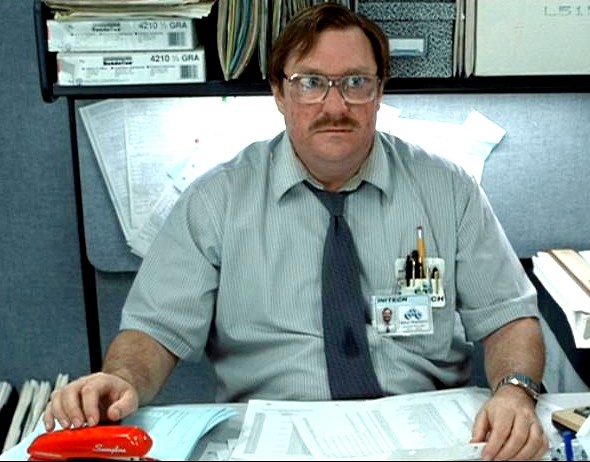
The iconic Milton(Stephen Root), one of American cinema's most inspired comic creations

The iconic Milton (Stephen Root), one of American cinema’s most inspired comic creations

Livingstone has just the right hang-dog expression of someone who feels that every day is the worst of his life, while Cole is fantastic as the repellant Lumbergh, sporting a ridiculous pair of spectacles and a mug of coffee forever glued to his hand. Aniston is also surprisingly good in an admittedly thin role (before she plumped for being typecast in retrograde romantic comedies).

However, it’s Stephen Root who walks away with the film as Milton, one of American cinema’s most inspired comic creations. With a nervous, barely contained hatred for the world around him, Milton is a heart attack waiting to happen and the more ridiculous looking cousin to Michael Douglas’ D-Fens in Falling Down (1993). The ritual humiliation he endures when his desk is constantly being moved around the office and then to the storage area is bad enough, but when his beloved stapler is removed by Lumbergh you feel it’s only a matter of time before he makes good on his barely coherent threat to burn the building down.

While Judge’s subsequent films, 2006’s Idiocracy and 2009’s more commercially successful Extract were very hit and miss, Office Space is a high watermark in American comedy and a work of genius from someone firing on all cylinders.

Great Films You Need To See – Dead Man’s Shoes (2004)

Although best known for introducing us to the memorable characters from This Is England, Shane Meadows has racked up a hugely impressive filmography – and none more memorable than his 2004 classic Dead Man’s Shoes.

Unlike those other stalwarts of British film Ken Loach and Mike Leigh, who go where the story takes them, Meadows has chosen to locate his features almost exclusively within spitting distance of his beloved Nottingham (with the exception of his 2008 film Somers Town); so much so that the Midlands and Meadows have virtually become conjoined twins.

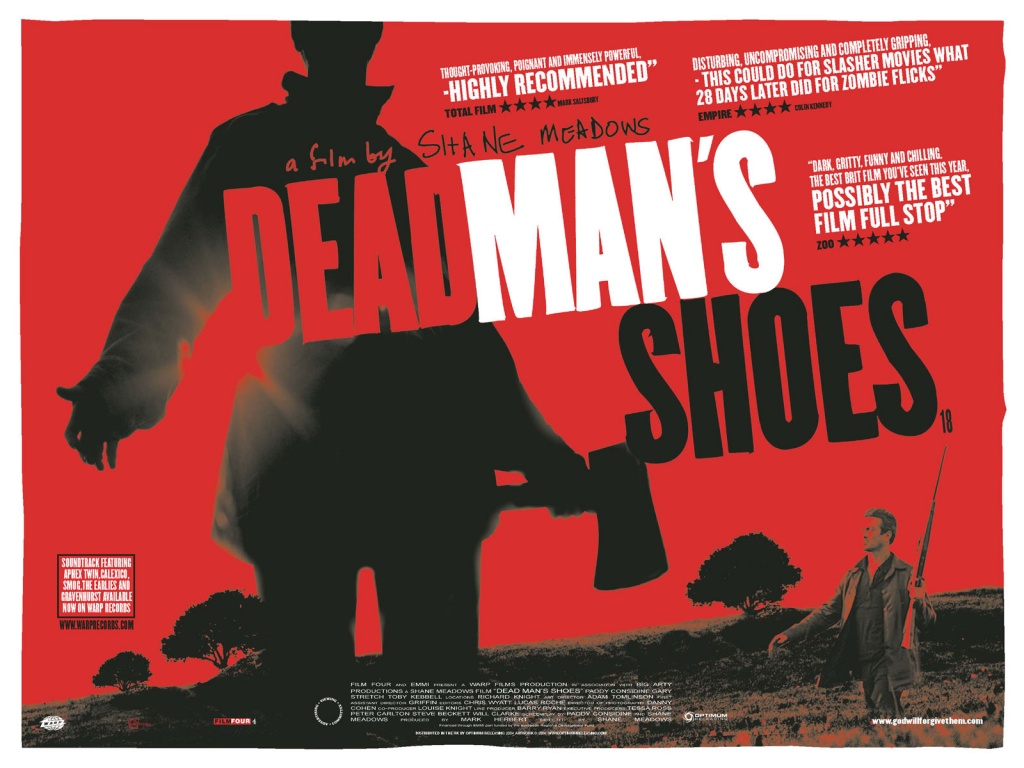
Dead Man's Shoes

Shane Meadows’ powerful revenge drama Dead Man’s Shoes

Meadows may stick to where he knows best, but that doesn’t mean he sits back on his laurels as a filmmaker. And instead of playing it safe with the kind of kitchen sink drama that is a staple of the UK’s film output, he often goes looking across the Atlantic for his influences. His debut feature Small Time had Scorsese all over it, while 2002’s Once Upon A Time In The Midlands (his one failure) gave a nod and a wink to Sergio Leone’s love letters to the American West.

The same can certainly be said of Dead Man’s Shoes. However, the influence of America and American cinema hasn’t led to his aping it. Instead, those Midlands settings marry together with Meadows’ idiosyncratic style to create something utterly unique.

Dead Man’s Shoes begins with Smog’s Bill Callahan singing “I can’t be held responsible for the things I’ve seen” – a portentous line for what is to come. Squaddie Richard (Paddy Considine) walks across picturesque countryside to his hometown of Matlock in the Peak

District with his brother Anthony (Toby Kebbell) in tow. Home video footage is interspersed of the siblings to underline the bond between them.

The screen fades to black and Richard says: “God will forgive them. He will forgive them and allow them into heaven. I can’t live with that.” The ‘them’ he is referring to are a gang of low-level thugs and drug dealers who abused Anthony, who we discover has learning difficulties, while Richard was in the army.

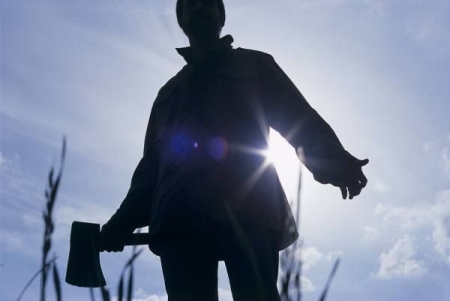
(Paddy Considine) wreaks his revenge in Dead Man's Shoes

Richard (Paddy Considine) wreaks his revenge in Dead Man’s Shoes

Richard makes his presence known when he faces down one of the abusers, Herbie (Stuart Wolfenden), first in a pub and then outside a flat, where he turns up wearing a military gas mask, leads Herbie and his mates on a merry chase and steals the drugs that have been supplied by gang leader Sonny (ex-boxer Gary Stretch).

Sonny confronts Richard, who advises they leave town or suffer the consequences, pointing out that it’s now “beyond words”. When Sonny and co fail to heed Richard’s suggestion they discover just who it is they are dealing with when one of the gang is discovered bludgeoned to death by an axe and the words ‘one down’ written in his blood.

Sonny goes on the offensive and with his lackeys heads to the abandoned farm Richard and Anthony are staying at to shoot him. However, the plan drastically backfires and the terrified gang retreat.

When the remaining members arrive back at Sonny’s house they search the place expecting to find their tormentor there. But Richard is hiding and while they are upstairs he laces their kettle with the drugs he stole. A few hours later and the surviving trio are out of their minds and easy prey for Richard, who kills them one by one in an extremely disturbing scene.

There is one final member left though and Richard travels to a nearby town in search of Mark (Paul Hurtsfield), who has left his bad days behind him and now lives with a wife and children. When the horror-struck Mark learns of who is after him, he unburdens his soul to his wife, telling her of the final act of abuse inflicted on Anthony which led to him killing himself. As it transpires Richard has been alone the whole time.

Paddy Considine in Dead Man's Shoes

Paddy Considine in Dead Man’s Shoes

Richard takes Mark hostage and forces him to drive to the spot where Anthony died. However, instead of exacting his final revenge, Richard instead forces Mark to kill him, telling him that all he wants to do is lie with his brother.

The film that comes to mind most when analysing Dead Man’s Shoes is the deeply pessimistic 1973 western High Plains Drifter, wherein the revenge plot is suffused with the supernatural (I choose to believe the character of Anthony is a ghost rather than a figment of Richard’s broken mind).

The story doesn’t quite ring true when you really think about it (where are the police in all of this?) and it soon becomes obvious that none of them is any match for Richard. The camerawork is a little pedestrian at times, also.

However, the plus points of Dead Man’s Shoes far outweigh the negatives. The acting by a largely inexperienced cast is naturalistic, with Kebbell a standout in his feature debut. Portraying someone with learning difficulties can easily come across as broad and forced (Sean Penn in I Am Sam is a notable example), but Kebbell underplays the part, making Anthony a truly tragic figure.

This is Considine’s show, though and he stands head and shoulders above everyone else. Since making his debut in Meadows’ A Room For Romeo Brass in 1999, Considine has become one of this country’s finest actors (and one of its most promising directors following the acclaimed Tyrannosaur).

It’s a powerhouse performance and he is terrifying and sympathetic in equal measure. Considine does a mesmerising job playing a man racked with guilt because he wasn’t there to help his brother and consumed with a rage that is as frightening to him as it is overwhelming. As Sonny points out following their first encounter: “I looked him right in the eye and he ain’t the same guy that left.”

Much like he did in Small Time, Meadows paints the gang as somewhat comical in nature, be it their Three Stooges-esque larking about, or the fact they drive around in a knackered old Citroen 2CV.  However, the stakes facing them are far higher and this tone at times sits a little uncomfortably with the subject matter, especially during the protracted scene where Richard dispatches Sonny and the others in brutal fashion.

The effortlessly cool soundtrack, featuring the likes of Aphex Twin, Richard Hawley and Bonnie “Prince” Billy is pitch-perfect and complements Meadows’ atmospheric cinematography, most notably in the moments Richard is walking through the countryside or on the farm.

Right now Meadows seems content with exploring the lives of the characters from This Is England. However, one hopes he will soon explore new avenues as we need more films like Dead Man’s Shoes made in this country.

Great Films You Need To See – Hard Eight (1996)

There are few directors who have masterminded such a ceaseless string of ambitious and visually brilliant films as Paul Thomas Anderson.

In a career that has spanned more than 15 years, Anderson has done for the American independent film what Christopher Nolan has for the blockbuster; namely to tear up the rulebook and treat audiences as the savvy, cine-literate group they largely are.

Paul Thomas Anderson's debut Hard Eight

Paul Thomas Anderson’s fantastic debut Hard Eight

As well as directing two of the greatest films of the ’90s – 1997’s seminal Boogie Nights and its Robert Altman-esque follow-up Magnolia in 1999, Anderson has also been responsible for one of this century’s greatest cinematic achievements, his 2007 masterpiece There Will Be Blood. Let’s also not forget his leftfield 2002 romantic comedy Punch Drunk Love, without doubt Adam Sandler’s finest hour (which I appreciate may come across as damning the film with faint praise – it’s really good).

Big things invariably start with small beginnings and in Anderson’s case this was the little-seen Hard Eight.

Anderson emerged from that post-Tarantino/post-Sex, Lies and Videotape moment in the early ’90s when studios of all sizes were falling over themselves to buy up anything ‘indie’ and repackage it for the mainstream.

In Anderson’s case, his short film Cigarettes and Coffee played at the 1993 Sundance Festival and led to his being invited to hone his burgeoning craft at the Sundance filmmakers’ lab, a sort of Hogwarts for talented young directors. As well as being spotted by Sundance, Anderson had also popped up on the radar at Rysher Entertainment, which financed his first feature.

What Rysher giveth, it took away, however, and after Anderson completed the feature – originally titled Sydney – it took it upon itself to re-edit the film. Anderson kept hold of the working print of his original cut though and, after finding the $200,000 needed to finish the film, a subsequent screening at the 1996 Cannes Film Festival and an agreement to rename it, Hard Eight made it onto the big screen. The fact it made only a small dent at the box office turned out to be irrelevant; Hard Eight proved a big hit critically and gave Anderson the calling card he needed to make Boogie Nights the following year.

Hard Eight

John (John C Reilly) is given a leg-up by the enigmatic Sydney (Philip Baker Hall) in Hard Eight

Hard Eight follows Sydney, an aging, well-heeled loner who takes the down-at-heels John under his wing. John is penniless and on his way out of Las Vegas after failing to win the $6,000 he needs to pay for his mother’s funeral. Sydney takes pity on the beaten-down John and takes him back to Vegas to mentor him in the way of making money at the casino.

The film picks up two years later with Sydney still the teacher and John his eager pupil. With the absence of a father, a paternal bond has also been formed which comes in handy when a desperate John calls on Sydney to help him deal with a situation involving his new wife – waitress and prostitute Clementine.

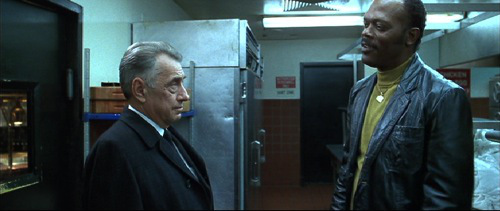
The first thing to say about Hard Eight is that it features a fantastic cast, led by the brilliant Philip Baker Hall as Sydney. Anderson apparently wrote the part specifically for Hall, who had been drifting in the wilderness for a number of years and has since gone on to enjoy a successful career in his autumn years. Hall brings real gravitas to a part that requires subtle changes of character. Sydney is a man trying to make amends for a terrible decision in his past in the best way he can, but he’s not to be messed with, as Jimmy (Samuel L Jackson) finds to his cost.

Equally good is John C Reilly as John. Reilly may now be best known for his comic roles, but his early career was made up almost exclusively with bit parts or dramatic roles. Hard Eight was as much Reilly’s calling card as it was Anderson’s and he uses his naturally doe-eyed persona to his full advantage in his portrayal of a character trying the best he can but who keeps making mistakes.

Jimmy (Samuel L Jackson) and Sydney (Philip Baker Hall) in Hard Eight

Jimmy (Samuel L Jackson) and Sydney (Philip Baker Hall) in Hard Eight

Gwyneth Paltrow also excels as Clementine. It’s a thankless role in some respects; the tart with a heart who falls for John and drags him into a situation they cannot deal with, but Paltrow doesn’t employ the aloofness that has marred some of her other performances here, instead making Clementine a damaged soul magnetised to the equally bruised John.

And let’s not forget Philip Seymour Hoffman in a small but notable cameo as an obnoxious craps player. He’s only on screen for a brief time, but Hoffman doesn’t need long to breathe life into his characters.

The influence of Martin Scorsese is all over the film (something acknowledged by Anderson), with sweeping tracking shots, dazzling visual flourishes and unusual editing style that he embraced even more fully in Boogie Nights. One criticism of the film is the use of music, which can feel a little over-bearing at times. Compared to There Will Be Blood‘s extraordinary soundtrack, Hard Eight feels a little cheap.

Hard Eight is nevertheless a fascinating first salvo in a superb directorial career (his latest, The Master is one of the most anticipated films of 2012) and an intriguing snapshot of the state of American independent cinema at the time (how many directors can boast such a top-notch cast with their first feature?). His is a star that is sure to burn brightly for many years to come.

Great Films You Need To See – Keane (2004)

Throughout the course of our movie-watching lives most of us probably stumble across at least one film that strikes a particular chord with us but fails to get the attention it deserves.

I have plenty and will be passing comment on them in good time, but the first film I want to champion is the little-known 2004 gem Keane.

Lodge Kerrigan’s superb directorial debut Keane

Back in 1994, Lodge Kerrigan’s directorial debut Clean, Shaven garnered critical plaudits across the board. A masterful treatise on one man’s battle with schizophrenia, it marked Kerrigan out as a genuine talent.

He returned to the subject of mental illness 10 years later with Keane. The film earned as much praise as Clean, Shaven had a decade earlier and, following a successful festival run culminating in a screening at the 2005 Cannes Film Festival, it gained a theatrical release. Some movies manage to break out of the festival circuit and make a genuine mark on the world stage; however, Keane was not one of them and soon enough quietly slipped through the cracks, taking Kerrigan’s directorial career with it.

But Keane deserves the dust to be blown off of it and reassessed as a defining film of 21st Century independent cinema.

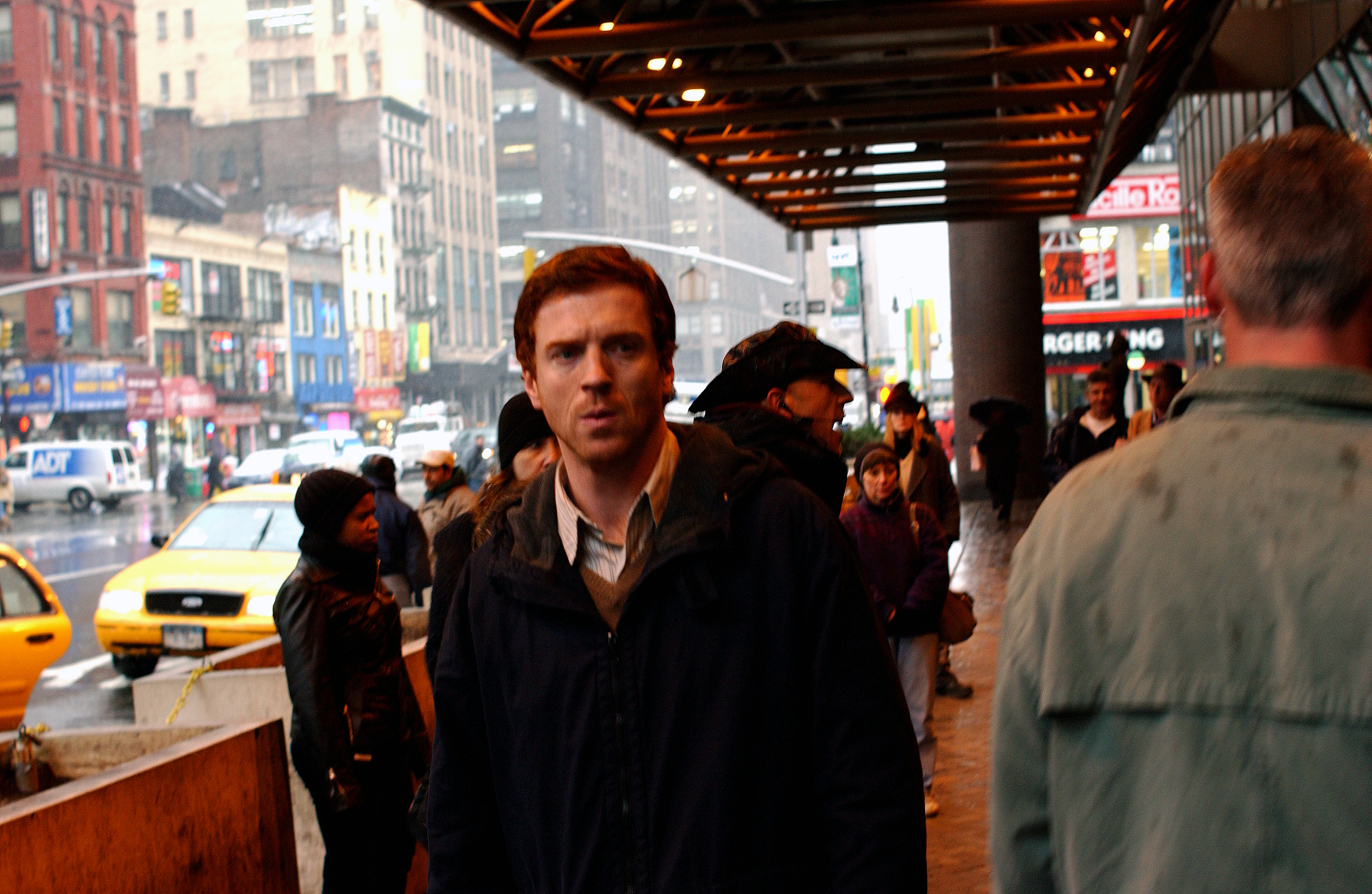
The film begins with a man showing a picture of a young girl to staff and commuters in New York’s Port Authority Bus Terminal and asking if they recognise her. The man is William Keane (Damian Lewis) and the girl is his daughter Sophia, who was abducted several months earlier from there.

Clearly desperate and extremely troubled, William wanders the streets muttering to himself and calling out for his daughter. Following a night spent sleeping rough, he returns to the hotel he has been staying at and is told he is behind on the rent. After paying up by cashing a disability cheque, he begins his daily routine once more, wandering around the Port Authority convinced the person who abducted his daughter is there.

When not looking for Sophia, William downs vodka and hoovers up lines of coke – which only seems to fuel his rampant paranoia. Back at the hotel he meets Lynn (Amy Ryan) and her young daughter Kira (Abigail Breslan) and helps out by offering them money. A bond of sorts is formed, and Lynn asks William to look after Kira for a few hours. He agrees, but when they return to the hotel and are told that Lynn won’t be back till the following day, William reassures Kira she is not being abandoned.

Keane

William (Damian Lewis) desperately searches for his missing daughter in Keane

The two spend the day together and, for a little while at least, it seems William’s life has meaning once again. But after Lynn returns and announces they are leaving, he takes Kira from school without Lynn’s permission and they go to the Port Authority, allegedly to meet her mother.

Inside the terminal, William sends Kira off to buy sweets and watches intently from a distance, seemingly convinced the man who abducted Sophia will try to do the same with Kira so he can catch him. However, when this inevitably fails to happen, William weeps for the loss of his daughter, perhaps finally realising that he is never going to see her again.

Born out of Kerrigan’s fear (and any parent’s one would imagine) of his own child’s disappearance, Keane may not be the feel-good-hit-of-the-summer, but as a piece of cinema it is thought-provoking, tragic and unremittingly haunting.

We’ve no doubt all encountered a character like William Keane before, and most likely given them as wide a berth as possible. However, there’s no escape here as from the first shot the handheld camera fixates on Keane’s face and barely leaves his side, lending the film a deep sense of  claustrophobia. Indeed, by the final credits you’ll be forgiven for feeling like you’ve just emerged blinking into the sunlight from a particularly long tunnel.

William (Damian Lewis) tries to hold it together in Keane

William (Damian Lewis) tries to hold it together in Keane

Spending an entire film with a character who is so mentally scarred is a tough ask, so it is to the credit of Lewis’ powerhouse performance that it never once feels like a chore. His breakthrough role after having starred in HBO’s mini-series Band of Brothers, Lewis (currently starring in TV show Homeland) totally inhabits the title role and never once delivers a false note.

Lewis somehow manages to make William neither too sympathetic, nor too off-puttingly crazy, instead delivering a performance of subtle nuances that suck you in.

Critics have questioned whether William’s daughter even exists, rather she is the delusion of a disturbed mind. However, this is to miss the point of the film – to William she is as real as any of us and as such we must ride along this dark, lonely road with him.

In all likelihood, Keane will never be considered a classic – it’s subject matter is too difficult and unconventional for that – but seek it out if you can. Cinema doesn’t come much better than this.