Review – Compliance

The defence “I was only following orders”, christened by panicked Nazis at the Nuremberg trials has become synonymous with those looking to absolve themselves of guilt or responsibility.

It’s a mitigation that runs through writer-director Craig Zobel’s deeply unsettling examination of the powers of authority and our  willingness to blindly obey it.

Compliance – a “deeply unsettling examination of the powers of authority”

Compliance centres on a prank phone call to an American fast food restaurant from someone claiming to be a police officer. The ‘officer’ swiftly convinces manager Sandra that young female employee Becky is responsible for stealing money from a customer’s purse. Not wishing to get into trouble and all too willing to accept her supposed guilt for the sake of an easier day, the caller convinces Sandra and then others to subject Becky to increasingly dehumanising and humiliating treatment.

Incredibly, the film is inspired by true events, specifically a 2004 incident when a man masquerading as a cop called a suburban McDonald’s and told the manager to imprison an employee he claimed was a thief and strip search her. The confused manager agreed and even drafted in her fiancé to guard her. Depressingly, this was not the only incident of its type; more than 70 similar cases were reported in 30 U.S states before someone was arrested.

If Compliance achieves nothing else, it is sure to have you shaking your head in disbelief that something like this could have been allowed to happen. Some have reacted so strongly to the film that they have walked out of screenings.

Zobel’s matter-of-fact directorial style lets the narrative play out and invites us to make our own minds up. The use of tight close-ups lends the film a fetid, claustrophobic tension; however, the decision to reveal the caller’s identity feels like a mistake. The film would have worked even more effectively, been even more stifling had it not strayed outside of the restaurant and let the audience deduce for themselves that the caller’s increasingly outrageous demands were the result of a sick prank.

Compliance

Dreama Walker as the terrified Becky in Craig Zobel’s Compliance

The caller pulls the strings of his unwitting puppets from the very beginning and gets off on how far he can go. Giving only the vaguest description of the thief, Sandra does the work for him by assuming he’s talking about Becky and promising “to do everything that you need”. Meanwhile, the young victim is coerced into agreeing to the strip search when he theatens her with jail if she doesn’t comply, even going so far to persuade her to be “a good actress” to make the other staff feel more comfortable.

Ann Dowd gives a fantastic performance as the sad, weak and compliant Sandra. We can see the confusion and fear in her eyes, while still trying to exert her own authority on her young, largely apathetic workforce and keep them on side. In a society where we are told to respect our peers, Sandra believes she isn’t doing anything wrong; quite the opposite in fact, in her mind she’s doing what anyone else would do under similiar circumstances.
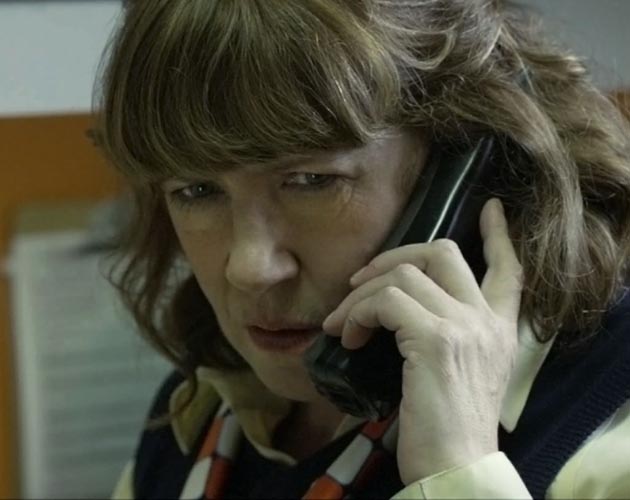
Fast-food restaurant manager Sandra (Ann Dowd) makes a very bad decision in Compliance

Fast-food restaurant manager Sandra (Ann Dowd) makes a very bad decision in Compliance

Zobel also draws strong performances from Dreama Walker as the terrified Becky who, like Franz Kafka’s K in The Trial is overwhelmed by circumstances of which she has no knowledge, and Bill Camp as Sandra’s acquiescent and eager-to-please boyfriend Van, who comes to realise he “did a bad thing” way too late.

Compliance, without resorting to histrionics or lectures, raises serious and worrying questions about the ease in which we can do horrible things with the best of intentions, the power of intimidation and our willingness to let someone else be the victim if it means we avoid trouble ourselves.

When the die is cast and the players believe they understand the rules, Zobel’s challenging and uncomfortable film leaves us to wonder just how long we’d be willing to let the game go on.

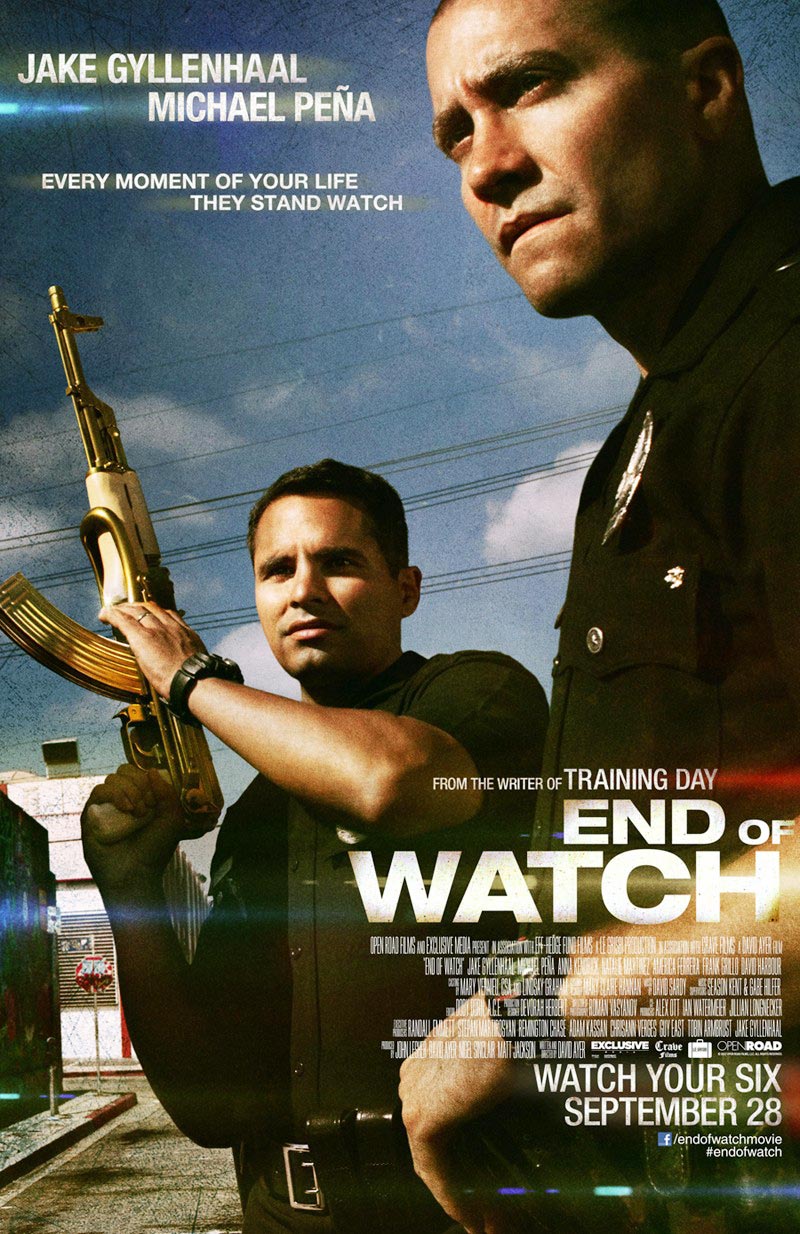
Review – End of Watch

Once the preserve of horror, the found footage film has spread its wings to encompass that other staple Hollywood genre; the cop thriller.

It was only a matter of time; our TV screens have been clogged up for years with such police-friendly ‘reality’ shows as Cops and Police, Camera, Action. All the while, fictional cop shows have endeavoured to become ever more authentic (minus the fruitier language), with arguably the most successful example of recent times being the acclaimed Southland.

End of Watch

End of Watch – enjoyable, but won’t stay long in the memory

In one episode of Southland, a patrolman must deal with the ramifications of punching a member of the public after it is caught on camera and broadcast online. As the episode’s opening narration states, “it’s a new age – a video age. People are always watching us [the police]. Everywhere”.

Writer-director David Ayer addresses this “new age” head-on in End of Watch. LAPD officer Brian Taylor (Jake Gyllenhaal) is filming his day-to-day official activities for a project, to the annoyance of his partner and close friend Mike Zavala (Michael Peña). To assist with this Taylor fixes tiny cameras to each of their shirts to allow for first-person filming.

Following an arrest which turns up a stash of cash and a gold-plated AK-47 (“two of the major food groups – money and guns”, Taylor states), the two investigate a Mexican drug cartel. Although urged to let it go, Taylor persuades Zavala to stay the course, but little do they realise they’ve made themselves the cartel’s most wanted.

Ayer has made a speciality of hard-bitten cop dramas, from writing stints on the Oscar-winning Training Day (2001) and under-rated Dark Blue (2002), to penning and directing the less successful Street Kings (2008); all of which dealt with police corruption, something that’s absent in End of Watch. Here the hook is the first-person filming style, described by Ayer as being akin to “watching YouTube — where something in your mind tells you this is real”.

It’s an interesting notion that at times works very effectively, especially during an edge-of-the-seat scene where Taylor and Zavala enter a burning building to save some kids. However, Ayer undermines these moments of found footage (and, in turn, the whole film) by sprinkling traditionally filmed shots in along the way (including that now ubiquitous ‘soaring above skyscrapers’ shot). You’re never sure whether you’re watching ‘real’ footage or not, which has the effect of pulling you out of the film. To make matters more confusing, when the camera is attached to the front of a gun, End of Watch resembles a first-person shooter computer game.

LAPD’s finest Brian Taylor (Jake Gyllenhaal) and partner Mike Zavala (Michael Peña) in David ‘Training Day’ Ayer’s End of Watch

When you strip away all the pseudo-realism and gimmicks, this is a good old-fashioned buddy movie, akin to Lethal Weapon, and it’s the hugely entertaining camaraderie between Gyllenhaal and Peña that really drives the film forward.

In his most high-profile role to date, Peña is magnetic. Sure, his character fits the Latino stereotype we’ve come to expect, all hot-blooded, street smart and full of attitude, but Peña is a smart enough actor not to overplay it and instead gives a raw and entirely believable performance.

Gyllenhaal is a hard actor to pin down, but is usually at his best when dialling it down in such films as Zodiac and Brokeback Mountain. Here he delivers the full range, from bug-eyed hot-shot to measured introspection and just about carries it off. He gives as good as he gets when playing opposite Peña and it’s in the scenes when they are riding in the patrol car where both actors bring their A-game and really ignite the film. Here the dialogue really fizzes in spite of its somewhat clichéd nature (the differences between white and Mexican culture).

Brian Taylor (Jake Gyllenhaal) gets up-close-and-personal in End of Watch

Brian Taylor (Jake Gyllenhaal) gets up-close-and-personal in End of Watch

Much like the over-rated Training Day, character development is sorely missing from End of Watch. Ayer deals in black and white simplicity here, chiefly in the way the Mexican cartel gang is portrayed. With absolutely no redeeming traits, we’re left to wait patiently until they can be chalked off. Indeed, when the shifty-eyed head honcho Big Evil responds to why he’s called that by stating “’cause my evil’s big”, it’s clear Ayer isn’t exactly straining himself to make his villians memorable.

By adopting the found footage approach, Ayer has delivered a fresh take on the police drama and in Gyllenhaal and Peña has found one of its most likeable partnerships. However, like much of the content on YouTube, End of Watch won’t stay long in the memory.

Review – The Sessions

The human spirit is a quite remarkable thing; our innate ability to overcome great obstacles and keep smiling in the face of tragedy sets us apart.

Our greatest inspiration is often found from those with disabilities who overcome significant obstacles to achieve things they and we never thought possible.

The Sessions – “uplifting cinema without the schmaltz”

Acclaimed poet and journalist Mark O’Brien was paralyzed from the neck down as a child after contracting polio and as a result was forced to spend the vast majority of each day confined to an iron lung to help with his breathing. Whilst interviewing other disabled people about how they found having and enjoying sex, Mark came to fervently envy them and became determined to lose his virginity.

This is the set-up for Ben Lewin’s warmly touching true-life drama based on Mark’s physical and spiritual adventure and the impact it and he had on those around him. A committed Catholic, Mark (played by John Hawkes) first consults Father Brendan (William H. Macy) about the theological quandary this poses. Taking into account Mark’s circumstances, he concludes the Almighty would in all likelihood give him “a free pass on this one”.

The stage is set for Mark to hire professional sex surrogate Cheryl Cohen-Greene (Helen Hunt). At first his fear and awkwardness is palpable, but as their sessions continue a tender bond develops between the two.

It’s a stone-cold fact that disability sells when it comes to awards season and it’s likely The Sessions will be recognised in the same way as The Diving Bell and the Butterfly, A Beautiful Mind and Forrest Gump before it.

Mark O’Brien (John Hawkes) employs the services of sex surrogate Cheryl Cohen-Greene (Helen Hunt) in Ben Lewin’s The Sessions

That being said, not a cynical bone exists in the picture’s body. The largely excellent cast see to that, pulling back when histrionics could be reached for or emotional heartstrings pulled.

Given her strongest role in years, Hunt excels. It’s a brave, utterly believable performance of a person who comes to re-evaluate herself the closer she gets to Mark, whose article On Seeing a Sex Surrogate the film is based on.

After scaring the bejesus out of us with quietly menacing portraits of a drug-addicted killer and cult leader in Winter’s Bone and Martha Marcy May Marlene respectively, Hawkes pulls a complete about-turn here as a man who gradually realises there’s nothing to be gained from punishing yourself for reasons beyond your control. His bright optimism hides a what-would-Jesus-say guilt and fear that erodes over time as he becomes more comfortable in his own skin.

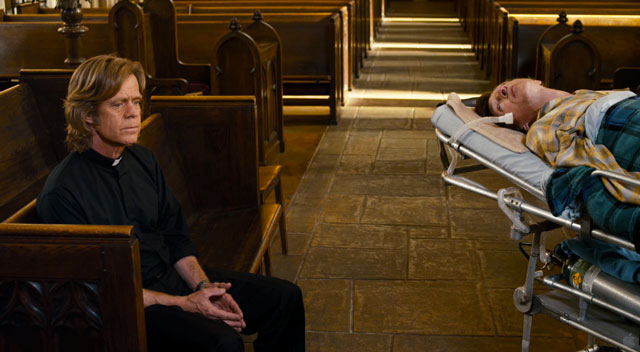
Father (William H Macy) conducts an unusual confessional with Mark O'Brien (John Hawkes) in The Sessions

Father Brendan (William H. Macy) conducts an unusual confessional with Mark O’Brien (John Hawkes) in The Sessions

In addition, Macy is on fine form as the sincere priest who forms a genuine friendship with Mark, while Moon Bloodgood’s poker face portrayal of Mark’s carer Vera nicely contrasts his heart-on-sleeve demeanour.

The warm hues used by Lewin (a polio survivor himself) reflect the cosy nature of the film, while Marco Beltrami’s soundtrack stays the right side of manipulative.

In many ways Mark’s preoccupations with sex, fear and religion are no different to many sections of American society, and while Lewin ultimately sides with the sexually liberated Cheryl’s mantra that we should “stop thinking about it so much” he never once pokes fun at Mark’s hang-ups.

The kind of film where a smile and a tear are never too far away from each other, The Sessions is uplifting cinema without the schmaltz and for that it should be congratulated.

Great Films You Need To See – Bob Roberts (1992)

When the Tea Party movement was being formed following Barack Obama’s 2008 presidential victory, it wouldn’t have been a surprise if its founders hadn’t gotten some twisted inspiration from Bob Roberts.

Although 20 years old, Tim Robbins’ scaborously satirical mock-umentary is arguably more prescient now than it was when it was released shortly before the 1992 election involving Bill Clinton and George Bush.

The themes explored in Bob Roberts are, alas, all too pertinent to what has played out before our eyes in each and every political race, where the politics of personality, fear, image and ignorance take precedence over reality and the issues that should really matter to the electorate.

Bob Roberts is “a bold, frightening and blackly satirical warning to a sleepwalking nation of the power of style over substance”

The film follows the campaign of Repubican senatorial hopeful Bob Roberts, a folk-singing self-made millionaire-turned “man of the people” and “leader of a generation”, according to his fanatical band of acolytes (including a young Jack Black in his feature debut as a Hitler youth-alike).

Roberts and his campaign team use a sympathetic media machine to push his rabidly right-wing agenda at the expense of the principled Democratic incumbent Senator Brickley Paiste (the late Gore Vidal), who “doesn’t see anybody at home” when looking into his opponent’s soul, but is unprepared for his opponent and, when tainted by a fabricated sex scandal naively proclaims that “this is America. Virtue always prevails”.

Roberts is hounded by an investigative reporter, Bugs Raplin (Giancarlo Esposito), who pertains to have evidence that the senatorial hopeful and his campaign chairman Lukas Hart (Alan Rickman) are involved in crooked deals and drugs despite peddling an anti-drugs message as part of his campaign.

As election day draws near, a seemingly tragic incident dramatically alters the public mood, but is everything as it appears?

Although there can be little doubt as to which side of the political fence Robbins sits, the vitriol of Bob Roberts is aimed more squarely at the political system as a whole. When the system is little more than the mouthpiece of big money and lobbyists, Robbins appears to argue, then it’s hardly surprising a figure as rotten as Roberts could rise up Omen-style from its darkest recesses.

The iconography of the 60s runs through the film like a stick of rock, most notably the work of  Bob Dylan. While Robbins clearly seems to pine for the ideals of that lost decade, he is shrewd enough to observe how what’s ‘cool’ from the 60s has been perverted and monetised by the morally and intellectually bankrupt, such as Roberts, for personal gain.

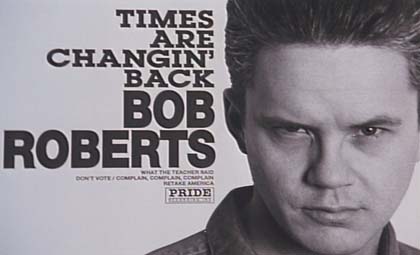
While declaring that “the 60s are, let’s face it, a dark stain on American history” during an interview on a morning chat show, Roberts churns out hate-filled folk records with such Dylan-aping titles as “The Freewheelin’ Bob Roberts”, “Times Are Changin’ Back” and “Bob on Bob”. He even reinvents Dylan’s iconic video to “Subterranean Homesick Blues” as “The Wall Street Rap”, his paean to the pursuit of money.

Bob Dylan pastiche #1 in Bob Roberts

Bob Dylan pastiche #2 in Bob Roberts

Robbins takes the Dylan reference further by adopting the same verite-style of the classic 1967 documentary about the singer Don’t Look Back, while in one scene Roberts, who rides ahead of his campaign bus on a motorbike, falls off, aping a similar incident suffered by the folk legend in 1966.

The corporatisation of politics and its leaders is hardly a new phenomenon, but Robbins turns it all the way up to 11 here. When his campaign staff aren’t manning the phones pushing Roberts the politician from the confines of their battle bus, they’re pushing Roberts the businessman by trading stocks and shares.

Bob Roberts – the Tea Party’s wet dream come to life in Tim Robbins’ searing satire

While Robbins can get bogged down hammering home the point that politics and society at large has regressed from the idealism of the 60s to a more reactionary, less tolerant state, his debut film has become ever more pertinent and timely over the years. His portrayal of a media machine that wallows in trivia and allows subjectivity to superseed objectivty foretells the world of 24-hour rolling news and the likes of Fox News. Robbins also attacks the deliberate erosion of the divide between church and state, something that has now become de rigueur in politics since George W Bush and the advent of the Tea Party.

Robbins exudes an oily charisma as the titular firebrand, capturing the dead-eyed smile we’ve seen from so many politicians. Equally great is Rickman as the not-quite-human Hart and Ray Wise as Roberts’ svengali-esque campaign manager Chet MacGregor.

Bob Roberts is a bold, frightening and blackly satirical warning to a sleepwalking nation of the power of style over substance and the sobering observation that you often get the leaders you deserve.

Review – Argo

It’s frankly remarkable Argo has taken this long to reach the big screen – a film with a you-just-couldn’t-make-it-up storyline in which Hollywood comes out smelling of roses.

More than 50 Americans were held hostage for 444 days after Islamist protestors and militants stormed the US embassy in Tehran, Iran, in 1979.

Argo is the kind of superior political thriller that all-too-rarely gets made these days

The story of their long ordeal has been well documented. What isn’t as well-known is the plight of six Americans who made it out of the country as a result of an extraordinary CIA plot led by operative Tony Mendez in which an elaborate cover story was hatched to pass the group off as a Canadian film crew scouting locations for a sci-fi movie called Argo.

It wasn’t until 1997 when President Bill Clinton declassified the CIA files that the story officially came to light and only now do we have the movie ‘based’ on Mendez’s historical account courtesy of actor/director Ben Affleck.

Much like Steven Spielberg’s Munich (2005), Argo adopts the look and feel of such classic 1970s nail-biters as Dog Day Afternoon (1975) and The Taking of Pelham 123 (1974), right down to the old Warner Bros logo at the front end of the movie and the use of old film stock to provide a suitably grainy look. Affleck also mixes things up with fast zooms, long lens shots and close-ups to crank up the tension.

The use of handheld cameras during the scenes in Iran give the action a confused, panicked quality that is effectively handled and works as a parallel to the comical exchanges between Mendez (Affleck), make-up artist and CIA contact John Chambers (John Goodman) and veteran producer Lester Siegel (Alan Arkin) as they work against the clock to put flesh on Argo‘s bones.

This is most powerfully demonstrated during the scene when a speech given by a spokeswoman for the militants outlining to the world’s media their political position is intercut with a script reading of Argo featuring actors in ridiculous costumes.

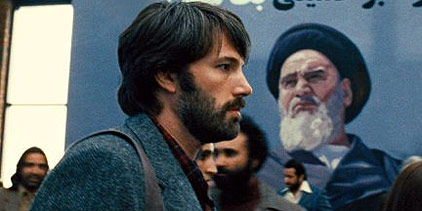
CIA agent hatches a so-crazy-it=might-just-work scheme to save a group of Americans in Ben Affleck's Argo

CIA agent Tony Mendez endeavours to save a group of Americans in Ben Affleck’s Argo

In lesser hands you would have heard someone dramatically declare “it’s crazy, but it might … just … work”. However, Affleck has matured as a director since his admirable 2007 debut Gone Baby Gone and shown he can helm claustrophobic action in his follow-up The Town (2010).

Affleck makes emphatically clear the life or death stakes facing the group and the paranoia and queasiness that fear can exert. You get a very real sense that one false step by any of them will mean the game’s up for all.

That being said, the wheels begin to fall off somewhat in the film’s final third. Lest we forget, this is a Hollywood picture, and as the embassy staff and Mendez make their tortuous way through Tehran Airport it’s difficult not to feel like you’re being deceived just as much as the security guards.

"It's so crazy it might just work". CIA agent Tony Mendez (Ben Affleck) teams up with Hollywood producer Lester Siegel (Alan Arkin) and make-up artist John Chambers (John Goodman)

“It’s so crazy it might just work”. CIA agent Tony Mendez (Ben Affleck) teams up with Hollywood producer Lester Siegel (Alan Arkin) and make-up artist John Chambers (John Goodman)

That’s not to say Affleck doesn’t handle the group’s final escape well – it’s a masterful, pulse-quickening action sequence that pushes all the right buttons. But the contrivances of the plot (plane tickets being confirmed with seconds to spare and other moments I won’t spoil) are hard to swallow (in fact they’re plain inaccurate) and bring to mind the over-the-top denouement to the otherwise enjoyable The Last King of Scotland (2006).

With Iran having rarely been out of the news for the past few years, Argo‘s politics are inevitably going to be put under the spotlight. Affleck doesn’t let himself down here. While we’re under no illusion who the heroes of this tale are, from the opening sequence (filmed as a movie storyboard) where we get a short history lesson on the brutality of the Shah’s rule and the subsequent revolution that saw the birth of an Islamic republic, we are asked to  understand the anger of the Iranian people and why the embassy was stormed. This is no Black Hawk Down (2001) with an implacable, faceless and one-dimensional enemy.

While Affleck won’t win any prizes for historical accuracy (what Hollywood film does?), Argo nevertheless stands on its feet as the kind of superior political thriller that all-too-rarely gets made in Tinseltown these days.