Cockneys vs Zombies – Probably the most entertaining British zombie film since Shaun of the Dead
It might be about as subtle as a boot in the Jacobs, but Cockneys vs Zombies is far more than its attention-grabbing title and probably the most entertaining British zombie film since Shaun of the Dead.
Brothers Andy (Harry Treadaway) and Terry (Rasmus Hardiker) and their ragtag gang are half way through robbing a bank to save their granddad Ray’s retirement home when a zombie apocalypse strikes London’s East End. Meanwhile, Ray (Alan Ford in full-on “Laaandan” mode) and his friends (including stalwarts Honor Blackman and Richard Briers) fight to keep the walking dead out of the home.
More often than not, films like this can be all title and no substance. While Cockneys vs Zombies can hardly be considered genre-defining it knows its strengths and plays to them. Writer James Moran isn’t afraid to have a laugh at the expense of East End clichés and stereotypes, be they Dudley Sutton’s ridiculously convoluted cockney rhyming slang, football hooligans (despite them being dead) or Lock, Stock… gangsterisms. Hell, even ex-EastEnders actress Michelle Ryan gets a major part.
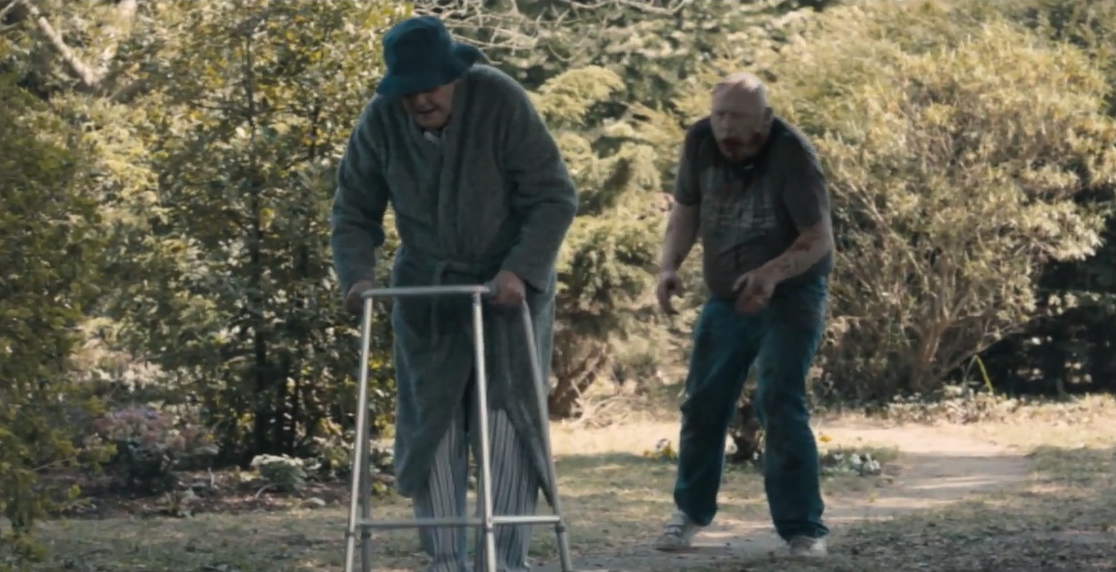
Hamish (Richard Briers) outwalks the undead in Cockneys vs Zombies
Moran and director Matthias Hoene subtly subvert the perception of the elderly in our society as being more than people waiting to die, while also giving us one of the most amusing scenes of the year when a zimmer-framed Briers tries to outrun a zombie.
You’d have to be dead not to find this ‘zomedy’ funny.
The excellent ensemble cast of Wes Anderson’s Moonrise Kingdom
Wes Anderson’s movies regularly split their audiences into those who embrace their whimsically eccentric nature or those who find them too smart for their own good.
Although the trademark Anderson-isms are present and correct (methodical, angular camerawork; retro soundtrack; self-referential dialogue), Moonrise Kingdom is his most accessible and warm-hearted work to date; a coming-of-age tale in which childhood sweethearts Sam and Suzy (Jared Gilman and Kara Heywood, both pitch-perfect) turn their small island community upside down when they run away together.
The performances from Anderson regulars (Bill Murray, Jason Schwartzman) and virgins (Edward Norton, Bruce Willis, Frances McDormand) are uniformly excellent in this splendid work that is equal parts sad and optimistic.
The power of persuasion is far more powerful than we would wish to believe.
Psychic mediums are a case in point. The most successful proponents of this brand of entertainment can attract hundreds, sometimes thousands of paying customers to their shows; people who are ready and willing to be told what they want to believe. Providing information that can often generously be described as ‘vague’, they usually allow their participants to fill in the blanks and do the work for them.
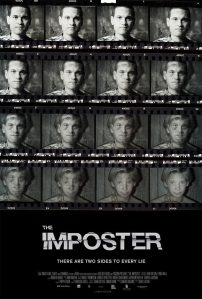
The Imposter is “one of the best documentaries of the year”
Although not claiming to be able to speak to the spirit world, Frédéric Bourdin is no less accomplished when it comes to manipulation, as the riveting documentary The Imposter reveals.
That being said, a con man will never succeed without willing participants and Bourdin lucked out beyond his wildest dreams when he inveigled himself into the family of Texan teen Nicholas Barclay, who went missing aged 13 in 1994.
It’s a story that staggers belief. More than three years after Nicholas disappeared, the grieving family received a phone call saying he had been found in Spain. Nicholas’ dumbfounded sister Carey immediately flew out to collect him. What no-one knew was that the call to the family had been placed by Bourdin, whose only resemblance to Nicholas was that they each had five fingers and toes.
Nicholas was blonde, blue-eyed and American; Bourdin had dark hair, brown eyes and spoke English with a heavy French accent. He was also seven years older than Nicholas. Although convinced he wasn’t going to get away with it, Bourdin nevertheless dyed his hair, got the same tattoos that Nicholas had and presented himself to Carey … who incredibly took him in as her long-lost younger brother without question.
The Imposter uses dramatic reconstructions to engaging effect
Remarkably, the con continued to stick upon their return to Texas, as Nicholas’ mother Beverley and other close family accepted him back into the fold. “He had changed so much it was mind-boggling,” said Beverley, who put his dramatic change of appearance down to his traumatic experiences.
Bourdin also fooled the media and FBI agent Nancy Fisher, who had serious suspicions but was convinced (at least initially) by the incredible story he spun about being abducted by an international vice ring. In fact it wasn’t until private invetigator Charlie Parker got involved and unearthed damning evidence of Bourdin’s fraudulent behaviour that the Frenchman realised the game was up.
It’s an astonishing tale and director Bart Layton, until now best known for his nightmare-in-paradise TV series Banged Up Abroad, is wise enough not to pull a Nick Broomfield and just let his subjects do the talking.
Instead he nods to the great documentarian Errol Morris by splicing reenactments with talking heads footage, at times so flawlessly as to underline just how blurred the line between fact and fiction became during this tangled, sorry mess.
The Imposter himself Frédéric Bourdin
It almost goes without saying that Bourdin is perhaps the ultimate unreliable narrator. A man so consumed by his serial addiction to impersonating other people (he claims to have assumed more than 500 false identities) that he was nicknamed ‘The Chameleon’ by the media, Bourdin is nothing if not fascinating. His selfish single-mindedness (“I care about myself, just about myself and f*ck the rest of it” – this coming from a man who’s since got married and had kids) is matched only by his superhuman intransigence.
Although Layton gives the lion’s share of the screen time to Bourdin, he doesn’t neglect Nicholas’ family, specifically Carey and Beverley who are both given ample time to address the question anyone who watches The Imposter will ask – how could they have been so spectacularly wrong?
Bourdin, as well as Parker and Fisher, claim certain members of the family knew a lot more about Nicholas’ disappearance than they were willing to reveal. Layton doesn’t allow the film to take a firm position on this; instead choosing to concentrate more on the humiliating, tragic subterfuge.
Bourdin feels that Carey (and by extension the rest of the family) probably knew deep down that he wasn’t their loved one, but were willing victims regardless, stating: “She (Carey) decided I was going to be her brother.”
Revealingly, the family recount the web of lies spun to them (speaking to the side of the camera – Bourdin is the only one who speaks straight to the camera) as if they are still facts. At no point do they say “he claimed this…”, rather each part of Bourdin’s story is oddly still taken at face value it seems.
Fifteen years on from those extraordinary events there remains bitterness and hurt within the family and a collective sense of bewilderment that will quite possibly never fully disappear. Carey may as well be speaking for the family (and the rest of us) when she asks: “How could I be so f*cking stupid?”
The Imposter often transcends the documentary format, moving into the realm of psychological thriller, especially in the breathless closing 30 minutes when the house of cards that Bourdin has built starts to collapse. It’s a suitably gripping conclusion, handled superbly by Layton, to what will undoubtedly be seen as one of the best documentaries of the year.
After so spectacularly scaling his own personal Mount Doom with his revered Lord of the Rings trilogy, could Peter Jackson somehow capture lightning in a bottle again with this second epic excursion into Middle Earth?
From the moment Rings was wrapped, Jackson was being called upon to sprinkle that same magic on J.R.R Tolkien’s earlier, much leaner children’s book The Hobbit.
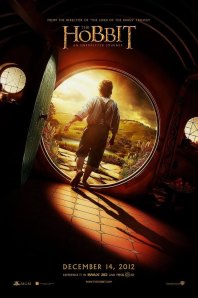
The Hobbit: An Unexpected Journey – very good, but not without its faults
The New Zealander originally wanted Guillermo del Toro to direct, but after the Mexican horror maestro left the project (he’s down as a co-writer), Jackson took it upon himself to oversee the mammoth undertaking. While it would have been fascinating to see Del Toro’s vision realised on screen, Jackson’s pedigree was irrefutable.
That The Lord of the Rings was made as a trilogy made perfect sense – three books, three films. However, when it emerged that Jackson was turning The Hobbit into not two, but three movies eyebrows were raised and questions asked as to whether this was a bridge too far. Now that An Unexpected Journey is finally here in all its many guises (3D, Imax, 24 or 48 frames per second, take your pick) does it succeed? Yes, but with reservations.
An Unexpected Journey walks a similar path to Fellowship of the Ring; a CGI-heavy prologue lays out the stakes, a hobbit is chosen to go on an adventure, a small band of diminutive people is forged and a life or death quest begins to achieve something bigger than all of them.
Watching An Unexpected Journey is akin to slipping on a well-worn pair of slippers; the restless, swooping camerwork, the stirring Howard Shore score and the jaw-dropping New Zealand locations (seriously, Jackson is a one-man NZ Tourism Board) are all present and accounted for and when the Shire appears on screen it’s like being reuinted with an old friend after a decade apart.
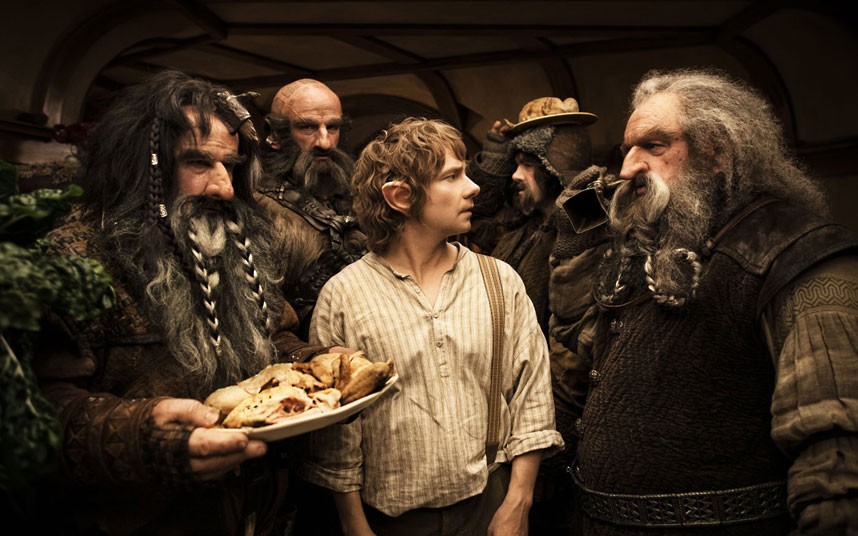
However, even old friends can get annoying as Jackson languishes in the Shire for what seems like an eternity. To be fair, a major reason for this is to introduce us to the 13-strong company of dwarves, led by the heroic Thorin Oakenshield (Richard Armitage), who come calling at the home of hobbit Bilbo Baggins (Martin Freeman) at the request of the wizard Gandalf (Ian McKellen). Bilbo is urged by Gandalf to join the dwarves on a perilous journey to reclaim their home and treasure from the dragon Smaug and, after much toing and froing belatedly embraces the opportunity.
Bilbo (Martin Freeman) reluctantly hosts a group of dwarves in The Hobbit: An Unexpected Journey
This overly-prolonged first act smacks of indulgence on Jackson’s part and has you wondering if three films really was a sensible idea. But once the gathering hit the road the film finally moves up the gears until a breathless last hour that promises much for next year’s The Desolation of Smaug.
As with his Rings trilogy, Jackson proves he’s no slouch when it comes to the big set pieces. The stone giant battle in which Bilbo and co unwittingly become a part of is genuinely thrilling and underlines the dangers inherent on their quest, while the dwarves’ and Gandalf’s dizzyingly elaborate escape from the Great Goblin’s cave lair (amusingly voiced by Barry Humphries) and his sizeable CGI army is reminiscent of, though not as impressive as the Mines of Moria/Balrog scene from Fellowship.
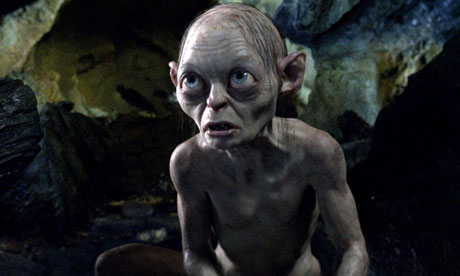
However, An Unexpected Journey‘s finest spectacle is saved for the game of riddles between an uneasy Bilbo and the pathetic, wretched Gollum; a masterclass in building tension that pivots the whole film and is the hobbit’s true turning point. The wonderful Andy Serkis dons the motion-capture suit once more to reprise his role as Sméagol/Gollum, whose split personality is equal parts humourous, childlike and disturbing , not least of which when he realises his “precious” ring has been stolen.
Gollum (Andy Serkis) is the star of the show in The Hobbit: An Unexpected Journey
The moment when Bilbo, invisible after wearing the ring, holds a sword to the unknowing Gollum’s throat and exercises mercy is really something. It’s at this point that Jackson’s faith in Freeman must have paid off. Freeman, previously best known for his TV work in The Office and Sherlock, shows his acting chops by conveying pity, disgust and humanity in a single look and affirming that this little hobbit is the part he was born to play. Bilbo is our Everyman and Freeman delivers just the right mix of self-doubt, wonder and fortitude.
McKellen is clearly having the time of his life revisiting the mischievous and good-hearted wizard and it’s good to see Christoper Lee and Cate Blachett reprising their roles as, respectively, Saruman and Galadriel; however, Ken Stott’s Balin and James Nesbitt’s Bofur are the only dwarves to make any major impact, while Armitage has yet to fully convince as this tale’s rugged hero in the way Viggo Mortensen managed with Aragorn.
An Unexpected Journey is very good, but it’s not without its faults and fails to match the heights of Fellowship. For many that will be more than enough, but Jackson still has some work to do if he hopes this trilogy will earn its place in cinema’s valhalla alongside his previous fantasy epic.
Teenagers are forced by a paranoid, dystopian government to compete in all-or-nothing game where they must use whatever weapons are at their disposal to kill each other in order to win.
You’d be forgiven for thinking a review of The Hunger Games would be forthcoming off the back of that premise. However, more than a decade before that acclaimed blockbuster made it to the big screen, director Kinji Fukasaku unleashed this ultra-violent black comedy.
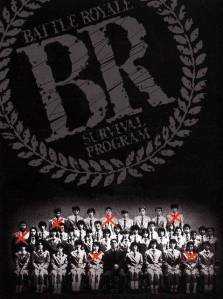
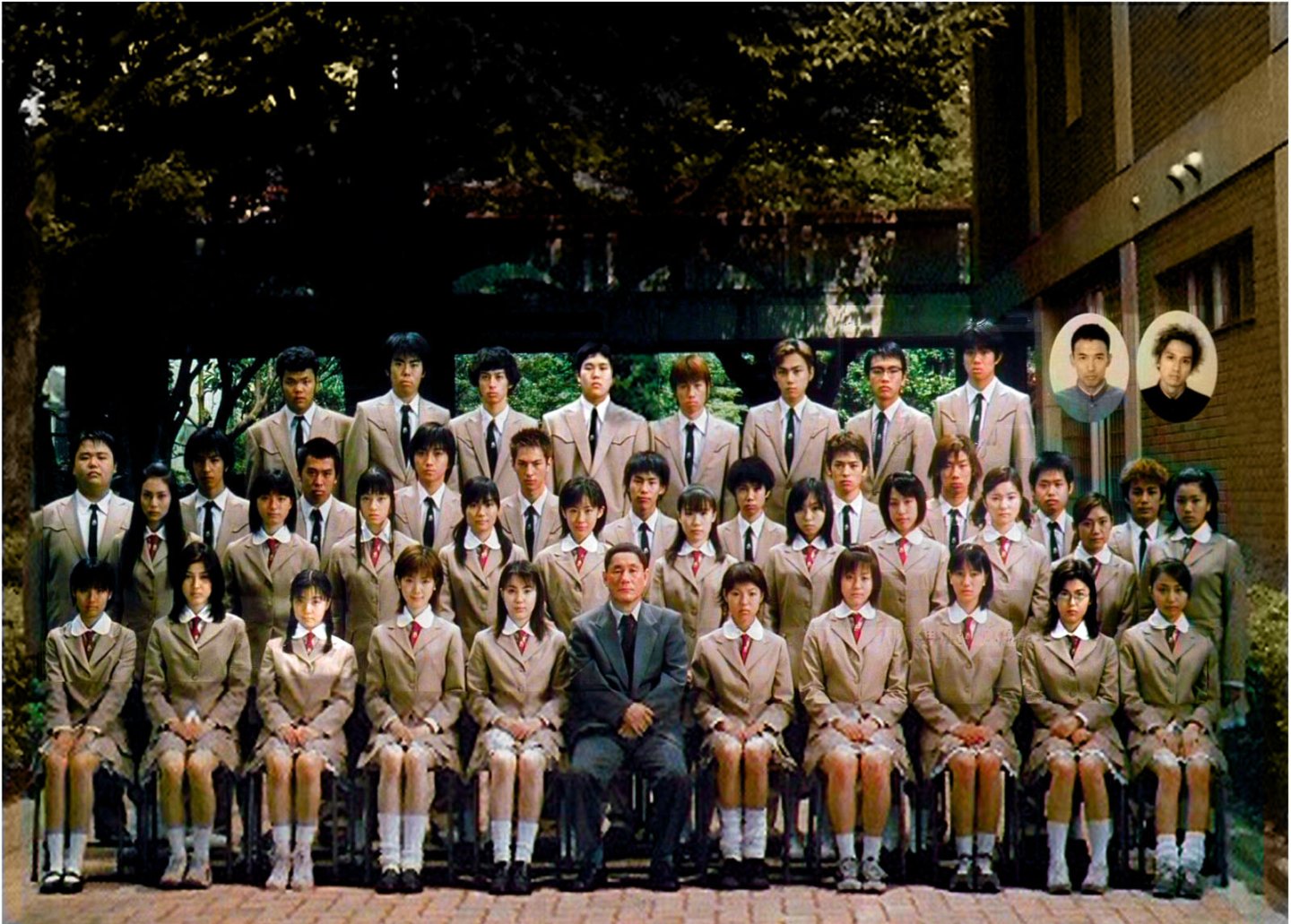
The ultra-violent black comedy Battle Royale
Subsequently re-released in 3D (in 2010 in Japan and this year in the United States, presumably to cash-in on the hysteria surrounding The Hunger Games), Battle Royale was as successful in its native Japan as it was controversial (there’s no such thing as ‘bad’ news when it comes to drumming up box office receipts, after all).
Adapted from Koushon Takami’s novel of the same name, the film begins with a prologue explaining how high unemployment, mass truancy, escalating juvenile crime and peadophobia led to the adoption of The Battle Royale Act, wherein a class of ninth grade kids are selected at random to participate in an epic bloodletting against their will. Ferried to a deserted island, the 40-plus friends and classmates are fitted with explosive neck braces and told they have three days to ensure they are the last one standing or face certain death.
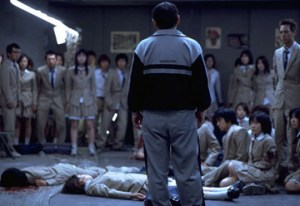
They are given this unwelcome news by their former teacher Kitano (played by Japanese actor/director ‘Beat’ Takeshi Kitano), who casually informs his ex-students that “today’s lesson is you kill each other off till there’s only one of you left; nothing is against the rules”. Kitano is a metaphor for the system; an implacable tyrant who stamps his authority by killing two of the terrified teens before the game has even started, one for whispering and the other for talking back. “You don’t respect adults”, he states, by way of explanation.
Some of the students choose to commit suicide rather than play along, while others either go it alone or fall back on the friendships they had in school and team up. Although class heart-throb Shuya (Tatsuya Fujiwara) emerges as the hero and Noriko (Aki Maeda) the plucky heroine, the film gives ample screen time to the other students to work together, turn on each other or die tragically (often all three).
Kitano (‘Beat’ Takeshi Kitano) gives his former pupils a lesson they won’t forget in Battle Royale
Fukasaku displays a clever understanding both of the overtly emotional, naive rebelliousness of many teens and the Dawson’s Creek-esque soap operas that have embellished these traits with lashings of post-modernist melodrama.
Scenes of eye-popping gore are followed by characters declaring their love as they lie dying in each other’s arms, punctuated by Masamichi Amano’s knowingly over-the-top score. Others wallow in reductive woe-is-me angst, usually just before killing or being killed.
Battle Royale definitely has plenty of fun with its subject matter. One girl’s amusing last words to the boy she loves are “you look really cool”, while another boy unsuccessfully attempts to convince the girl he likes to have sex with him, shortly before he’s stabbed to death by her. Classroom rivalries are also allowed to reach their natural conclusion when the characters concerned each have a weapon in hand.
The class in happier, less-deadly times in Battle Royale
That being said, there’s no winking at the audience by the young cast, who equip themselves admirably and play it straight. Only the psychopathic Kiriyama (Masanobu Ando) feels a little out-of-place, his killer-who-just-won’t-die routine more suited for slasher films.
Although the events taking place on the island aren’t screened on television for mass consumption, the media is seen scrambling over itself to cover the story – the ultimate example of the ‘if it bleeds it leads’ axiom.
Sequels to dystopian dramas such as this tend to switch focus to the resistance that is born in its wake. Battle Royale II: Requiem adheres to this formula, but does so to full effect with a daring, post-9/11 narrative that courts controversy even more gleefully than its predecessor and should also be sought out.
Battle Royale is ultimately a story about the loss of innocence and its young cast can be seen as a microcosm of where Fukasaku possibly felt society was headed. Adults are presented here as a different species, afraid and confused in equal measure of a generation they have spectacularly failed to understand and engage with. Like all those who live in fear, the walls go up and the consequences be damned.







 three rows back