Review – The Last Exorcism Part II

The word “last” clearly shouldn’t be taken literally in this lazy and derivative money-grabbing sequel that puts the ‘moron’ into oxymoron.
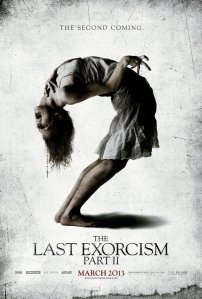
The word "last" clearly shouldn't be taken literally in this lazy and derivative money-grabbing sequel that puts the 'moron' into oxymoron in The Last Exorcism Part II

The word “last” clearly shouldn’t be taken literally in this lazy and derivative money-grabbing sequel that puts the ‘moron’ into oxymoron in The Last Exorcism Part II

Made for a pittance, 2010’s The Last Exorcism was something of a surprise hit with both horror-lovers and critics. Its plot was a clever twist on a tried and tested genre and at its core was a genuinely impressive performance by the relatively unknown Ashley Bell as troubled Nell Sweetzer.

Ashley Bell after reading the script for The Last Exorcism Part II

Ashley Bell after reading the script for The Last Exorcism Part II

The filmmakers (including producer Eli Roth) looked to have shaken off the tired and stale tropes of the found footage format for the first 70 unnerving and taut minutes, lost their bottle in the final reel and retreated to tried and tested genre staples, undermining everything the movie until that point had worked so hard to subvert.

The fact the film made a big profit was undoubtedly the driving force behind this ill-judged follow-up, whose title is as hilarious as it is non-sensical. Once again produced by Roth, directing duties have this time fallen to Canadian Ed Gass-Donnelly in what was presumably hoped to be a career breakthrough.

An unusual sleep pattern in The Last Exorcism Part II

An unusual sleep pattern in The Last Exorcism Part II

The opening credits are essentially a flashback to the events of the first movie, wherein a disillusioned preacher (played by Patrick Fabian) works with a documentary film crew to chronicle his final ‘exorcism’ and expose the whole practice as nothing more than religious hokum. The subject is Nell, whose father is convinced is possessed by the devil; but little do the preacher and film crew know that this particular case of satanic possession is all-too-real.

Picking up a short time afterwards, Part II‘s creepiest moments occur in the first few minutes when a demonic-looking Nell is discovered hiding in a couple’s kitchen. Alas, the promise of the opening scene dissolves quicker than you can say “Pazuzu”, and we’re very swiftly subjected to a game of spot the rip-off.

Poor old Nell Sweetzer (Ashley Bell) in The Last Exorcism Part II

Poor old Nell Sweetzer (Ashley Bell) in The Last Exorcism Part II

Nell is sent to a home for girls run by the kindly Frank (Muse Watson) and gradually comes out of her shell. She makes friends with several of the other girls, gets a job as a chambermaid and even develops a budding romance with bland hotel worker Chris (Spencer Treat Clark).

However, you know something bad’s going to happen when Frank reassures Nell by saying: “Whatever you’re running from won’t find you here.” And you definitely know it’s a case of famous last words when Nell happily declares: “There was a darkness, but now it’s gone … none of it was real.”

Gwen (Julia Garner) looking bland/evil in The Last Exorcism Part II

Gwen (Julia Garner) looking bland/evil in The Last Exorcism Part II

It almost goes without saying that Nell’s going to pay for wearing lipstick, being attracted to Chris and listening to rock ‘n’ roll (the devil’s music, lest we forget), but the film doesn’t even try to subvert what we know is coming from a mile off. What scares there are (next to none) are ruined by the lazy cliché of being accompanied by explosions of sound. A film’s always in trouble when is has to resort to that.

Bell gives a far better performance than the film deserves. Without her it would have been a total car wreck and it’s to her credit her turn brings to mind Sissy Spacek’s Carrie and Mia Farrow in Rosemary’s Baby. It’s a good job too, as the largely forgettable supporting cast only seem able to alternative between looking confused, evil or dumb.

To make matters worse, the door is left open for a sort of Omen III: The Final Conflict-style sequel which sounds about as much fun as being decapitated by a sheet of glass. Still, The Last Last Last Exorcism as it should be known could hardly be as demonic a waste of time as this.

In Retrospect – Children Of Men (2006)

If the terrorist atrocities of 9/11 and 7/7 are the defining moments of this young century, then Alfonso Cuarón’s Children Of Men could arguably be cinema’s most defining response.

Although in essence about a society falling apart due to the fact no children have been born for 18 years, Cuarón’s loose adaptation of P.D. James’ novel is more a parable on the fear of the ‘other’ that has spread since those dreadful events of September 2001.

A truly astounding cinematic experience, Alfonso Cuarón's Children Of Men is profound filmmaking that will shock and awe in equal measure

A truly astounding cinematic experience, Alfonso Cuarón’s Children Of Men is profound filmmaking that will shock and awe in equal measure

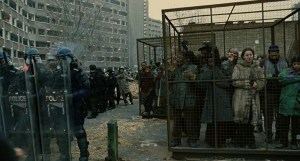
Refugees, "hunted down like cockroaches" in Children Of Men

Refugees, “hunted down like cockroaches” in Children Of Men

It is also a story of hope and thinly veiled spirituality that sees former activist turned cynical salaryman Theo Faron (Clive Owen) embarking on a perilous journey of redemption to help save the human race from its own destruction.

Set in 2027 Britain, Theo is offered money by his estranged wife Julian (Julianne Moore) – leader of a radical group fighting to protect immigrants’ rights called the Fishes – to escort refugee Kee (Clare-Hope Ashitey) to the coast. Theo discovers just how important she is to the future of humanity, but must evade both government forces and terrorists if they are to survive.

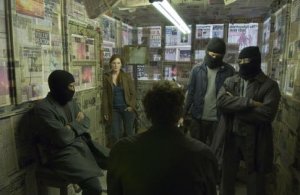
Julian (Julianne Moore) spells it out to estranged husband Theo (Clive Owen) in Children Of Men

Julian (Julianne Moore) spells it out to estranged husband Theo (Clive Owen) in Children Of Men

Children Of Men is unlike any science fiction film you’ve seen before. While most sci-fi wallows in high concept special effects and extravagant production design, Cuarón adopts an immersive vérité style to show a London on the verge of collapse. The pre-credits scene sets up the film perfectly. As customers in a packed cafe watch TV with despair at the news of the death ‘Baby’ Diego, the world’s youngest person, Theo absent-mindedly buys his coffee and walks out onto a busy London street dominated by piled-up rubbish, run-down public transport and rickshaws. His apathy towards Baby Diego’s death saves his life, however, as seconds later the shop is torn apart by an explosion triggered by the Fishes.

Ageing hippie Jasper Palmer (Michael Caine), no relation to Harry Palmer, in Children Of Men

Ageing hippie Jasper Palmer (Michael Caine), no relation to Harry Palmer, in Children Of Men

The UK, as we learn from government propaganda proudly stating “only Britain soldiers on”, is one of the few countries that hasn’t tipped over into outright anarchy. Society nevertheless seems on the brink of collapse. Refugees desperate to flee the chaos that has gripped much of the world have landed on British shores, only to be met by a police state that “hunts them down like cockroaches”, according to Theo’s friend, ageing anti-establishment hippie Jasper Palmer (Michael Caine).

Theo (Clive Owen) fights for survival in Children Of Men

Theo (Clive Owen) fights for survival in Children Of Men

The masses are told to remain suspicious of immigrants (bringing to mind Cold War East Germany) and walk around in a ghostly daze seemingly resigned to humanity’s gradual extinction. This is nicely observed when Theo goes to see his government minister cousin Nigel who, when asked why he still ‘rescues’ works of art when no-one will be around to appreciate them, responds: “I just don’t think about it.”

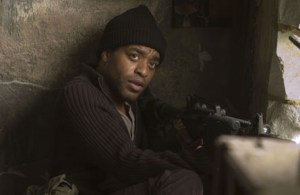
Senior rebel Luke (Chiwetel Ejiofor) in Children Of Men

Senior rebel Luke (Chiwetel Ejiofor) in Children Of Men

Cuarón pointedly evokes the holocaust in such provocative and chilling images as refugees staring hopelessly out of caged buses heading for the nightmarish concentration camp located in the former seaside town of Bexhill. In addition, piles of burning cattle bring to mind the apocalyptic scenes seen in Britain during the foot and mouth outbreak.

The use of diagetic and non-diagetic sound is masterfully handled by Cuarón. The sound of attack dogs seems to echo in every frame, while John Taverner’s elegiac, passionately spiritual Fragments of a Prayer is introduced at key moments in the film.

Children Of Men isn’t devoid of humour, however. While society falls apart, ceremonial traditions such as the Royal Horse Guard’s trot down The Mall are still observed. Theo also wears a faded London 2012 top, which is given a blackly ironic twist as it would have been the first Olympics to take place after babies stopped being born. The film isn’t afraid to throw in a few fart gags too.

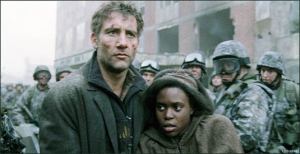
Theo (Clive Owen) leads Kee (Clare-Hope Ashitey) to safety in Children Of Men

Theo (Clive Owen) leads Kee (Clare-Hope Ashitey) to safety in Children Of Men

Owen has never been better as Theo, a reluctant hero who steps up to become Joseph to Kee’s Mary almost in spite of himself. The stellar supporting cast elevate the film, including the always-excellent Chiwetel Ejiofor as Julian’s right-hand man Luke, Ashley’s confused and frightened Kee and Pam Ferris as Fishes member Miriam, a former midwife who gets one of the movie’s most eloquent lines when she observes “very odd what happens in a world without children’s voices”.

Children Of Men‘s most indelible moments come during several bravura one-take shots. An ingeniously filmed chase sequence shot entirely within a car containing Theo, Julian, Luke, Miriam and Kee is chaotic, shocking and astonishing, while a tracking shot of Bexhill being turned into ground zero in the fight between government forces and the rebels is nothing short of extraordinary. You’ll be shaking your head at how Cuarón and cinematographer Emmanuel Lubezki pull it off.

Cuarón wisely avoids delving too directly into the causes of the mass sterility, although the theological subtext of the film (the struggle to ensure a child is born to save humanity from itself) suggests divine intervention. A truly astounding cinematic experience, Children Of Men is profound filmmaking that will shock and awe in equal measure.

Great Films You Need To See – Punishment Park (1971)

This is my second contribution to The Big Picture, the internationally-recognised magazine and website that offers an intelligent take on cinema, focussing on how film affects our lives. This piece about Peter Watkins’ controversial docudrama Punishment Park was written as part of The Big Picture’s self-explanatory Lost Classics section, although I am including it within my list of Great Films You Need To See.

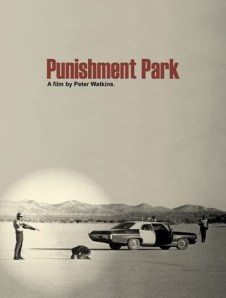
The Boston Phoenix may have predicted Peter Watkins’ potent philippic on the frightening consequences of unchecked power was a “cult hit waiting to happen”, but 40 years after its controversial release it’s still twiddling its thumbs waiting for the world to catch on.

Peter Watkins' Punishment Park - "it's striking just how resonant the issues of the film still remain"

Peter Watkins’ Punishment Park – “it’s striking just how resonant the issues of the film still remain”

Watkins’ pioneering brand of radical pseudo-documentary filmmaking was always going to leave him shouting at the world from the sidelines.

His 1965 BBC nuclear war docudrama The War Game was judged “too horrifying for the medium of broadcasting” by Auntie and shelved for 20 years. Set in a dystopic America that Watkins could see on the horizon, Punishment Park never recovered from the hostile critical reaction it mostly received and sank without trace.

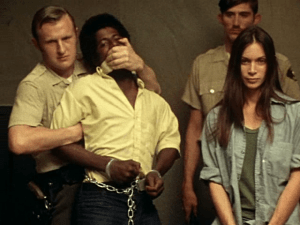
The 'prisoners' find the going tough in Punishment Park

The ‘prisoners’ find the going tough in Punishment Park

Dismissed at the time as nothing more than hyperbolic paranoia on the part of the director (The New York Times described it as “the wish-fulfilling dream of a masochist”), seen today it’s striking just how resonant the issues of the film still remain.

With the Vietnam War escalating, Nixon invokes legislation authorising a police state wherein those deemed “a risk to internal security” can be arrested and tried by a civilian tribunal. Presumed guilty, the hippies, draft dodgers and seditious types arrested for “hindering the war effort” are offered long jail time or three gruelling days in Punishment Park (or the option of signing a Hitler oath-style pledge of loyalty).

They fought the law, the law won in Punishment Park

They fought the law, the law won in Punishment Park

Promised liberty if they evade the police and National Guard and make it across scorching hot desert to capture the US flag 53 miles away, the ‘subversives’ who choose this option little realise their blood-thirsty pursuers have no intention of letting them gain their freedom (or, in some cases, letting them live).

The screw is turned as the film, comprised of faux BBC news footage narrated by an increasingly splenetic Watkins, cuts between the one-sided kangaroo court (its chairman, a politician, gags a prisoner for getting on his nerves bringing to mind Bobby Seale), the terrified rebels in Punishment Park and law enforcement officers hungry for action. In a cruel irony one runner tells the camera crew “I don’t think they’re trying to kill us”, before Watkins cuts to a sheriff describing how best to shoot someone.

The spectre of Bobby Seale looms large in Punishment Park

The spectre of Bobby Seale looms large in Punishment Park

Interestingly, the non-professional actors were cast based on their own political beliefs and were told by Watkins to let rip against each other as if the situation were real. As a result the scenes within the tribunal tent crackle with tension as the prisoners and tribunal members have what might be called “a failure to communicate” and end up screaming at each other.

Echoes of Punishment Park (and Watkins’ previous diatribe The Gladiators) can be seen in such variable fare as The Running Man, Battle Royale and The Hunger Games.

Filmed in the aftermath of and coloured by the Kent State massacre when the US was ripping itself apart over Vietnam, Watkins’ hellish vision of an America consumed by war and whose citizens are judged by their loyalty to the state may have been branded paranoia, but 40 years on looks pretty prescient when taking into account the War on Terror, Patriot Act and Guantanamo Bay and lends credence to that old proverb ‘the more things change, the more they stay the same’.

Review – The Great Gatsby

A great adaptation of what’s considered the Great American Novel has proven as elusive as the symbolic green light the obsessed Gatsby is desperately reaching for.

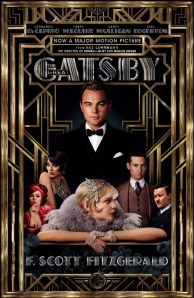
Baz Luhrmann's The Great Gatsby - "a beautifully designed but ultimately hollow experience which, much like Gatsby, would rather you didn't scratch beneath the veneer"

Baz Luhrmann’s The Great Gatsby – “a beautifully designed but ultimately hollow movie which, much like Gatsby, would rather you didn’t scratch beneath the veneer”

It’s been almost 40 years since the Robert Redford-starring misfire and now it’s the turn of Australian director Baz Luhrmann to see if he can capture the essence of F. Scott Fitzgerald’s most celebrated work.

Luhrmann certainly has some pedigree bringing iconic literature to the big screen; his unconventional modern-day version of Shakespeare’s most famous romantic tragedy (Romeo + Juliet) was a big hit and introduced the Bard to a whole new audience. His Oscar-nominated 2001 smash Moulin Rouge! also proved he’s no stranger when it comes to visual excess. That his 3-D take on The Great Gatsby is a failure, therefore, is a shame; all be it one with enough to save it from being labelled a disaster.

Nick Carraway (Tobey Maguire), sandwiched between dodgy businessman Meyer Wolfsheim (Bollywood star Amitabh Bachchan) and Jay Gatsby (Leonardo DiCaprio) in The Great Gatsby

Nick Carraway (Tobey Maguire), sandwiched between dodgy businessman Meyer Wolfsheim (Bollywood star Amitabh Bachchan) and Jay Gatsby (Leonardo DiCaprio) in The Great Gatsby

The source of the problem lies with Luhrmann himself, specifically his inability to both construct a well-paced scene and find the soul of the book. To borrow that great line from Shakespeare’s Macbeth, Luhrmann’s Gatsby is full of sound and fury, signifying nothing.

Set in New York at the height of the Roaring Twenties, our way into the story is through Nick Carraway (Tobey Maguire), an aspiring writer working in the city selling bonds, who rents a modest property next to the opulent mansion owned by the enigmatic and secretive Jay Gatsby (Leonardo DiCaprio). Carraway befriends Gatsby, whose decadent parties are the talk of the town, but can never pin down his true character. All he knows is that Gatsby is obsessed with Carraway’s cousin Daisy (Carey Mulligan), who’s unhappily married to two-timing millionaire Tom Buchanan (Joel Edgerton).

Unhappily married couple Daisy (Carey Mulligan) and Tom Buchanan (Joel Edgerton) in The Great Gatsby

Unhappily married couple Daisy (Carey Mulligan) and Tom Buchanan (Joel Edgerton) in The Great Gatsby

Films generally succeed or fail with their audience within the first 20 minutes. Luhrmann’s approach to winning us over in the first two reels is to burn a hole in the retina with a kinetic explosion of colour, razzmatazz, CGI and stomach-churning, epileptic camerawork – all accompanied by Jay-Z’s scattershot soundtrack taking in hip hop, George Gershwin and plenty more besides – that tries to batter you into submission but just ends up coming off as a mess.

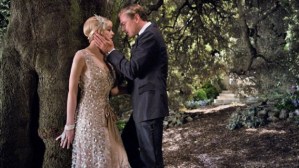
Daisy (Carey Mulligan) and Gatsby (Leonardo DiCaprio) steal a kiss in The Great Gatsby

Daisy (Carey Mulligan) and Gatsby (Leonardo DiCaprio) steal a kiss in The Great Gatsby

While Luhrmann’s at his most comfortable and confident during the myriad party scenes, where his supersonic style of direction suits the frenzied action on screen, when the story demands restraint to allow the narrative to flow and the characters to develop the film badly loses its way. The whole middle section is listless, with scenes that should be gripping (in particular the pivotal hotel room showdown that drives the final act) feeling unengaging and oddly lifeless.

The one truly great shot of Baz Luhrmann's The Great Gatsby

The one truly great shot of Baz Luhrmann’s The Great Gatsby

Luhrmann and co-writer Craig Pearce invent scenes of Carraway writing about his experiences with Gatsby while being treated in a sanatorium for “morbid alcoholism” as a way of explaining the narration, but get bogged down by continually returning to the washed-up wannabe writer pouring his tortured soul onto the page, even going so far as to etch choice bits of prose onto the screen.

Maguire’s lost puppy look soon grates and doesn’t work. Carraway may feel “within and without” of the world he stumbles into, but Maguire’s performance suggests he’s far happier observing than getting his hands dirty. Mulligan’s scared and inert southern belle is more believable, however, while Edgerton chews the scenery as the self-entitled Buchanan.

Nick Carraway (Tobey Maguire) and Jordan Baker (Elizabeth Debicki) in The Great Gatsby

Nick Carraway (Tobey Maguire) and Jordan Baker (Elizabeth Debicki) in The Great Gatsby

DiCaprio stands head and shoulders above everyone else (with the exception of Elizabeth Debicki’s cynical Jordan, a friend of Daisy), giving a performance far more understated and nuanced than anything else in the movie. His introduction – stood in front of a volley of fireworks, glass raised – is the one moment the film lives up to the title. DiCaprio has matured significantly as an actor in the past few years and delivers an engaging mix of charisma, mystery, sadness and unnerving obsession that saves the film from falling flat on its face.

At one moment Carraway compares what he’s witnessing to an “amusement park”. It’s a fitting description of this beautifully designed but ultimately hollow experience which, much like Gatsby, would rather you didn’t scratch beneath the veneer.

Four Frames – Night Of The Living Dead (1968)

I’m proud to say that I’ve become an offical contributor to The Big Picture, the internationally-recognised magazine and website that offers an intelligent take on cinema, focussing on how film affects our lives. Aimed at the enthusiastic film-goer at large, The Big Picture provides an original take on the cinematic experience. This piece is part of the Four Frames section, wherein the importance of four significant shots are discussed, in this case from George A. Romero’s horror classic Night Of The Living Dead.

It’s perhaps fitting that in the year that saw the world descend into civil unrest, a micro-budget splatter movie in which the dead rise from the grave and usher in the apocalypse would redefine both the horror genre and contemporary cinema.

Night of the Living Dead

There’s horror before 1968’s epochal Night of the Living Dead and there’s what came after, such is the seismic impact that George A. Romero’s debut feature continues to have.

Chucking out the rulebook in true anti-establishment style, he found a unique and unorthodox way to envisage the tipping point society seemed to be inevitably careering towards at the time.

Night of the Living Dead

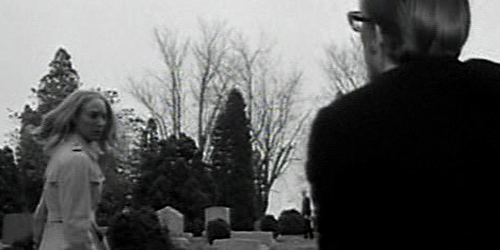
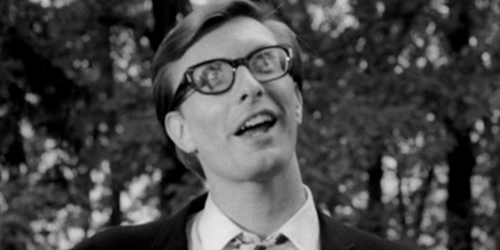
Romero monkeys about with the audience’s expectations from the film’s opening moment when siblings Barbra (Judith O’Dea) and Johnny (Russell Steiner) visit their father’s grave. Our assumed hero Johnny latches onto his sister’s unease and, putting on his best Boris Karloff pokes fun saying: “They’re coming to get you Barbra!”

He continues to freak out an angry Barbra and observes a shambling figure seen earlier in long-shot drawing ever nearer. “Look! There’s one of them now!”

Night of the Living Dead

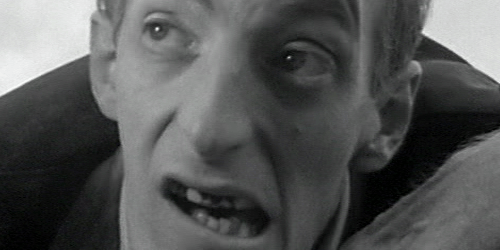
The unintended irony of this statement arrives with a jolt when the man (Bill Hinzman, who in basing his shuffling gait on Karloff in The Walking Dead proves that the old ways are sometimes the best) attacks Barbra. We presume Johnny will come to the rescue, but in fighting the ghoul (the word “zombie” is never uttered in the film) he falls and smacks his noggin on a headstone. Not so much the hero after all.

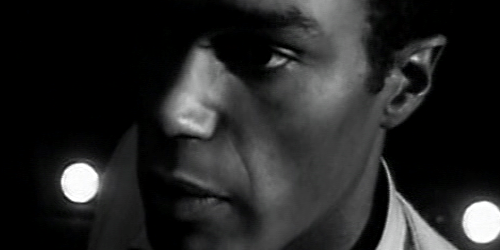
With our assumptions in tatters, all bets are off as Barbra flees to a farmhouse and is joined by Ben (Duane Jones), who doesn’t convince anyone, least of all himself when he shuts the growing horde of undead out (or imprisons them both, more to the point) and says “it’s alright”.

Night of the Living Dead

Not for nothing has Steiner’s Karloff impression become a defining moment in horror cinema. Romero, deciding that no-one else was going to do it passed the baton to himself by choosing to subvert an old icon, as if to say: “That’s then, this is now and you ain’t seen nothin’ yet.”

Tellingly, it’s the one amusing moment in a film that, like its implacable army of the undead, relentlessly progresses towards a soul-shattering conclusion.