Review – Escape Plan

The godfathers of testosterone-fuelled old school action cinema are back to show the young pretenders how they did it in the 80s in this infectiously entertaining slice of nonsense.

Although nowhere near Sly and Arnie's best, Escape Plan does enough to satisfy anyone rubbing their hands with nostalgic anticipation at the prospect of finally seeing these two heavyweights of action cinema let rip together

Although nowhere near Sly and Arnie’s best, Escape Plan does enough to satisfy anyone rubbing their hands with nostalgic anticipation at the prospect of finally seeing these two heavyweights of action cinema let rip together

It may not carry the same dramatic heft as the famous scene in Heat when Robert De Niro and Al Pacino finally appeared together, but watching the iconic Arnold Schwarzenegger and Sylvester Stallone trading one-liners and wielding big guns has its own guilty pleasure.
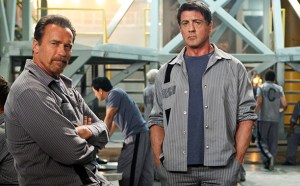
Emil Rottmayer (Arnold Schwarzenegger) and Ray Breslin (Sylvester Stallone) realise it's not the 1980s anymore in Escape Plan

Emil Rottmayer (Arnold Schwarzenegger) and Ray Breslin (Sylvester Stallone) realise it’s not the 1980s anymore in Escape Plan

This may not be the first movie where they’ve shared screen time – that came in truncated form in The Expendables and its forgettable sequel – but Escape Plan has the bragging rights of being the first time these two former enemies-turned best buddies have shared top billing.

Stallone plays Ray Breslin, a security expert who tests the reliability of prisons by breaking out of them. He’s offered a challenge (and a big payday) he can’t resist; namely to escape from a top-secret, ultra-secure jail called ‘The Tomb’. His partners Abigail (Amy Ryan) and tech wiz Hush (Curtis ’50 Cent’ Jackson) don’t like it, but his business partner Lester Clark (Vincent D’Onofrio) can already smell the cash and urges Ray to accept.
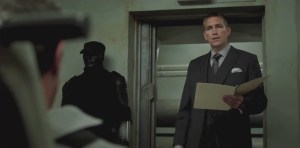
Jim Caviezel couldn't be bothered learning his lines as Warden Willard Hobbs in Escape Plan

Jim Caviezel couldn’t be bothered learning his lines as Warden Willard Hobbs in Escape Plan

No sooner is Ray inside, though, he realises he’s been set up and so must recruit fellow inmate Emil Rottmayer (Schwarzenegger) to devise a cunning escape plan to break out of The Tomb. However, he must not only contend with the sadistic guards, who look like extras from Westworld, but also evil warden Willard Hobbs (Jim Caviezel).
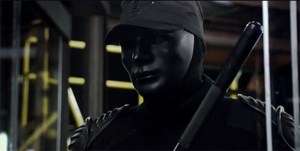
One of the Westworld-style prison guards in Escape Plan

One of the Westworld-style prison guards in Escape Plan

Anyone (myself included) who grew up watching Sly and Arnie taking down whole armies single-handed or saving the world from unstoppable robots were generally more interested in the hilariously over-the-top violence and corny one-liners than unimportant things like ‘acting’ or ‘characterisation’.

Inmates Ray Breslin (Sylvester Stallone) and Emil Rottmayer (Arnold Schwarzenegger) get acquainted in Escape Plan

Inmates Ray Breslin (Sylvester Stallone) and Emil Rottmayer (Arnold Schwarzenegger) get acquainted in Escape Plan

That fine tradition has been maintained in Escape Plan, which knows its audience and doesn’t try to do anything more sophisticated than serve up a healthy portion of buddy movie clichés and geriaction set pieces.

Ray Breslin (Sylvester Stallone) brings the pain in Escape Plan

Ray Breslin (Sylvester Stallone) brings the pain in Escape Plan

That’s certainly not to say it’s a bad film – far from it. Mikael Håfström may not be the most inspiring of directors (his style can probably be best described as ‘functional’), but he’s smart enough to give moviegoers what they want, namely plenty of Sly and Arnie.

Schwarzenegger in particular looks like he’s having a ball and does a nice job wringing the laughs out of the script. If The Expendables franchise has proved anything, it’s that Stallone works better these days playing opposite someone instead of trying to carry a film by himself and looks relaxed and energised as the straight man opposite Arnie.

Vincent D'Onofrio channeling Marlon Brando (physically anyway) as Lester Clark in Escape Plan

Vincent D’Onofrio channeling Marlon Brando (physically anyway) as Lester Clark in Escape Plan

Both Ryan and Sam Neill, who plays Dr Emil Kyrie, look like they’re waiting for their pay cheque to arrive, while D’Onofrio seems to be going for Touch Of Evil-era Orson Welles in his white hat and expanding waistline. Meanwhile, Jackson can’t act if his rap career depended on it; Britain’s Vinnie Jones goes through his usual repertoire of angry faces as head screw Drake; and Caviezel provides a seriously hammy turn as Hobbs, a counterpoint to his role as Number 6 in the 2009 TV miniseries The Prisoner based on the classic 1960s show.

Hobbs’ chief hobby, aside from tormenting the inmates, is trapping butterflies in clear  boxes, which is as deep and symbolic as it gets.

Although nowhere near Sly and Arnie’s best, Escape Plan does enough to satisfy anyone rubbing their hands with nostalgic anticipation at the prospect of finally seeing these two heavyweights of action cinema let rip together.

Review – Captain Phillips

Jack Sparrow is thankfully nowhere to be seen in this buttock-clenching high seas hijack thriller from shaky-cam supremo Paul Greengrass.

Captain Phillips lands so many gut punches you'll be left an exhausted, staggering mess come the end of a mesmerising masterclass in white-knuckle filmmaking.

Captain Phillips lands so many gut punches you’ll be left an exhausted, staggering mess come the end of a mesmerising masterclass in white-knuckle filmmaking.

No longer the preserve of men with ridiculous beards, pet parrots and a penchant for rum, piracy nevertheless remains a very clear and present danger to seafarers. And whil globalisation may have helped many, for those left behind, such as the Somali fishermen in Captain Phillips, poverty can lead to desperate measures.

One of Greengrass’ many strengths is that he understands there are two sides to every story; a trait he honed as first a journalist and then a documentary filmmaker. It’s this skill, assisted by Barry Ackroyd’s visceral cinematography and Billy Ray’s largely excellent script (based on the book A Captain’s Duty by Richard ‘Captain’ Phillips), that sets this absorbing film apart from the likes of Ridley Scott’s Black Hawk Down.

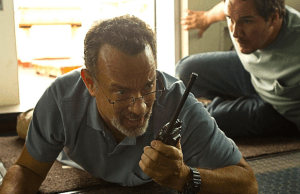
Pirates make their move on the American container vessel commanded by Captain Phillips (Tom Hanks)

Pirates make their move on the American container vessel commanded by Captain Phillips (Tom Hanks)

Merchant Marine Captain Phillips (Tom Hanks) is tasked with getting American container vessel Maersk Alabama from Yemen to Mombasa through the Horn of Africa, a stretch of water synonymous with piracy. Not long into their voyage the Alabama is targeted by a band of Somali bandits, led by Abduwali Muse (Barkhad Abdi), who manage to get aboard and take command of the boat by force. As Greengrass turns the screw ever tighter, it becomes clear both Phillips and Muse are way out of their depth and at the mercy of forces beyond their control.

The pirates in search of loot in Captain Phillips

The pirates in search of loot in Captain Phillips

Structurally, Captain Phillips bears a close similarity to Greengrass’ remarkable 9/11 film United 93 – both concern a real life hijacking that takes on geopolitical ramifications and ratchet up a claustrophobic dread. He has that rare ability to wring every last drop of tension and drama from a script and here revels in locking the door behind you, throwing away the key and watching your anxiety build.

"I'm the captain now..." - Richard Phillips (Tom Hanks) is confronted by Somali fisherman turned pirate Abduwali Muse (Barkhad Abdi) in Captain Phillips

“I’m the captain now…” – Richard Phillips (Tom Hanks) is confronted by Somali fisherman turned pirate Abduwali Muse (Barkhad Abdi) in Captain Phillips

Although from very different parts of the world, Phillips and Muse are not so different really. Both are doing what they can to make ends meet and find themselves embroiled in a “real world situation” they soon cannot escape from.  Greengrass is at pains not to paint the hijackers as ‘villains’. Muse and his men are only doing what they’re doing to satisfy the demands of a local warlord; they know it’s foolhardy and potentially deadly, but desperation has forced their hand.

The lifeboat that sets up the film's second half in Captain Phillips

The lifeboat that sets up the film’s second half in Captain Phillips

This reaches home most poignantly when, challenged by Phillips that “there’s gotta be something other than kidnapping people”, a fateful Muse responds resignedly: “Maybe in America.”

Desperate times for Richard Phillips (Tom Hanks) in Captain Phillips

Desperate times for Richard Phillips (Tom Hanks) in Captain Phillips

Captain Phillips isn’t perfect; the drop in pace in the middle section feels more pronounced following the heart-stopping opening act, while Muse’s makeshift band of pirates are a little too stereotypical (the ultra-agressive one, the naive youngster). But it’s by spending time getting to know these men that gives the final act its dramatic and emotive weight. To that end, the film resembles the little-seen Brazilian documentary Bus 174, which tells the tragic story of a bungled robbery that turns into a hostage crisis.

Abdi, in his film debut, gives an astonishing performance, at turns frightening, frightened and all-too-human. His first encounter with Phillips is brilliantly acted and chilling to watch (no doubt given a greater impact by the fact Greengrass kept Abdi and Hanks apart until the day the scene was filmed). But despite holding all the cards at that moment, when Muse says “I’m the captain now”, you’re unsure who he’s trying to convince more, Phillips or himself.

The screw turns ever tighter in Captain Phillips

The screw turns ever tighter in Captain Phillips

In what could well be the performance of his career, Hanks is superb. Hanks is this generation’s James Stewart, an everyman who’s just as at home playing an all-American astronaut in Apollo 13 or a mob enforcer in Road To Perdition. Phillips feels like the role he was born to play and allows Hanks to stretch himself to breaking point, most notably when Phillips does indeed break down in what is undoubtedly one of the scenes of the year.

Captain Phillips lands so many gut punches you’ll be left an exhausted, staggering mess come the end of a mesmerising masterclass in white-knuckle filmmaking.

Review – The Fifth Estate

If ever there was a film that tried to have its cake and eat it, it’s this Bill Condon-directed thriller that attempts to pull the curtain back on WikiLeaks and its enigmatic founder Julian Assange.

The Fifth Estate The Fifth EstateIn promoting The Fifth Estate, two separate posters have been produced featuring a portrait of Benedict Cumberbatch’s Assange, one with the word ‘hero’ on it and on the other the word ‘traitor’ – a piece of marketing that inadvertently speaks to the film’s central problem.

Most of us have an opinion on how good or bad for the world WikiLeaks has been, but in trying so earnestly to appear fair and balanced, Condon has ended up sucking the dramatic life out of the film.

Condon presumably had ambitions for this to be All The President’s Men for the internet age, but The Fifth Estate actually feels like a digital cousin of The Social Network in its depiction of a bromance being poisoned by the monster that brought them together.

Traitors or heroes? You decide in The Fifth Estate

Traitors or heroes? You decide in The Fifth Estate

The Fifth Estate itself is the moniker given to the rise of hacktivism, a more radical form of traditional journalism (the fourth estate), and the film underlines this by charting the history of news communication in the title sequence, from the invention of writing to the birth of the net. The fourth and fifth estates are uneasy bedfellows, however, and the movie is at its best when laying bare the ethical differences between Assange and the more established news organisations over protecting privacy.

One of the visual devices used by director Bill Condon to get across the tech stuff in The Fifth Estate

One of the visual devices used by director Bill Condon to get across the tech stuff in The Fifth Estate

The film centres on the unprecedented coalition The Guardian, Germany’s Der Spiegel and The New York Times formed with WikiLeaks in 2010 to publish the biggest leak of information in history. It was a mammoth story that sent shock waves throughout the world, not least of which in America where the thousands of classified documents had originated.

While the papers followed traditional means of journalism by redacting names in order to protect their identity, Assange pushed ahead with publishing the documents in their unexpurgated form and in so doing plunged the final nail in the coffin of his partnership with Daniel Domscheit-Berg, on whose book Inside WikiLeaks: My Time with Julian Assange at the World’s Most Dangerous Website the film is partly based.

Julian Assange (Benedict Cumberbatch), Icelandic MP/activist Birgitta Jónsdóttir (Carice van Houten), Daniel Domscheit-Berg (Daniel Brühl) and hacker Marcus (Moritz Bleibtreu) consider what to order online in The Fifth Estate

Julian Assange (Benedict Cumberbatch), Icelandic MP/activist Birgitta Jónsdóttir (Carice van Houten), Daniel Domscheit-Berg (Daniel Brühl) and hacker Marcus (Moritz Bleibtreu) consider what to order online in The Fifth Estate

Condon and screenwriter Josh Singer flash back to Domscheit-Berg’s first encounter with Assange, their burgeoning friendship and numerous successes in bringing corporations to heel. But as WikiLeaks grows more influential, their professional relationship and personal kinship slowly erodes over just how far they should go in the name of transparency.

Benedict Cumberbatch gives an uncanny portrayal of WikiLeaks founder Julian Assange in The Fifth Estate

Benedict Cumberbatch gives an uncanny portrayal of WikiLeaks founder Julian Assange in The Fifth Estate

There’s a fascinating story to be told here of how the beauty of genius can turn ugly when tainted by hubris and paranoia, but The Fifth Estate is too afraid to get off the fence to really give the subject the treatment it deserves. Assange has very publicly denounced the film as Hollywood propaganda (he similarly tore into Alex Gibney’s acclaimed documentary We Steal Secrets: The Story Of WikiLeaks), although he’d be better served criticising its narrative failings.

Senior US Government officers Sarah Shaw (Laura Linney) and James Boswell (Stanley Tucci) discuss the fallout of the WikiLeaks leaks in The Fifth Estate

Senior US Government officers Sarah Shaw (Laura Linney) and James Boswell (Stanley Tucci) discuss the fallout of the WikiLeaks leaks in The Fifth Estate

The film has its moments, such as when Domscheit-Berg states that WikiLeaks doesn’t edit because “editing is bias”, before Assange slaps the headline ‘Collateral Murder’ over video footage it’s received of American forces gunning down unarmed civilians in Iraq. However, the film essentially hangs itself by its own petard by following genre conventions and using serious dramatic licence to illustrate a story supposedly about the ‘truth’.

In trying so earnestly to appear fair and balanced, Condon has ended up sucking the dramatic life out of The Fifth Estate.

In trying so earnestly to appear fair and balanced, Condon has ended up sucking the dramatic life out of The Fifth Estate.

Tech-movies have often struggled to avoid looking a bit naff when trying to get across the ‘science bit’ and this doesn’t fare any better. Condon falls back on using flashy camerawork and gimmicky effects to explain what Assange and co are up to, but it ends up getting in the way and actually muddies the narrative.

The Fifth Estate‘s biggest strength is its superb cast, led by Cumberbatch’s uncanny portrayal of Assange. It’s doubtful anyone knows the real Julian Assange, but Cumberbatch certainly gets the mannerisms spot on, whether it’s the Australian accent or twitchy body language, and seems to capture that unique freedom fighter charisma he exudes.

Daniel Brühl, so good as Formula 1 driver Nikki Lauder in Rush, is impressive as Domscheit-Berg; an insider who slowly turns into an outsider as he and Assange become more estranged. Meanwhile, David Thewlis is as reliable as ever as Guardian reporter Nick Davies, although he seems to be basing his portrayal on movieland journalists instead of real life ones.

Such performances deserve a better film than this. In time, a definitive account of this most 21st Century of tales will undoubtedly emerge; for now we’ll have to make do with this tepid and underwhelming slide show.

Review – Filth

For a supposedly ‘unfilmable’ novel, Jon S. Baird has made a pretty impressive stab at bringing Irvine Welsh’s blackly comic tale of cops, corruption, cocaine to the big screen.

Filth may live up (and down) to its title, but from the gutter comes a darkly funny, uncompromising and uniquely British moviegoing experience that has at its core one of the year's very best performances

Filth may live up (and down) to its title, but from the gutter comes a darkly funny, uncompromising and uniquely British moviegoing experience that has at its core one of the year’s very best performances

This is helped in no small part by James McAvoy, whose powerhouse central performance as bent Detective Bruce Robertson makes Abel Ferrara’s Bad Lieutenant look like Dixon of Dock Green.

Bruce Robertson (James McAvoy) ain't your average copper in Filth

Bruce Robertson (James McAvoy) ain’t your average copper in Filth

Robertson is one of the most memorable characters in Welsh’s arsenal of literary creations, an utterly squalid and repellant human being who’s prepared to back-stab, double-cross and shaft his way to a promotion within Edinburgh’s Lothian constabulary.

The veneer of superiority, cockiness and self-entitlement starts to crack, however, and the self-loathing, insecurity and nihilism that’s always been there creeps to the surface as Robertson implodes in a shitstorm of cocaine, pills and hard liquor.

Watching the Detectives - Ray Lennox (Jamie Bell), Peter Inglis (Emun Elliot), Bruce Robertson (James McAvoy) and Dougie Gillman (Brian McCardie) in Filth

Watching the Detectives – Ray Lennox (Jamie Bell), Peter Inglis (Emun Elliot), Bruce Robertson (James McAvoy) and Dougie Gillman (Brian McCardie) in Filth

On the face of it, Filth sounds as appealing a prospect as spending the day with its central character, but Baird (who also wrote the screenplay) understands there has to more to Robertson than the monster we first see.

Danny Boyle and screenwriter John Hodge overcame a similar challenge when working on Welsh’s Trainspotting by finding the humanity – and humour – within a group of heroin addicts. It’s a tough nut to crack, but McAvoy somehow manages to elicit our sympathy for a character whose litany of truly abhorrent deeds would normally have you rooting for his grisly demise. Using his strikingly expressive eyes, McAvoy show the pain that undercuts the rage and mischievousness, a pain that’s rooted in a tragic back story that gradually reveals itself.

Things ain't looking great for Detective Bruce Robertson (James McAvoy) in Filth

Things ain’t looking great for Detective Bruce Robertson (James McAvoy) in Filth

I’ve never been McAvoy’s biggest fan, thinking him too lightweight an actor for the demands of the characters he’s played in the likes of The Last King Of Scotland and this year’s Welcome To The Punch. However, in what’s by far his best performance to date, he brings a real physicality to the role, supplanting those boyish good looks with a bloated demeanour and scraggly beard.

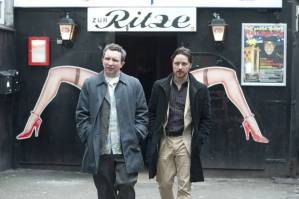
Brits abroad Bladesey (Eddie Marsan) and Bruce Robertson (James McAvoy) in Filth

Brits abroad Bladesey (Eddie Marsan) and Bruce Robertson (James McAvoy) in Filth

Robertson may a nasty piece of work, but most of those around him are far from perfect. His colleagues are mostly either bigoted, homophobic, useless or coke-heads, while others around him paddle in the same moral sewer he dives into. Perhaps the only truly ‘good’ person he knows is his only real friend, Bladesey (Eddie Marsan), although even that’s tainted due to the fact he’s targeting his vampish wife Bunty (Shirley Henderson) with anonymous dirty phone calls.

Both Marsan and Henderson (who also recently played a married couple in the acclaimed UK miniseries Southcliffe) are both as excellent as you’d expect, as are many of the supporting cast, including John Sessions as Robertson’s colourful boss Bob Toal, Gary Lewis as the nice but dim Gus Bain and Jamie Bell as Robertson’s coke-addicted partner Ray Lennox.

Bruce Robertson (James McAvoy) confronts his talking tapeworm (Jim Broadbent) in Filth

Bruce Robertson (James McAvoy) confronts his talking tapeworm (Jim Broadbent) in Filth

Jim Broadbent also gets to have some fun playing a massively over-the-top Australian shrink, the talking manifestation of a tapeworm inside Robertson’s body that’s assisting his mental collapse. The ‘talking tapeworm’ sections of Welsh’s book were always going to be a particularly challenging trick to pull off and, it has to be said, it doesn’t quite work; if for no other reason then it’s not made terribly clear to those who haven’t read the novel what Broadbent’s character is supposed to represent.

In a nice touch, the car Robertson drives (and occasionally sleeps in) features ‘KES’ as part of its number plate, a nod to Ken Loach’s iconic debut film of the same name.

Filth may live up (and down) to its title, but from the gutter comes a darkly funny, uncompromising and uniquely British moviegoing experience that has at its core one of the year’s very best performances.

Review – Prisoners

The mark of Scandinavian crime drama seeps into every gloomy frame of this brutal and nihilistic English language debut from director Denis Villeneuve.

Prisoners may retreat into traditional thriller territory, especially in its final act, but it offers no easy answers and paints a very troubling picture of God-fearing American suburbia

Prisoners may retreat into traditional thriller territory, especially in its final act, but it offers no easy answers and paints a very troubling picture of God-fearing American suburbia

Prisoners opens with carpenter Keller Dover (Hugh Jackman) uttering the Lord’s Prayer before his son (Dylan Minnette) shoots his first deer. It’s a symbolic moment – a violent act performed in God’s name, one in which forgiveness is spoken of but ultimately ignored.

Keller Dover (Hugh Jackman) demands action from Detective Loki (Jake Gyllenhaal) to find his daugher in Prisoners

Keller Dover (Hugh Jackman) demands action from Detective Loki (Jake Gyllenhaal) to find his daugher in Prisoners

Keller is a deeply religious man whose New Testament nature gives way to Old Testament retribution when his young daughter Anna (Erin Gerasimovich) goes missing along with the daughter of his good friend Franklin Birch (Terrence Howard) during a Thanksgiving dinner. Panic and grief give way to murderous vengeance for Keller when the police, led by Detective Loki (Jake Gyllenhaal), are forced to release their chief suspect, the mentally challenged Alex (Paul Dano).

Prime suspect Alex (Paul Dano) is interrogated by Detecive Loki (Jake Gyllenhaal) in Prisoners

Prime suspect Alex (Paul Dano) is interrogated by Detecive Loki (Jake Gyllenhaal) in Prisoners

Loki implores Keller and his wife Grace, who’s become virtually catatonic through grief, to let him do his job, which involves methodically following whatever leads the case throws up. But blinded by rage and convinced that Alex knows where the girls are being held, an obsessive Keller takes it upon himself to act as judge, jury and, if necessary, executioner to find the ‘truth’, sucking Franklin and his wife Nancy (Viola Davis) into his increasingly disturbing descent.

Keller Dover takes the law into his own hands in Prisoners

Keller Dover takes the law into his own hands in Prisoners

Cinematographer par excellence Roger Deakins infuses Prisoners with an almost suffocating dread – woods haven’t looked this spine-tingling since The Blair Witch Project. Not only does the film coldly nod in the direction of Scandi-drama, it also owes a lot to the slate-grey creepiness of David Fincher (in particular Seven and Zodiac), whose most recent film is, of course, his remake of The Girl With The Dragon Tattoo. Another Scandi-connection can be found in the atmospheric soundtrack provided by Icelandic composer Jóhann Jóhannsson.

As well as the obvious religious overtones, it’s also easy to find a 9/11 allegory in Prisoners – a wounded America (religious everyman Keller) goes in search of revenge against its quarry (Alex) and is prepared to sacrifice its moral superiority to quench its thirst for vengeance.

Franklin and Nancy Birch (Terrence Howard and Viola Davis) are dragged into Keller Dover's quest for vengeance in Prisoners

Franklin and Nancy Birch (Terrence Howard and Viola Davis) are dragged into Keller Dover’s quest for vengeance in Prisoners

Aaron Guzikowski’s script asks some troubling questions, most notably, to what lengths would you as a parent go when your worst nightmares are realised. Given the right material, Jackman can really act and shows he’s far more than the Wolverine with a raw and powerful performance as Keller. Jackman’s natural physicality lends a ticking time bomb nature to his character, someone who you believe will do anything to get his daughter back.

Aunt Holly (Melissa Leo) protects Alex (Paul Dano) in Prisoners

Aunt Holly (Melissa Leo) protects Alex (Paul Dano) in Prisoners

Gyllenhaal, who played a political cartoonist dragged into tracking down a serial killer in Zodiac, gives Loki (another Scandinavian connection) a stoical implacability that nicely mirrors Keller’s bull-in-a-china-shop aggressiveness. His pronounced blinking suggests an appalled bewilderment at what his character is investigating and contributes to what is the latest in a line of fine performances from Gyllenhaal.

Detective Loki (Jake Gyllenhaal) on the case in Prisoners

Detective Loki (Jake Gyllenhaal) on the case in Prisoners

The heavyweight supporting cast are uniformly excellent. Dano, normally a little too over-the-top, dials it right down as the tragic Alex; Howard and Davis are entirely believable as a couple who suddenly find themselves on the wrong side of the moral line and don’t know what to do; while Melissa Leo is reliably great as Alex’s impassive Aunt Holly.

It’s not until you watch the film that you realise just how rare a commodity it is in American studio cinema these days. Prisoners may retreat into traditional thriller territory, especially in its final act, but it offers no easy answers and paints a very troubling picture of God-fearing American suburbia.