Review – American Hustle

A story about people doing anything to survive may not sound like a laugh riot, but David O. Russell’s wild ride through the hair strewn world of 70s era grifters is irresistibly entertaining.
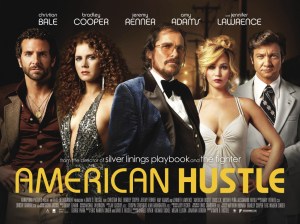
Featuring performances as crazy as the film is chaotic, American Hustle is a feast for the senses and as much fun as you'll have in front of the big screen this year

Featuring performances as crazy as the film is chaotic, American Hustle is a feast for the senses and as much fun as you’ll have in front of the big screen this year

Russell has a thing for dysfunctional families, from boxer Mickey Ward’s (Mark Wahlberg) mouthy clan in The Fighter to the parents of Pat (Bradley Cooper) in Silver Linings Playbook, who are almost as nuts as he is.

In American Hustle, Russell cranks it up another notch by having Christian Bale’s con artist Irving Rosenfeld married to the deeply unhappy Rosalyn (Jennifer Lawrence), while also having a mistress in the form of ex-stripper Sydney Prosser (Amy Adams), who becomes Irv’s partner-in-crime by posing as an English aristocrat in order to better sell his money-making scams.
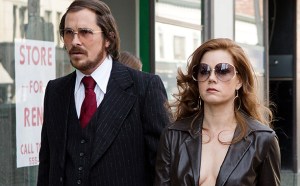
Irving Rosenfeld (Christian Bale) and partner-in-crime/girlfriend Sydney Prosser (Amy Adams) in American Hustle

Irving Rosenfeld (Christian Bale) and partner-in-crime/girlfriend Sydney Prosser (Amy Adams) in American Hustle

When they’re trapped by FBI agent Richie Di Maso (Cooper) they’re forced to help set up an elaborate sting operation (based loosely on the FBI’s Abscam operation) involving a fake Sheikh that at first targets popular New Jersey politician Carmine Polito (Jeremy Renner) before becoming something much bigger, and far more dangerous.

Russell’s affinity for families extends to the repertoire of actors he has formed during his career, with The Fighter‘s Bale and Adams and Silver Linings Playbook‘s Cooper and Lawrence returning, all be it in very different guises.
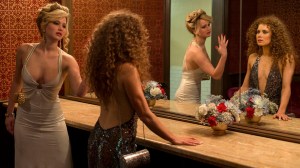
American HustleIn another Machinist-esque body transformation, Bale’s rotund Irv Rosenfeld (he gained 40 lbs for the role) is arguably his most complete performance to date. The “elaborate” comb over that we see Irv methodically setting in place at the start of the film thanks to plenty of hair glue and spray speaks to the polished act he puts on for the world that’s always a gust of wind away from falling apart.
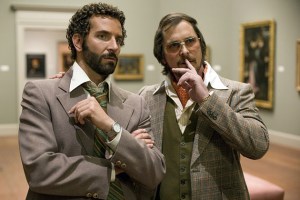
FBI agent Richie Di Maso (Bradley Cooper) and con man Irving Rosenfeld (Christian Bale) in American Hustle

FBI agent Richie Di Maso (Bradley Cooper) and con man Irving Rosenfeld (Christian Bale) in American Hustle

Richie’s tight, manicured perm equally sends out a message of control that is at odds with the character once things start to get heavy. Cooper does his best work with Russell and brings plenty of entertaining tics to the table to make Richie a memorable character.

Russell has spoken publicly of his interest in strong female roles and the work of both Adams and Lawrence is outstanding. Adams especially is a powerhouse and oozes self-confidence and self-loathing in equal measure. Sydney is the smartest person in the room and it’s easy to understand why both Irv and Richie are so drawn to her.

A fantastic ensemble is the key to the success of American Hustle

A fantastic ensemble is the key to the success of American Hustle

Renner, who also sports a hairdo that can best be described as “very 70s”, holds his own as a politician doing the wrong thing for the right reasons, while a brief cameo from an uncredited Robert De Niro is one of the film’s many highlights.

American Hustle is very much the bastard offspring of Martin Scorsese and Paul Thomas Anderson, while Steven Soderbergh could very well be its godfather (pun not intended). It’s impossible to watch the kinetic camerawork and quick zooms and not be reminded of Goodfellas and Casino, while the beautiful squalor of Boogie Nights is also evoked. Likewise, the caper element is very reminiscent of Ocean’s Eleven, all be it without the smugness.

Irving Rosenfeld (Christian Bale) kind-of admires his gut in American Hustle

Irving Rosenfeld (Christian Bale) kind-of admires his gut in American Hustle

At 138 minutes, the film feels too long and could have done with a 20-minute trim to make it truly great instead of very good. On the flip side, we’re treated to more of Russell’s razor-sharp dialogue and amusing vignettes, not least of which the whole “science oven” (aka microwave) sequence and Lawrence’s OTT stab at Paul McCartney’s Live And Let Die in her rubber kitchen gloves.

Featuring performances as crazy as the film is chaotic, American Hustle is a feast for the senses and as much fun as you’ll have in front of the big screen this year.

Sound And Vision – The Best Uses Of Songs In Movies

Since its birth more than a century ago, cinema has used music to heighten and manipulate our emotions.

Before the invention of sound, everything from a simple piano to a full-blown orchestra was employed by silent movies to make us smile, tug the heartstrings or set the pulse racing.

This kinship between sound and vision has continued to this day and, when done right, can leave a lasting impression and elevate a film in the eyes and ears of the viewer.

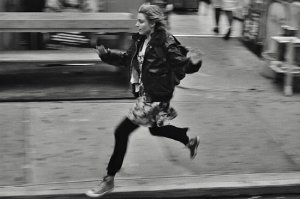
The thought struck me again during a recent viewing of Noah Baumbach’s Frances Ha, specifically the scene in which Greta Gerwig’s titular protagonist dances giddily through the streets of New York as David Bowie’s Modern Love plays over the soundtrack. It’s a joyful confluence of moving picture and an 80’s classic that, more than anything else in the film, has stayed with me.

There are far too many memorable examples of movie scenes that remain stuck in my head because of the way the director has used a song to enhance the action on screen. Here are just a handful of my picks – as ever I’d love to know:

What are your favourite movie scenes set to a great song?

Goodfellas (1990)
Layla (Piano Exit) by Derek And The Dominos

Martin Scorsese has long been a master of the soundtrack, none more so than in his 1990 masterpiece Goodfellas. The film is chock full of classic music overlayed over striking visuals; however, the scene that always sticks in my mind is when dead bodies start showing up across the city, be they in a car, a refuse truck or the back of a meat lorry. Regarded as one of rock ‘n’ roll’s most definitive love songs, Scorsese’s inspired use of Derek And The Dominos’ Layla (Piano Exit) instead gives the scene an elegiac tone as we know this marks the beginning of the end for wiseguys Henry Hill (Ray Liotta), Jimmy Conway (Robert De Niro) and Tommy DeVito (Joe Pesci).

Easy Rider (1969)
Born To Be Wild by Steppenwolf

And low, the New Hollywood was born. Although released a year earlier, Steppenwolf’s Born To Be Wild will forever be joined at the hip with Easy Rider, such is the impact the film had. It’s impossible to think of another song that could be used in its place as Peter Fonda and Dennis Hopper’s drug-smuggling bikers take to the road to get to Mardi Gras in New Orleans. Just as Fonda’s decision to dispose of his watch marked a turning point in cinema, that iconic opening drum beat and insanely catchy guitar riff was the perfect soundtrack.

Reservoir Dogs (1992)
Stuck In The Middle With You by Stealers Wheel

Another director synonymous for using the ‘needle drop’ is Quentin Tarantino; so much so in fact that for his debut feature Reservoir Dogs, the fictional K-Billy’s Super Sounds of the Seventies is as integral a character in the film as Mr White et al. Call it unfortunate timing for poor old Officer Marvin Nash (Kirk Baltz), but when Stealers Wheel’s appropriately titled Stuck In The Middle With You takes to the airwaves, it provides the psychopathic Mr Blonde (Michael Madsen) with the musical spur he needs to perform some unwanted ear surgery. There are numerous other great songs used to superb effect by Tarantino throughout his career, but this remains the most potent example.

Boogie Nights (1997)
Jessie’s Girl by Rick Springfield

Once the porn star’s porn star, Dirk Diggler’s (Mark Wahlberg) desperate collapse into drug addiction reaches its sad nadir in this mesmerising scene, one of the finest of Paul Thomas Anderson’s astonishing career. Dirk, Reed Rothchild (John C Reilly) and their pal Todd’s (Thomas Jane) misguided attempt to sell drug dealer Rahad Jackson (Alfred Molina) baking soda instead of cocaine predictably goes awry. As Jackson dances to Rick Springfield’s uplifting Jessie’s Girl, the folly of their plan gradually dawns on an increasingly jittery Dirk and the unbearable tension builds with every firecracker dropped by Jackson’s mute friend. Anyone who says Wahlberg can’t act just needs to watch how he gets lost in the song before strung-out paranoia and self-loathing seeps into his eyes – it’s a masterclass in subtle character shifts. Molina, meanwhile, is spot-on as always with a genuinely unnerving performance as the loathsome dealer.

Trainspotting (1996)
Born Slippy.NUX by Underworld

Danny Boyle is among a rare breed of directors who understand how and where to use dance music in their films without it sounding naff. He had demonstrated his keen understanding of the form by inventively switching between slow motion and speeded up footage to the penetrating sound of Leftfield’s title track in his debut film Shallow Grave. In his adaptation of Irvine Welsh’s cult novel, Boyle laid a little-known b-side by the then equally little-known Underworld over the film’s closing scene. Played quietly in the background at first, the tune slowly builds to a pulse-quickening crescendo as Ewan McGregor’s Renton steals off with his friends’ loot and vows to choose life over heroin.

The Big Lebowski (1998)
Just Dropped In (To See What Condition My Condition Was In) by Kenny Rogers & The First Edition

It’s easy to forget just how integral music is to the Coens’ oeuvre. From O Brother, Where Art Thou? to their latest Inside Llewyn Davis, their use of music is as carefully thought out as their storyboarded visuals. Arguably their most memorable needle-drop scene is the surreal ‘Gutterballs’ dream sequence from The Big Lebowski. Set to the psychedelic Just Dropped In (To See What Condition My Condition Was In), a wide-eyed Dude’s (Jeff Bridges) love of bowling is indulged as he rents a pair of shoes from Saddam Hussein, teaches Julianne Moore’s Nordic-clad Maude Lebowski how to bowl and then becomes the ball as he ‘rolls’ through the spread legs of dancing girls in swimsuits. The Dude does, indeed, abide.

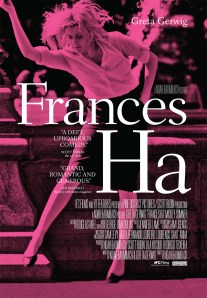
Review – Frances Ha

One shouldn’t judge a book by its cover – as Noah Baumbach’s charming tale about arrested development on the too-cool-for-school streets of New York City attests.

Frances Ha can be seen as that last hurrah before the inescapable call of adulthood becomes too loud to ignore. Don't pre-judge it; just go with the flow like Frances and give yourself in to its charms

Frances Ha can be seen as that last hurrah before the inescapable call of adulthood becomes too loud to ignore. Don’t pre-judge it; just go with the flow like Frances and give yourself in to its charms

More respected than cherished, Baumbach has made a habit of shining a harsh light on his liberal WASP-ish characters, none more so than in his last three pictures The Squid And The Whale (2005), Margot At The Wedding (2007) and Greenberg (2010), wherein Ben Stiller’s titular misanthrope stumbles along a fine line between amusing and annoying.

For his latest film, Baumbach softens this harsh gaze by switching his focus away from characters crippled by regret to a protagonist who, in her own words, isn’t “a real person yet”.

Frances (Greta Gerwig) and best friend Sophie (Mickey Sumner) in Frances Ha

Frances (Greta Gerwig) and best friend Sophie (Mickey Sumner) in Frances Ha

That character is played by Greta Gerwig, whose turn as Violet Wister in Whit Stilman’s ill-judged Damsels In Distress was so irritating as to colour my judgement of the actress. In spite of the near-universal praise lavished on Frances Ha, I consequently approached the film with apprehension.

However, just as Sally Hawkins’ performance as the relentlessly upbeat Poppy in Mike Leigh’s Happy-Go-Lucky won me over in spite of myself, so to does Gerwig as Frances, a struggling dancer in her late twenties who lives day-to-day with her best friend Sophie (Mickey Sumner) in Brooklyn.

Frances' one-time flatmates Lev (Adam Driver) and Benji (Michael Zegen) in Frances Ha

Frances’ one-time flatmates Lev (Adam Driver) and Benji (Michael Zegen) in Frances Ha

Frances compares their relationship to that of “a lesbian couple that doesn’t have sex anymore”, but when Sophie is asked to move into the perfect apartment with her boyfriend the bubble bursts. Frances has a habit of falling on her feet, though, and the film follows her as she moves between apartments, her parent’s home in Sacramento and a spontaneous sojourn in Paris.

Those with a glass-half-empty disposition may find themselves shifting uneasily in their seats during the opening montage which sees Frances and Sophie kookily buzzing around NYC. However, spend some time with Frances and it becomes impossible not to warm to her heart-on-sleeve brio despite regular bouts of self-absorption.

There's more than a hint of François Truffaut in Frances Ha

There’s more than a hint of François Truffaut in Frances Ha

Gerwig, who co-wrote the script with Baumbach, gives the best performance of her career and infuses Frances with an awkwardness and eagerness-to-please that’s set against bursts of shameless exuberance. Her dance through the New York streets to David Bowie’s Modern Love is as joyous a moment of cinema as you’ll see all year. It’s one of several inspired marriages of sound and vision (to borrow another Bowie song title); another being the use of Hot Chocolate’s Every 1’s A Winner over Frances’ impromptu trip to Paris.

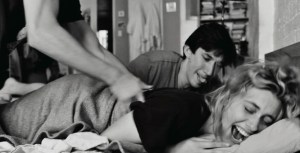
Sumner does a fine job as a more toned-down version of Frances; someone who is facing her own doubts about moving on. Sophie’s nostalgia for a life-less-complicated is matched by hipsters Lev (Girls‘ Adam Driver) and Benji (Michael Zegen), who temporarily share their apartment with Frances and find themselves sucked in to her ever-changing life.

Frances (Great Gerwig) hangs out with Lev (Adam Driver) in Frances Ha

Frances (Great Gerwig) hangs out with Lev (Adam Driver) in Frances Ha

Benji shares a particular bond with Frances over their penchant for self-contradiction. By way of example, Benji proudly points to a photo and says: “That’s me with Jay Leno.” When Frances retorts “he’s such a dick”, Benji replies: “I know, but don’t you just love him?”

The film’s stunning black and white photography inevitably brings to mind that other ode to New York, New York; Woody Allen’s Manhattan, although the film’s willful abandon also very consciously nods in the direction of the French New Wave, in particular François Truffaut.

Frances Ha can be seen as that last hurrah before the inescapable call of adulthood becomes too loud to ignore. Don’t pre-judge it; just go with the flow like Frances and give yourself in to its charms.

Four Frames – Trading Places (1983)

This is my latest contribution to The Big Picture, the internationally-recognised magazine and website that offers an intelligent take on cinema, focussing on how film affects our lives. This piece is part of the Four Frames section, wherein the importance of four significant shots are discussed, in this case from John Landis’ comedy classic Trading Places.

It’s a pity it took the global financial crisis for politicians to wake up to the lessons espoused in Trading Places.

The legacy of John Landis’ 1983 classic screwball comedy is such that it inspired the so-called ‘Eddie Murphy rule’ contained within Obama’s 2010 Wall Street reform to stamp out the sort of shady insider trading depicted in the movie.

Trading Places

Sadly, it’s pretty much the only positive thing Murphy’s name has been attached to for many years, although back in the early 80s both he and fellow Saturday Night Live alumnus Dan Ackroyd were at the top of their game.

Murphy is superb as wise-cracking street hustler Billy Ray Valentine, who is lifted out of the gutter by super-rich schemers Randolph (Ralph Bellamy) and Mortimer Duke (Don Ameche) and unwittingly trades places with pampered commodities executive Louis Winthorpe III (a career-best turn by Ackroyd) to satisfy a bet over nature vs nurture.

Trading Places

Winthorpe affirms Randolph’s suspicion that he would “take to crime like a fish to water” if stripped of everything he holds dear by infiltrating the Duke’s Christmas party dressed as Santa Claus to frame Valentine, whom he holds responsible for his plight. When that backfires he’s left with nothing but a whisky bottle and a gun.

Landis earlier emphasises just how far Winthorpe has fallen (and makes a sly observation of how the poor might as well not exist in the eyes of the super-rich) by having him stand outside a restaurant getting pissed on by rain and dolefully looking in as Valentine hits it off at a business dinner.

Trading Places

Valentine, meanwhile, sees the Duke’s true colours when he overhears them gleefully discussing their “scientific experiment” and their illegal plans to corner the frozen concentrated orange juice market.

Perceiving that “the best way you hurt rich people is by turning them into poor people”, Valentine and Winthorpe team up to hit the Duke’s where it hurts.

Trading Places

Not for nothing is the film set in Philadelphia – the birthplace of the US Constitution where the idealism of equality and opportunity for all is thrown into stark relief by the opening credits which cut between the lowly 99% and super-rich as the city starts another day.

Just as in the comedies of Preston Sturges and Frank Capra, Trading Places has an old fashioned charm and a resonant political and societal message etched into each frame.

It also just goes to show how little has changed when a 30-year-old satirical comedy lampooning the unfettered capitalism and rampant hubris of Reagan-era big business feels as timely now as it did then.

Ho Ho No – Christmas Turkies

Christmas is the season of goodwill to all men (and women). However, that generosity of spirit need not – and should not – extend to the slew of bad yuletide movies that make a plate of soggy Brussels sprouts look appealing.

For every Elf, It’s A Wonderful Life or Scrooged there are countless turkies seeking to cash-in on our festive cheer that make you want to shout “bah humbug” at their sheer cynicism and ineptitude.

Below are a selection of just some of the many risible Christmas movies I’ve unfortunately come across over the years. Consider this list a warning – don’t ruin your well-earned festive goodwill by subjecting yourselves to them. That being said, I’d love to know:

What are the worst Christmas movies you’ve seen?

Santa With Muscles (1996)

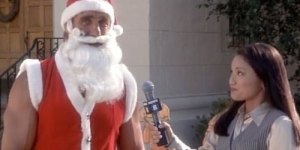
Santa With Muscles

In an all-too-familiar example of commerce winning over common sense, there was a period back in the 1990s when Terry Gene Bollea, otherwise known by his ring name Hulk Hogan, was something approaching a movie star. The fact he coudn’t act seemed unimportant. Put it down to collective insanity on the part of all involved (including Mila Kunis in only her second film), but Santa With Muscles must figure as one of the most far-out excursions into Christmas movie-making ever seen. Hogan stretches himself by playing a professional wrestler who believes he’s Santa Claus following a bang to noggin and tries to save an orphanage from an evil scientist. I’ll leave it there.

Four Christmases (2008)

Four Christmases

The truly uninspired (and poorly photoshopped) poster for Four Christmases of Vince Vaughn and Reese Witherspoon standing with their backs to each other should tell you all you need to know about this car crash of a film. Christmas should be a happy time of year, but Vaughn and Withspoon turn this tale of a couple visiting their divorced parents’ homes on Christmas Day into one of the most joyless experiences you can imagine. Worse still, the film co-stars Jon Favreau, which only serves to make you want to go back and watch Swingers instead.

Jack Frost (1998)

Jack Frost

No, not the 1964 Russian film (or the 1997 cult horror comedy), but rather the frankly bizarre fantasy flick starring Michael Keaton as the titular Jack Frost, who dies in a car accident and returns to life as a snowman. I’ll repeat that: returns to life AS A SNOWMAN and gets a second chance “to be the world’s coolest dad” to his young son. The classic animated short film The Snowman showed how magically something akin to this can be done; however, Jack Frost simply tugs the heartstrings (and trips the mind) and hopes that’ll be enough for audiences to ignore just what a pile of yellow snow it is.

Surviving Christmas (2004)

Surviving Christmas

Ben Affleck is now enjoying the fruits of a successful directorial and acting career, but there was a time not so long ago when all he touched turned to poop. Alongside such box office bombs as Gigli and his other Christmas-set movie Reindeer Games, Surviving Christmas came and went from cinemas quicker than you can say “Santa”. It’s an appropriate title, as watching Affleck as an annoying millionaire who pays a family to spend the festive season with him feels like an exercise in survival itself. What’s even more tragic is that it also stars the late James Gandolfini.

Fred Claus (2007)

Fred Claus

Vince Vaughn has the dishonour of appearing twice on this list, such are his crimes against Christmas cinema. Here he plays Fred, the elder and less well known brother of Santa Claus (Paul Giamatti), who is forced to make toys at Christmas HQ after being bailed out of jail by his younger sibling – with unamusing results. In spite of a great cast (Giamatti, Miranda Richardson, Kevin Spacey, Kathy Bates, Rachel Weisz), the film will leave you as cold as its North Pole setting. Now please Mr Vaughn: stop making Christmas movies. Think of the kids.