Review – Godzilla

The King of the Monsters may have rediscovered his rrrrroar after Roland Emmerich’s 1998 disaster (pun intended), but Gareth Edwards’ creature feature follow-up to his micro-budget debut doesn’t quite reach the giddy heights you’d hope it would.

Godzilla is almost a first-rate blockbuster, it just doesn't have the magic formula of great action and great characters to make it truly rrrroar-some

Godzilla is almost a first-rate blockbuster, it just doesn’t have the magic formula of great action and great characters to make it truly rrrroar-some

Trailers often fail to quicken the pulse, but the promos for Gojira’s latest big screen outing were a masterclass in wringing every last of drop of anticipation from an audience rubbing their hands at what the director of Monsters would bring to the table.

There are enough moments here to remind you of why Edwards is such an exciting talent. However, for a film that (correctly) chooses to spend so much of its time exploring the human story, it’s a shame too many of the characters fail to leap off the screen.

Nuclear physicist Joe Brody (Bryan Cranston) and son Ford (Aaron-Taylor Johnson) go in search of the truth in Godzilla

Nuclear physicist Joe Brody (Bryan Cranston) and son Ford (Aaron-Taylor Johnson) go in search of the truth in Godzilla

Godzilla‘s cracking opening credits sequence doffs its cap to Ishirō Honda’s 1954 Japanese original and runs with that film’s nuclear-inflected theme. Rather than a nuclear test, the hydrogen bomb dropped on Bikini Atoll by the US military was, we learn, aimed at destroying the gigantic ocean-dwelling Gojira.

All is quiet until 1999 when a Japanese nuclear power plant succumbs to what’s labelled a ‘natural disaster’, although plant supervisor Joe Brody (Bryan Cranston) is having none of it and believes something else is going on. Cut to 15 years later and Joe’s search for the truth lands him in hot water, forcing his estranged bomb disposal expert son Ford (Aaron-Taylor Johnson) to leave his wife Elle (Elizabeth Olsen) and son behind in San Francisco to fly to Japan to bring him back to the US. Joe’s convinced the government is hiding something, although not even he can quite believe what it eventually turns out to be and soon enough all hell is breaking loose.
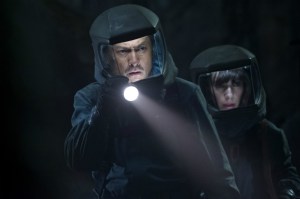
Scientists  Ishiro Serizawa (Ken Watanabe) and Vivienne Graham (Sally Hawkins) investigate in Godzilla

Scientists Ishiro Serizawa (Ken Watanabe) and Vivienne Graham (Sally Hawkins) investigate in Godzilla

That Edwards’ Godzilla stomps all over Emmerich’s effort is pretty much a given (Ed Wood could have made a better film in all honesty). However, a cast full of stellar names are often reduced to delivering one-note performances that serve the story without adding any substance.

The strained father-son relationship between the Brody bunch is worthy of screen time and a driver of the film’s opening half, but Cranston and Taylor-Johnson never truly sell it to us.

The US military HALO jumps into the carnage in Godzilla

The US military HALO jumps into the carnage in Godzilla

Ken Watanabe spends almost the entire film as scientist Serizawa looking like he needs to go to the toilet, while the incredibly versatile Sally Hawkins never deviates from appearing ashen-faced as Seizawa’s colleague Graham. In fact, all the female roles are underwritten; with Juliette Binoche in a blink and you’ll miss it turn as Joe’s wife Sandra, while Olsen gets very little to do as Elle.

That being said, it’s admirable in this day and age for a blockbuster to even give a second’s thought to developing relationships and a narrative ahead of budget-sapping CGI. It’s an approach that worked well for Edwards in Monsters (although, with next-to-no funding it’s always easier to film talking heads rather than space creatures) and, with a little more finesse, will undoubtedly serve him well going forward.

A terrified Elle (Elizabeth Olson) and son hope for the safe return of husband Ford (Aaron-Taylor Johnson) in Godzilla

A terrified Elle (Elizabeth Olson) and son hope for the safe return of husband Ford (Aaron-Taylor Johnson) in Godzilla

Where Edwards really hits it out of the park is in the action scenes involving Godzilla and the massive unidentified terrestrial organisms (MUTOs) that are thrown into the mix. These aren’t just faceless CGI monsters; each of these creatures (Godzilla especially) are emotive forces of nature, whether it be the extended glance shared by ‘zilla and Ford or the moment of tenderness shared by the MUTOs amid the destruction. If this is indeed going to become a franchise (as looks likely) then it’s only right that you feel something for the King of the Monsters.

ROOOOAAARRR!!

ROOOOAAARRR!!

Other dramatic moments, including the Fukushima-inflected destruction of the Japanese nuclear power plant are deftly handled, while the film’s real highlight remains the awesome HALO jump sequence (a candidate for scene of the year), wherein Ford and a crack team of soldiers free-fall into a devastated San Francisco to the eerie strains of György Ligeti’s Requiem (a piece of music used to equally unnerving effect in 2001: A Space Odyssey).

Edwards’ love for Spielberg’s Jaws is evident throughout, from the name Brody, to the long delay in showing the monster in all its titanic glory and the boat which Ford clambers onto in the film’s final act. Let’s hope the sequels fare better than the follow-ups to that franchise.

Godzilla is almost a first-rate blockbuster, it just doesn’t have the magic formula of great action and great characters to make it truly rrrroar-some.

Here’s that awesome trailer…

Review – Blue Ruin

If revenge is a dish best served cold, then it’s never tasted so deliciously chilly than this stripped-back modern classic.

Concluding his Kickstarter pitch, Jeremy Saulnier stakes his career on the promise that he'll make good on those willing to put their faith in his film. After watching Blue Ruin, it's safe to say that faith has been hugely rewarded

Saulnier staked his career on the promise that he’d do good by those willing to put their faith in his film. After watching Blue Ruin, it’s safe to say that faith has been hugely rewarded

Looking for funding to help complete his sophomore feature through Kickstarter, writer-director Jeremy Saulnier pitched Blue Ruin as “not your standard revenge film. It does not glorify violence; it does not justify violence. It does the opposite”.

Thank goodness the public stepped in to hand over their hard-earned cash to help Saulnier deliver on that promise and turn in a truly subversive take on the traditional revenge picture.

Dwight (Macon Blair) prepares for a grisly deed in Blue Ruin

Dwight (Macon Blair) prepares for a grisly deed in Blue Ruin

Beach bum Dwight’s (Macon Blair) sheltered and reclusive life takes a hellish turn when he receives sickening news from an unlikely source. The revelation sets Dwight on a self-destructive path of revenge that leads to a bloody and unremitting aftermath he is ill-prepared for.

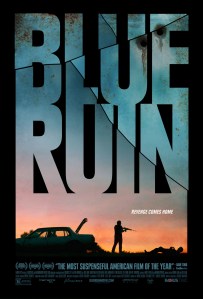
Blue Ruin has invited comparisons to the Coens, specifically their noirish debut Blood Simple, although the sombre and haunted No Country For Old Men feels like a more suitable reference point, right down to the similarity of the two films’ posters.

Dwight's (Macon Blair) descent begins in Blue Ruin

Dwight’s (Macon Blair) descent begins in Blue Ruin

The comparison to Joel and Ethan’s work is understandable, but somewhat depressing as it underlines just how rare films of this ilk are in American cinema.

Revenge movies invariably fall into the tried and tested constraints described by Saulnier in his Kickstarter pitch and adopt an ends-justify-the-means approach. Those films tend to conclude with the ‘happy ending’ of the revenge having been successfully realised, but Blue Ruin takes the entirely darker approach of showing what happens next.

Sam (Amy Hargreaves) takes her brother Dwight (Macon Blair) to task in Blue Ruin

Sam (Amy Hargreaves) takes her brother Dwight (Macon Blair) to task in Blue Ruin

If history has taught us anything, it’s that violence begets violence and Saulnier’s picture isn’t afraid to have Dwight traverse an increasingly bleak and bloody road to hell.

The violence, when it does come, is startling and visceral. There are no winks at the audience or satisfied one-liners; merely chaos, confusion and terror.

Ben (Devin Ratray) shows Dwight (Macon Blair) the ropes of how to use a gun in Blue Ruin

Ben (Devin Ratray) shows Dwight (Macon Blair) the ropes of how to use a gun in Blue Ruin

Clocking in at exactly 90 minutes, the film doesn’t waste a single shot. Dwight is shown in the near-wordless opening reel as a pretty methodical guy, all be it someone living out of a rusted old car. Upon receiving his news, he quickly turns his attention to the mission at hand, but it’s when the act of revenge is complete that Dwight discovers any semblance of control he had no longer exists and all bets are off.

Dwight (Macon Blair) puts those gun skills to test in Blue Ruin

Dwight (Macon Blair) puts those gun skills to test in Blue Ruin

As much as this is Saulnier’s film, so too is it Blair’s. It’s a refreshing performance, one that has a through-line of everyman authenticity to it. Dwight’s no macho action hero; he’s a broken shell with nothing to live for except to save his sister Sam (Amy Hargreaves) and her kids from harm. Blair’s saucer-like eyes are deeply expressive and sell the fear and bewilderment his character endures throughout.

Concluding his Kickstarter pitch, Saulnier staked his career on the promise that he’d do good by those willing to put their faith in his film. After watching Blue Ruin, it’s safe to say that faith has been hugely rewarded.

Review – Pompeii

If imitation is the sincerest form of flattery, then Paul W.S. Anderson’s CGI-fuelled swords and sandals disaster flick really ain’t fooling around in its obsequiousness.

There's a potentially exciting and engaging film to be made about the tragic events that befell the city of Pompeii in AD79. This isn't it

There’s a potentially exciting and engaging film to be made about the tragic events that befell the city of Pompeii in AD79. This isn’t it

Although written by human beings, Pompeii‘s script and narrative structure could just as easily have been the product of a computer algorithm generated from the storylines of Gladiator, Spartacus, Quo Vadis and about a dozen other Roman epics, as well as Titanic and Romeo and Juliet (and a raft of others no doubt).

That in itself isn’t necessarily a death sentence, but when you’ve got Kiefer Sutherland putting on the worst English accent since Kevin Costner gave a stab in Robin Hood: Prince Of Thieves then it’s time to pour molten lava on proceedings.

Milo, aka The Celt (Kit Harrington) forms a firm friendship with fellow slave Atticus (Adewale Akinnuoye-Agbaje) in Pompeii

Milo, aka The Celt (Kit Harrington) forms a firm friendship with fellow slave Atticus (Adewale Akinnuoye-Agbaje) in Pompeii

In fact, it says rather too much about Pompeii that the most convincing character in the movie is angry old Mt Vesuvius, which can’t blow its top quickly enough, frankly.

The film follow Milo, aka ‘The Celt’ (Kit Harrington), who as a young lad witnessed the murder of his parents and fellow villagers by Roman General Corvus (Sutherland) before being kidnapped by slave traders and transported years later from Britannia (where it’s always raining – how original) to Pompeii.

Slave Milo (Kit Harrington) embarks on a forbidden romance with Roman girl Cassia (Emily Browning) in Pompeii

Slave Milo (Kit Harrington) embarks on a forbidden romance with Roman girl Cassia (Emily Browning) in Pompeii

There he befriends fellow slave Atticus (Adewale Akinnuoye-Agbaje) and catches the eye of the rebellious Cassia (Emily Browning), daughter of city ruler Severus (Jared Harris) and his wife Aurelia (Carrie-Anne Moss). When Corvus – now a Roman Senator – sails into Pompeii, Milo senses an opportunity to finally realise his long held desire for revenge. However, the small matter of an erupting volcano threatens to spoil everything.

Anderson is best known for directing the Resident Evil franchise, which is appropriate because Pompeii effectively turns into a computer game once Vesuvius erupts. The film could hardly be credited with depth, but it truly jumps the shark during a ridiculous chase scene involving a horse and chariot that would have had Charlton Heston spinning in his gun-lined coffin.

Pantomime villain Corvus (Kiefer Sutherland) in Pompeii

Pantomime villain Corvus (Kiefer Sutherland) in Pompeii

The romance between Milo and Cassia simply doesn’t work, which is a shame as Harrington and Browning at least try to inject some chemistry. A better bond is created between Milo and Atticus, whose initial rivalry and subsequent friendship is the best part of the film, especially during the gladiatorial scenes which allow Milo the opportunity to exact some humiliation on the evil Corvus.

Much like any other disaster film, you’re left twiddling your thumbs before the money shot finally arrives (just in case we’ve forgotten it’s coming, we have Atticus to helpfully point out that the regular pre-eruption tremors are just “the mountain” and nothing to worry about).

Mt Vesuvius gets angry in Pompeii

Mt Vesuvius gets angry in Pompeii

When Vesuvius finally does erupt, it at least does so with impressive style, but it doesn’t take long before boredom sets in once again and you’re hoping a fireball will take out most of the cast. Besides, anyone who’s seen the overly extended trailer will know exactly what to expect.

One suspects that Anderson’s tongue was wedged firmly in his cheek judging by the film’s histrionic tone and Sutherland’s pantomime performance, but that doesn’t forgive the sheer tedium of what’s on display here.

There’s a potentially exciting and engaging film to be made about the tragic events that befell the city of Pompeii in AD79. This isn’t it.

Review – Transcendence

The argument that Hollywood should be making movies that aspire to something smarter than big dumb action hasn’t been well served by this misguided sci-fi disappointment.

In spite of his obvious talent with the camera, Pfister would probably have been better served working on a less ambitious project in order to get properly comfortable in the director's chair

In spite of his obvious talent with the camera, Wally Pfister would probably have been better served working on a less ambitious project in order to get properly comfortable in the director’s chair

Wally Pfister’s directorial debut was among the most highly anticipated films of the year. Certainly the pedigree was there; Pfister’s work as Christopher Nolan’s DoP on such striking works as Inception and The Dark Knight trilogy set pulses racing, while the mouth-watering cast of Johnny Depp, Rebecca Hall, Paul Bettany and Nolan veterans Morgan Freeman and Cillian Murphy promised much.

What a shame then that such promise has been squandered on a movie that fails to turn an interesting central concept into a logical and engaging viewing experience.

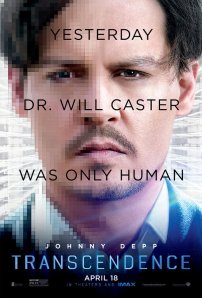
Dr Will Caster (Johnny Depp) explains his theories in Transcendence

Dr Will Caster (Johnny Depp) explains his theories in Transcendence

Depp plays Dr Will Caster, a genius in artificial intelligence whose work to create a sentient computer – a tipping point he calls transcendence – rubs up against an extremist group who shoot Caster and launch a series of terror attacks against tech labs. As Will slowly dies from his wound, his wife and colleague Evelyn (Hall) and best friend Max Waters (Bettany) work on a radical plan to upload his consciousness into a super computer.

Now free to roam online, Will-A.Im (sorry) promises technological nirvana and a better world, but invites suspicion among even those closest to him, including scientist Joseph Tagger (Freeman), as well as FBI agent Donald Buchanan (Murphy).

Scientist Joseph Tagger (Morgan Freeman) and FBI agent Donald Buchanan (Cillian Murphy) are shown around by Will's wife Evelyn (Rebecca Hall) in Transcendence

Scientist Joseph Tagger (Morgan Freeman) and FBI agent Donald Buchanan (Cillian Murphy) are shown around by Will’s wife Evelyn (Rebecca Hall) in Transcendence

The thrust of Pfister’s film, based on a script rescued from the Black List, is both intriguing and prescient – have we becomes slaves to technology that’s now moving so fast we can’t control it? Will the ‘singularity’ – the moment when machines achieve the ability to think for themselves – be a defining moment in mankind’s technological revolution or spell our doom, a la Skynet?

However, a sound idea does not a great script make and the cracks quickly start to show. The film takes odd leaps of logic; characters make decisions that aren’t properly explained; and dialogue gets bogged down in expository ramblings that make conversations sound stilted.

The shady Bree (Kate Mara) gets chatting to Max Waters (Paul Bettany) in Transcendence

The shady Bree (Kate Mara) gets chatting to Max Waters (Paul Bettany) in Transcendence

As you’d expect from Pfister’s background, the film looks great. His use of stark lighting is especially impressive and gives the impression of a cold intelligence at work, while the dead-end town of Brightwood, which is turned into Will’s HQ, is an effective location; all be it one Pfister isn’t able to take full advantage of, especially in the film’s lackadaisical final act.

Depp, who must be wondering if his box office magic is on the wane in light of Transcendence‘s and The Lone Ranger‘s disastrous performances, never looks comfortable, least of all when he’s playing a less sardonic version of Holly from Red Dwarf. The further Depp walks away from his more interesting ‘indie’ career choices, the less interested he looks.

Will (Johnny Depp) reaches out to Evelyn (Rebecca Hall) beyond the internet in Transcendence

Will (Johnny Depp) reaches out to Evelyn (Rebecca Hall) beyond the internet in Transcendence

Hall and Bettany are fine actors and do their best, but as the movie goes on they start to look less convinced of the material, while Freeman (whose terrible line – “It will be the end of mankind as we know it” – from the trailer was a stupid marketing decision rather than a Pfister-ism apparently and doesn’t appear in the finished movie) and Murphy are given next to nothing to do.

In spite of his obvious talent with the camera, Pfister would probably have been better served working on a less ambitious project in order to get properly comfortable in the director’s chair. Oh well, at least we have Interstellar to look forward to, right?

Review – The Amazing Spider-Man 2

Amazing by name, but not unfortunately by nature, this bloated second installment in the hastily rebooted Spidey franchise fails to trap you in its web.

A trio of great performances can't save what is, at best, a very average movie and another underwhelming entry in a franchise that's so far failing to live up to its title

A trio of great performances can’t save what is, at best, a very average movie and another underwhelming entry in a franchise that’s so far failing to live up to its title

When Sam Raimi brought Spider-Man to the big screen in 2002, it landed at a time when the new era of comic book movies that had begun with X-Men two years earlier was still in its infancy.

Fast forward to 2012 and Marc Webb’s The Amazing Spider-Man arrived in a far more crowded market place, dominated by the double whammy of Christopher Nolan’s The Dark Knight Rises and Marvel’s The Avengers.

Peter Parker (Andrew Garfield) investigates the death of his parents in The Amazing Spider-Man 2

Peter Parker (Andrew Garfield) investigates the death of his parents in The Amazing Spider-Man 2

While it did good business, when compared to these two box office behemoths, The Amazing Spider-Man felt like a lesser film. Lest we forget, it had only been five years since Raimi’s forgettable Spider-Man 3 and Webb’s reboot felt like what it was – a money-grabbing exercise by Sony Pictures to muscle in on the comic book movie boom.

The strongest aspects of that film remain the highlights of this follow-up – namely the performances of Andrew Garfield as awkward teenager Peter Parker turned superhero Spider-Man and Emma Stone as his smart and spiky love interest Gwen Stacy; and the winning chemistry both actors have together.

Nerdy Oscorp employee Max Dillon (Jamie Foxx) shortly before becoming Electro in The Amazing Spider-Man 2

Nerdy Oscorp employee Max Dillon (Jamie Foxx) shortly before becoming Electro in The Amazing Spider-Man 2

The Amazing Spider-Man 2 finds Peter struggling to maintain the promise he made to Gwen’s father to stay away from his daughter in order to keep her safe, while also settling into his role as Spidey. With great power comes great responsibility and Peter’s responsibility to the people of New York is severely tested by the arrival of powerful supervillain Electro (Jamie Foxx), formerly sad and lonely Oscorp engineer Max Dillon.

Meanwhile, Peter’s long-absent childhood pal Harry Osborn (Dane DeHaan) returns home in time to take over the reins of Oscorp from his dying father (Chris Cooper) and it’s not long before Spider-Man gets in the way of their friendship.

Peter Parker's love interest Gwen Stacy (Emma Stone) in The Amazing Spider-Man 2

Peter Parker’s love interest Gwen Stacy (Emma Stone) in The Amazing Spider-Man 2

The film inevitably draws comparisons to 2004’s Spider-Man 2, easily the best in Raimi’s Spidey trilogy, but falls short. The narrative is pretty similar – a brilliant Oscorp employee accidentally mutates into a supervillain and, with the help of a vengeful Harry Osborn, faces off against Spider-Man. However, while that film featured a properly three-dimensional villain and a storyline that zipped along, Electro’s arc feels underdeveloped, the action set pieces fail to properly engage and the pace often flags (at 142 minutes, it’s at least half-an-hour too long).

It also falls into the same trap as too many other comic book movies (Spider-Man 3 in particular) of believing that bigger is always better. Paul Giamatti’s Russian nutjob Aleksei Sytsevich is as superfluous as he is ridiculous and has presumably been injected into the film as a platform between this film and the next chapter in the franchise, while the curious shifts in tone between comic book goofiness and brooding seriousness suggest a movie that’s trying to be all things to all people, but ends up coming off as directionless.

Peter Parker (Andrew Garfield) catches up with old buddy Harry Osborn (Dane DeHaan) in The Amazing Spider-Man 2

Peter Parker (Andrew Garfield) catches up with old buddy Harry Osborn (Dane DeHaan) in The Amazing Spider-Man 2

The Amazing Spider-Man 2‘s saving grace are the trio of Garfield, Stone and DeHaan. The strained relationship between Peter and Gwen is effectively brought to life by both actors and Stone in particular radiates in a role that commands strength, purpose and fortitude. DeHaan, meanwhile, is great as the increasingly desperate Harry and employs a smile that turns more crooked as the film wears on.

Special mention should go to the soundtrack, crafted by Hans Zimmer in collaboration with Pharrell Williams and several others. The music that introduces the newly created Electro is particularly effective as it both drives the action and provides a schizophrenic audio accompaniment to the confusion and anger coursing through the character’s mind.

However, a trio of great performances can’t save what is, at best, a very average movie and another underwhelming entry in a franchise that’s so far failing to live up to its title.