In Retrospect – A Hard Day’s Night (1964)

Anarchy in the UK may have been more than a decade away, but the Fab Four’s debut big screen feature must have felt like a shot of joyous adrenaline to the youth of a country still recovering from the war.
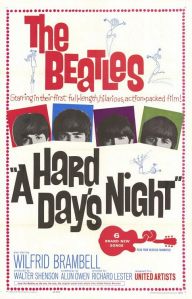
A Hard Day's Night may be a product of its time, but its infectious energy and immortal songbook means it remains as fab today as it did 50 years ago

A Hard Day’s Night may be a product of its time, but its infectious energy and immortal songbook means it remains as fab today as it did 50 years ago

The Beatles were in the right place at the right time to exploit the cultural revolution that had been bubbling away and, through a mix of catchy songs, natural charisma and clever marketing created a phenomenon.

The giddy chaos of the opening few minutes (still one of cinema’s great credit sequences) as John, Paul, George and Ringo leg it from a horde of screaming girls and guys over the film’s title track can be seen as a visual metaphor for a generation of young people hungrily going after something they can claim as their own.

It's a Hard Day's Night and the boys have working like dogs...

It’s a Hard Day’s Night and the boys have working like dogs…

A Hard Day’s Night is light on plot (the band travel by train to a TV gig in London, sit around in a hotel and get involved in various scrapes), but rich in character, satire and great tunes. They entrusted their feature debut to American director Richard Lester, primarily for his work in bringing the spectacularly successful Goons radio show to the small screen and his collaboration with Peter Sellers and Spike Milligan on The Running Jumping & Standing Still Film (1960).

Lester’s love of Buster Keaton also married well with the band’s natural wit, while Merseyside-based screenwriter Alun Owen was brought on board to exploit their dry sense of humour and character traits.

George gives road manager Shake (John Junkin) a 'shave' in A Hard Day's Night

George gives road manager Shake (John Junkin) a ‘shave’ in A Hard Day’s Night

Widely regarded as having invented the music video, the film is clearly influenced by the French New Wave and fills the space in between the musical numbers with often surreal interludes that bring to mind Luis Buñuel; such as when George gives road manager Shake (John Junkin) a ‘shave’ by spraying foam on the mirror where Shake’s stubble should be and gliding the razor along its surface.

Another turn for the quirky comes when, having got on the nerves of a stuffy city gent who grumpily exclaims that he “fought the war for you sort”, the band ask him for their ball back, only to suddenly appear running and cycling alongside the train a second later asking the same question.

Paul hides out with 'Grandfather' (Wilfrid Brambell) in A Hard Day's Night

Paul hides out with ‘Grandfather’ (Wilfrid Brambell) in A Hard Day’s Night

Get past the cartoonish exterior of this scene, however, and there’s plenty more going on; particularly a two-fingered salute to the establishment in the way four working class lads sit merrily in the first class carriages and ignore the hectoring of their supposed peers.

A Hard Day’s Night is careful not to laugh at the Fab Four’s hysterical fans; rather its satire is targeted more at the nonsense that goes with superstardom. A scene in which the band take part in a fast and loose press conference descends into a merry-go-round of inane questions and increasingly ridiculous answers, most amusingly when Paul responds conspiratorially “no, we’re just good friends” to whatever question he’s posed.
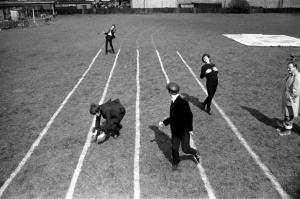
The Fab Four in full-on lark mode in A Hard Day's Night

The Fab Four in full-on lark mode in A Hard Day’s Night

The film also takes a swipe at the homogenising impulse of marketing, as symbolised by Kenneth Haigh’s cynical publicist Simon, who tries to use George as a mouthpiece for some new clothing he’s planning to flog to the masses. Simon sees the band as nothing more than fresh meat on a conveyor belt and responds to George’s failure to play ball by derisively saying: “Here’s this kid trying to give me his utterly valueless opinion when I know for a fact within a month he’ll be suffering from a violent inferiority complex and loss of status if he isn’t wearing one of these nasty things.”

They’re not shy about sending themselves up either; Ringo especially, who endorses George’s observation that he has “an inferiority complex” by responding: “Yeah, that’s why I play the drums.”

The one and only John Lennon in A Hard Day's Night

The one and only John Lennon in A Hard Day’s Night

In spite of Ringo’s inferiority complex, the film is pretty equitable in the screen time it gives to each of the Beatles as well as those around them, the inimitable Wilfrid Brambell in particular who has plenty of fun playing Paul’s Irish ‘Grandfather’. Famous at the time for his role as cantankerous “dirty old man” Albert Steptoe in BBC sitcom Steptoe and Son, there’s a running gag throughout that his character always looks so clean.

A Hard Day’s Night may be a product of its time, but its infectious energy and immortal songbook means it remains as fab today as it did 50 years ago.

Review – Under The Skin

If the reward for sitting through endless anodyne Hollywood train wrecks is Jonathan Glazer’s gloriously idiosyncratic Under The Skin then hand over the popcorn and bottomless brown sugar water.

You'll either love or hate Under The Skin. Me? I thought it was mesmeric

You’ll either love or hate Under The Skin. Me? I thought it was mesmeric

Glazer has never been one to shy away from subversion. His brilliant debut Sexy Beast (2000) played with our expectations of what had become an exhausted genre – the British gangster film – by reverse casting hard man Ray Winstone as a quietly terrified retiree and Ben ‘Ghandi’ Kingsley as one of cinema’s most memorable psychopaths.

His astonishing follow-up Birth (2004), meanwhile, remains one of cinema’s most under-appreciated love stories, although it’s as far removed from the Nicholas Sparks school of romance as you can get.

The alien (Scarlett Johannson) goes about her business in Under The Skin

The alien (Scarlett Johannson) goes about her business in Under The Skin

This long-awaited third feature once again finds Glazer ripping up the rulebook by casting Scarlett Johannson as an alien being who adopts the guise of a beautiful English woman to stalk and harvest unwitting men on the streets of Scotland. On the face of it, the casting of one of the sexiest women on the planet to play such a part makes perfect sense. However, Species (1995) this ain’t as Glazer’s deeply disquieting film means the sight of a semi-clad Johannson ends up being both creepy and (ahem) alienating.

This undermining of Johannson’s natural screen allure has also been explored very recently in Spike Jonze’s Her (in which the actress played an operating system) and the two films share similar themes of loneliness and what it means to be human.

The window of the soul reveals much in Under The Skin

The window of the soul reveals much in Under The Skin

When we first observe the alien she is a blank slate, having just taken the body of the dead woman as if newly born into the world. She applies makeup after noticing how cosmetics are used to enhance appearance and gets behind the wheel of an innocuous white van to snare men into a fate that’s as startling as it is unnerving.

Once these men fall under her spell, they willingly allow themselves to be consumed by a pool of black viscous fluid, the purpose of which becomes clear during a moment of hypnotic horror when the alien’s latest victim watches as another man is literally sucked dry. It’s as close to a surreal nightmare as one would ever wish to see.

A victim is soon to learn his fate in Under The Skin

A victim is soon to learn his fate in Under The Skin

As she goes about her business – all the while being closely monitored by another alien who has inhabited the body of a male motorcyclist – we begin to observe increasingly human characteristics in her eyes. She may wear the face of a charming and alluring woman who’s interested in the conversation of her prey, but the windows of the soul come to tell a different story as we register guilt, confusion and repulsion breaking through the veneer.

Glazer placed secret cameras inside the van to film Johannson driving around for real, picking up unsuspecting passers-by and engaging them in conversation to see what would happen. In interviews he’s alluded to great footage that had to be left out because the person concerned didn’t want to sign a release form. It’s a tantalising thought to wonder what other directions the film could have taken had this footage been available.

The mask begins to fall in Under The Skin

The mask begins to fall in Under The Skin

Just as some parts inevitably have a rough and ready feel to them, other sections are stunningly realised, in particular a devastating scene set on a beach involving a surfer, a couple and their baby. The moment shortly afterwards when the motorcyclist returns to the beach to retrieve an object is one of the most starkly chilling sequences this reviewer can recall.

Glazer’s eerie visuals are lent even greater impact by British singer/songwriter Mica Levi’s queasy and discordant score that envelops you in the same way as the mysterious black liquid.

I’ve never been one for star ratings, but it strikes me that anyone giving Under The Skin a fence-sitting three-out-of-five hasn’t properly watched what is one of the most uncompromising, mysterious and polarising films in recent years. You’ll either love or hate it. Me? I thought it was astonishing.

In Retrospect – Batman (1989)

It’s difficult to overestimate just what a seismic impact Tim Burton’s reimagining of the Dark Knight’s on-screen persona had on the movie landscape.

Twenty five years on, the cracks and holes in Burton's first of many forays into blockbuster filmmaking are all-too glaring to miss

Twenty five years on, the cracks and holes in Burton’s first of many forays into blockbuster filmmaking are all-too glaring to miss

While Steven Spielberg had given birth to the Hollywood blockbuster with Jaws (1975) and George Lucas had taken it into the stratosphere in Star Wars (1977), ‘event’ cinema reached a whole new level with the arrival of Batman in 1989.

I was one of the many millions seduced by the carefully orchestrated marketing hype that became known as ‘Batmania’ and queued as a young lad with barely contained excitement on the opening day… before watching it again the following day.

At the time I recall thinking it was “ace”. However, 25 years on, the cracks and holes in Burton’s first of many forays into blockbuster filmmaking are all-too glaring to miss.

The Nosferatu-esque Batman hunts his prey in Tim Burton's Batman

The Nosferatu-esque Batman hunts his prey in Tim Burton’s Batman

Taking its lead from Alan Moore and Brian Boland’s classic graphic novel The Killing Joke, the film follows the early days of Batman’s war against crime in Gotham City, an urban cesspool riven by police corruption, terrified citizens, desperate politicians and mob rule.

An intervention by the Caped Crusader (Michael Keaton) at a chemical plant inadvertently leads to the ‘death’ of senior mob enforcer Jack Napier (Jack Nicholson) and the ‘birth’ of the cackling, psychopathic Joker and soon Gotham turns into the playground in which these two opposing sides of a scarred coin go mano-a-mano. Dragged into the fray is star photo-journalist Vicky Vale (Kim Basinger), who’s lured to Gotham by the fantastical news of a “winged freak” terrorising the city’s underground.

Gotham City, as depicted in Tim Burton's Batman

Gotham City, as depicted in Tim Burton’s Batman

The first thing that strikes you is Anton Furst’s astonishing vision of Gotham City; a mish-mash of conflicting architectural styles that’s brought to life so vividly it practically dwarfs everything else.

With such eye-opening visuals to contend with, Burton’s long-time collaborator Danny Elfman needed to bring his A-game for Batman‘s score and did just that. Elfman threw everything and the kitchen sink in, from the dark and sinister to screwball via operatic organs and the pulse-quickening march which memorably opens the movie.

The Joker (Jack Nicholson) hatches another dastardly plan in Batman

The Joker (Jack Nicholson) hatches another dastardly plan in Batman

However, a great score and production design do not a great film make. Despite several quotable lines – “Think about the future”; “I think I’ve got a live one here!”; “This town needs an enema!”; “Have you ever danced with the devil in the pale moonlight?” – Sam Hamm and Warren Skaaren’s screenplay is all over the place (Burton subsequently admitted that chunks of the script were improvised on the hoof).

Burton allows scenes to go on too long, usually to indulge Nicholson, while others are clunky or completely unnecessary, most notably the sequence in Gotham City Museum wherein the Joker and his henchmen bespoil a series of valuable artworks.

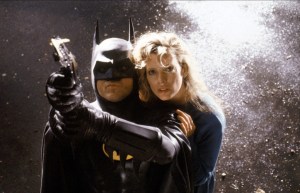
Batman (Michael Keaton) protects reporter Vicky Vale (Kim Basinger) in Batman

Batman (Michael Keaton) protects reporter Vicky Vale (Kim Basinger) in Batman

Elfman’s score is so memorable that the inclusion of Prince’s soundtrack feels jarring next to it. The decision to draft in Prince – one of the most popular musicians on the planet at the time – was savvy thinking on the part of the money men at Warner Bros, but the film has an awkward time crowbarring the tunes into the narrative.

Burton works hard to create a dark and brooding tone akin to a 1940s-era noir (everyone wears hats!), but counterbalances it with a series of cartoonish moments (Napier’s bleached white hand emerging from the chemical waste; Wayne caught hanging Bat-like upside down by Vale) that seek to remind us we’re watching a comic book superhero movie. The movie also nods not once, but twice, to Raiders Of The Lost Ark‘s swordsman scene.

Batman's coolest shot

Batman’s coolest shot

It’s difficult to believe that neither Vale nor fellow reporter Alexander Knox (Robert Wuhl) would know why Bruce Wayne – Gotham City’s most well-known businessman after all – is an orphan. Furthermore, it stretches credulity that so many people fail to suspect the Joker (who, let’s not forget, had tried to kill the city’s citizens a short time earlier) has an ulterior motive when he announces he’ll be staging a night parade in which he’ll dish out millions in cash.

In a parallel with Gene Hackman’s casting of Lex Luthor in Superman, the film’s biggest name is its villain. Nicholson seemed like the most logical choice at the time and there are moments when he truly strikes the balance between humourous and homicidal. However, too often his performance feels like a big screen extension of Cesar Romero’s take in the 1960s camp TV show. Meanwhile, Keaton is better than you’d expect as Batman, although Wayne inevitably takes a back seat.

The Batmobile, as imagined in Tim Burton's Batman

The Batmobile, as imagined in Tim Burton’s Batman

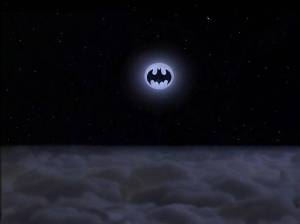
The homage to Nosferatu when we first see the Dark Knight is nicely done, as is the nod to Batman creator Bob Kane (in spite of being refered to as a “dick” by Knox when he shows the young reporter a mock-up of what the Bat Man looks like). There’s also a cool moment when the Batwing flies in front of the moon. However, these moments are too few and far between to override the feeling that this is a film which has dated badly.

Burton himself summed up Batman better than any critic when he said on reflection: “I liked parts of it, but the whole movie is mainly boring to me. It’s OK, but it was more of a cultural phenomenon than a great movie.”

Great Films You Need To See – Contact (1997)

This is my latest contribution to The Big Picture, the internationally recognised magazine and website that offers an intelligent take on cinema, focussing on how film affects our lives. This piece about Robert Zemeckis’s 1997 sci-fi classic Contact was written as part of The Big Picture’s Lost Classics strand, although I am including it within my list of Great Films You Need To See.

If they ever considered stopping by our planet, aliens should prepare themselves for a rough welcome if our exhaustive list of films featuring malevolent little green men is anything to go by.

Contact ultimately lets us decide for ourselves whether the mysterious signal is the work of an alien intelligence or not. It's a question really of how much you believe

Contact ultimately lets us decide for ourselves whether the mysterious signal is the work of an alien intelligence or not. It’s a question really of how much you believe

Aliens have been many things in the movies, but peaceful is rarely one of them. Even Steven Spielberg, who waved the flag for benevolent beings from outer space in Close Encounters Of The Third Kind (1977) and E.T. The Extra-Terrestrial (1982), ended up making War Of The Worlds (2005). Needless to say, those guys weren’t interested in making music or phoning home.

Robert Zemeckis’ 1997 adaptation of cosmologist Carl Sagan’s novel Contact feels like a riposte to the biggest evil green men movie of them all, Independence Day, which had been released the previous year.

Jodie Foster stars as SETI radio astronomer Dr Ellie Arroway in Contact

Jodie Foster stars as SETI radio astronomer Dr Ellie Arroway in Contact

Ostensibly about the mystery that surrounds a signal of possibly alien origin detected by radio astronomer Dr Ellie Arroway (Jodie Foster), Contact is more concerned with exploring the uneasy relationship that exists between religion, science and politics.

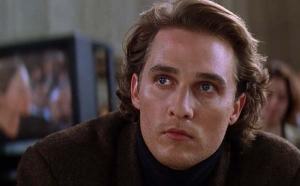
While James Woods’ National Security Advisor Michael Kitz represents the hawkish impulse of authority to control what isn’t fully understood; the push/pull connection shared between Ellie and Christian philosopher Palmer Joss (Matthew McConaughey) suggests that scientific conviction and religious certainty are two sides of the same coin.

Christian philosopher Palmer Joss (Matthew McConaughey) mulls over the role of God in all this in Contact

Christian philosopher Palmer Joss (Matthew McConaughey) mulls over the role of God in all this in Contact

Indeed, the genius of Contact is in the way its obsessive leading character finds herself acting increasingly on faith the closer she gets to discovering the ultimate truth behind what is, potentially, the greatest scientific breakthrough in human history.

Although she doesn’t believe in the afterlife, a revealing moment early on (following the extraordinary opening shot which pulls back from Earth to follow humanity’s radio broadcasts through the solar system, the Milky Way and beyond) comes when a young Ellie asks her father if they can contact her dead mother via radio. This is reflected later in the film when, following an apparent trip to the other side of the universe, she finds herself in heaven, for all intents and purposes.

The 'alien' machine is  made a reality in Contact

The ‘alien’ machine is made a reality in Contact

Foster is perfectly cast in the role of the dogged and inquisitive Ellie. Not everyone can carry off speeches that contain the words “Einstein Rosen Bridge” (aka wormhole) and Foster imbues her lines with a conviction that could have you fooled into thinking she’s Professor Brian Cox’s mentor.

While not the finished Oscar-winning item he would later become, McConaughey brings his good ol’ Southern charm to the role of Joss, who gets to present the other side of the argument without succumbing to Bible-thumping craziness (that role’s taken by Jake Busey’s wildly exaggerated preacher in one of the film’s only missteps).

Dr Ellie Arroway (Jodie Foster) prepares for the ultimate trip in Contact

Dr Ellie Arroway (Jodie Foster) prepares for the ultimate trip in Contact

After incorporating Kennedy, Johnson and Nixon into Forrest Gump (1994), Zemeckis went one better by interweaving footage of sitting US President Bill Clinton’s press conferences into the narrative of Contact.

It’s a gamble that works and adds an extra layer of authenticity to a film that never apologises for wanting to make you think, rather than suggesting you switch off your brain on the way in.

Contact ultimately lets us decide for ourselves whether the mysterious signal is the work of an alien intelligence or not. It’s a question really of how much you believe.

Review – 3 Days To Kill

If you thought the world needed another B-movie about an ageing American CIA agent laying waste to half of Paris, you’ll probably think again after watching this sloppy Eurotrash from journeyman McG.

No-one's happier to see Costner back on the big screen than I, it's just a shame it's in something as underwhelming as 3 Days To Kill

No-one’s happier to see Costner back on the big screen than I, it’s just a shame it’s in something as underwhelming as 3 Days To Kill

Following an early career spent making offbeat and highly stylised action films, Luc Besson has largely turned to writing and producing thrillers that are as formulaic as they are interchangeable.

In certain cases that formula has chimed with audiences – The Transporter series proved a tidy hit and turned Jason Statham into a bona fide action star, for instance. Taken also set the box office alight and gave Liam Neeson a surprising and unlikely new career turn as a movie hard ass.

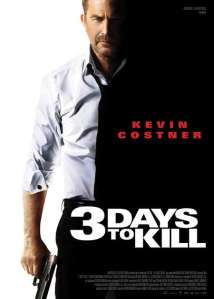
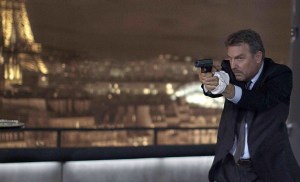
It's an ageing American CIA guy (played by Kevin Costner) in Paris (again) in 3 Days To Kill

It’s an ageing American CIA guy (played by Kevin Costner) in Paris (again) in 3 Days To Kill

There’s an argument to be made for giving audiences what they want; however, Besson has barely bothered changing up the formula and, with McG’s lunk-headed direction in tow, the end result is the unnecessary and lazy 3 Days To Kill.

That being said, it’s great to see Kevin Costner back as a leading man following a series of supporting turns in the likes of Man Of Steel (2013) and this year’s unfairly maligned Jack Ryan: Shadow Recruit, even if he looks like he’d rather be sightseeing in Paris than shooting half of its citizens.

Ethan Renner (Kevin Costner) shares a moment with her estranged daughter Zoey (Hailee Steinfeld) in 3 Days To Kill

Ethan Renner (Kevin Costner) shares a moment with her estranged daughter Zoey (Hailee Steinfeld) in 3 Days To Kill

Costner plays CIA agent Ethan Renner, who’s diagnosed with a terminal disease and decides to spend his last days trying to rebuild his fractured relationship with estranged daughter Zoey (Hailee Steinfeld) and, in turn, ex-wife Christine (Connie Nielsen). Ethan’s Company service is cut short by his illness; however, he’s drafted in by CIA assassin Vivi Delay (Amber Heard) to track down an international arms dealer called the Wolf (Richard Sammel). You can guess the rest.

The single biggest problem with 3 Days To Kill – aside from the fact it’s not very good – is that it doesn’t know what film it wants to be. On one hand there’s a family drama in which an absent father endeavours to reconnect with the people who really matter once all the assassinating and running after criminals appears to have been swept aside. Steinfeld is a fine young actress and the scenes she shares with Costner are nicely played. Tellingly, it’s in these quieter moments when Costner looks properly switched on.

CIA assassin Vivi Delay ('actress' Amber Heard) in 3 Days To Kill

CIA assassin Vivi Delay (‘actress’ Amber Heard) in 3 Days To Kill

On the other hand there’s the well-worn action set pieces that involve Costner waving a gun around and chasing down generic evil-looking foreign terrorists. Even the film’s big explosive set piece loses its impact after having appeared in the trailer (naturally).

Linked to all this gunplay is the character is Vivi Delay, who looks like she’s been dragged in from a European porn film. It’s fair to say Heard doesn’t get cast in movies for her acting prowess, but she’s on hilariously bad form here and the scenes she shares with a bewildered looking Costner are frankly bananas.

No-one’s happier to see Costner back on the big screen than I, it’s just a shame it’s in something as underwhelming as 3 Days To Kill.