Review – Interstellar

For a film that puts so much currency in science, Christopher Nolan’s most grandly ambitious work to date ultimately asks us for something far more down to earth – our faith.

As a spectacle, Interstellar is astonishing and its ambition is virtually unmatched, but an overblown final act means we're going to have to wait that little bit longer for Nolan's masterpiece

As a spectacle, Interstellar is astonishing and its ambition is virtually unmatched, but an overblown final act means we’re going to have to wait that little bit longer for Nolan’s masterpiece

In many ways Interstellar can be seen as a companion piece to Robert Zemeckis’ Contact. Aside from starring Matthew McConaughey and featuring imput from theoretical physicist Kip Thorne, the galaxy-spanning premise of both films is grounded by a seemingly impossible human connection between a daughter and her father.

The hard science at the core of each movie gradually gives way to a far more intimate tale wherein love is the rocket fuel that propels us to the closing credits and faith, when given into, can transcend time and space. In that respect it also bears more than a passing resemblance to Solaris (more the Steven Soderbergh version rather than Andrei Tarkovsky’s 1972 Russian classic).

Watching Interstellar, the excitable talk surrounding the picture prior to its release was that Nolan had delivered his masterwork; his 2001: A Space Odyssey. While there are obvious threads to Kubrick’s magnum opus and Hans Zimmer’s use of organs is as direct a nod as you’re ever likely to get, this is a very different animal; one that, for good or ill, is a product of 21st Century moviemaking.

The Endurance crew - Cooper (Matthew McConaughey), Amelia (Anne Hathaway) and Romilly (David Gyasi)  in Interstellar

The Endurance crew – Cooper (Matthew McConaughey), Amelia (Anne Hathaway) and Romilly (David Gyasi) in Interstellar

Nolan’s script, written with his brother Jonathan (who originally penned it with Spielberg in mind to direct, interestingly), falls into the trap of so many sci-fi films before it (2001 notwithstanding, it must be said) of turning certain characters into walking exposition announcers. Michael Caine is particularly ill-served in this regard as Professor Brand, who very swiftly convinces NASA test pilot-turned-farmer Cooper (McConaughey) to leave his kids Murph (Mackenzie Foy) and Tom (Timothée Chalamet) in the care of father-in-law Donald (John Lithgow) in order to embark on a grand quest to save humanity.

Professor Brand (Michael Caine) spells it out in Interstellar

Professor Brand (Michael Caine) spells it out in Interstellar

The lapses in logic that marred The Dark Knight Rises (exactly how did a penniless/passport-less Bruce Wayne get back to Gotham City from the arse end of nowhere?) come back to haunt Nolan here. Glaring moments, such as when fellow crew member Romilly (David Gyasi) gives a ‘wormholes for dummies’ talk to Cooper as they are about to enter one (as opposed to before they’d even left Earth, for example), pull you out of the film.

The criticism often lazily thrown at Nolan that he’s too ‘cold’ and doesn’t invest enough in his characters doesn’t stand up to closer scrutiny here, thanks largely to a committed cast who work extremely hard to overcome the occasionally clunky script. McConaughey anchors the film as an everyman who never forgets the reason why he’s risked life and limb travelling thousands of light years from home. He’s smart enough not to overdo it, which gives his big moment when an increasingly distraught Cooper watches a series of family videos transmitted from Earth that much more impact.
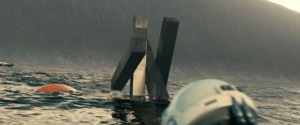
TARS comes to the rescue in Interstellar

TARS comes to the rescue in Interstellar

Anne Hathaway successfully convinces as Cooper’s fellow intrepid astronaut Amelia in spite of having to utter more than a few leaden lines, while Jessica Chastain’s flinty-eyed scientist adds heft to her scenes as she tries to save an Earth succumbing to blight and ferocious dust storms that resemble something out of The Grapes Of Wrath.

If the script doesn’t entirely convince, the visuals surely do and it’s here that Interstellar goes, well, interstellar. Right from his devious debut film Following, Nolan has proven extremely adept at knowing what to do with the camera and over the course of an increasingly revered career has continued to refine this skill. He also tries where possible to use physical effects in-camera rather than relying on CGI and by having his actors interact with replicas of spacecraft or go on location to an Icelandic glacier (captured beautifully by the director’s new cinematographer Hoyte van Hoytema) to represent an alien world adds an authenticity that computer effects cannot match.

Interstellar goes, errrr, Interstellar

Interstellar goes, errrr, Interstellar

The film’s several set pieces are edge-of-the-seat stuff, in particular an enthralling sequence in which Cooper attempts to dock with a damaged mothership. It’s in these near-wordless moments when Zimmer’s bombastic score lifts the film, but too often elsewhere the soundtrack ends up overcooking the tension and drowning out sections of dialogue.

Murph (Jessica Chastain) faces the slow death of Earth in Interstellar

Murph (Jessica Chastain) faces the slow death of Earth in Interstellar

The crew’s robot companions TARS (humourously voiced by Bill Irwin) and CASE (Josh Stewart) – which resemble 2001-esque monoliths when motionless – are both believable in their functionality and engaging in their own right. We root for them in the same way we would Cooper or the rest of the crew and form a genuine emotional bond in much the same way as we do with Dewey, Huey and Louie in Silent Running.

As a spectacle, Interstellar is astonishing and its ambition is virtually unmatched, but an overblown final act means we’re going to have to wait that little bit longer for Nolan’s masterpiece. The question now is, where does he go from here?

Review – Only Lovers Left Alive

After testing the limits of our patience with the languorous The Limits Of Control, Jim Jarmusch has returned to his ironically idiosyncratic best by unashamedly injecting some arthouse into the well-worn vampire flick.

This year has seen plenty of highlights in the world of film; the return to form of Jim Jarmusch is one of the most welcome

This year has seen plenty of highlights in the world of film; the return to form of Jim Jarmusch is one of the most welcome

There really isn’t anyone out there who does what Jarmusch does and for that reason alone his status as life ambassador for effortlessly cool American independent cinema is assured.

There have been some misses, for sure. The Limits Of Control (2009) disappeared up itself and Night On Earth (1991) never quite got going, but set against such fare as his breakout Stranger Than Paradise (1984), the wonderful Dead Man (1995) and hugely atmospheric Ghost Dog: The Way Of The Samurai (1999), Jarmusch’s filmography remains one to be reckoned with.

The effortlessly cool Adam (Tom Hiddleston) and Eve (Tilda Swinton) in Only Lovers Left Alive

The effortlessly cool Adam (Tom Hiddleston) and Eve (Tilda Swinton) in Only Lovers Left Alive

Only Lovers Left Alive finds the candy floss-haired writer/director in a rich vein (sorry) of form and leaves you wondering why he hasn’t done a vampire movie before now. As ubiquitous as this sub-genre has become, there is still plenty of room for exploration and Jarmusch casts a melancholic glance at an America that no longer exists.

Instead of chucking in werewolves or getting bogged down in tedious vampiric lore, the film’s central bloodsuckers Adam (Tom Hiddleston) and Eve (Tilda Swinton) have a loving warmth that belies the fact they’ve been effectively ‘dead’ for centuries.

Playwright Christoper Marlowe (John Hurt), looking good for 600 (or so)  in Only Lovers Left Alive

Playwright Christopher Marlowe (John Hurt), looking good for 600 (or so) in Only Lovers Left Alive

In spite of being on the planet for so many years, Eve still sees wonder in the world as she walks the streets of Tangier and sources “the good stuff” from her old friend, the English playwright Christopher Marlowe (John Hurt), who has been sitting on a secret anti-Shakespeare conspiracy theorists would love.

Adam, meanwhile, is very much a glass half empty vampire and finds his only solace in vintage instruments and sound equipment, which he acquires from the eager-to-please Ian (Anton Yelchin). Adam purchases his O-Negative from Dr Watson (Jeffrey Wright), who refers to his vampire customer as Dr Faust (in a cute nod to Marlowe’s most famous play).

Eve (Tilda Swinton) enjoys a blood lolly in Only Lovers Left Alive

Eve (Tilda Swinton) enjoys a blood lolly in Only Lovers Left Alive

Adam lives in the industrial wastelands of Detroit and, unlike most vampires, steers clear of “zombies” (humans) whom he scolds for allowing the world to go to rack and ruin and infecting their blood with chemicals. A visit from Eve also soon brings with it an unwelcome stopover from Eve’s annoying sister Ava (Mia Wasikowska).

The relationship between Adam and Eve is beautifully handled by Hiddleston and Swinton (looking amazing for her age; maybe she went method for the role), who exude a otherwordly detachment from the world, whilst the love their characters share is exquisitely human. In spite of having been together for hundreds of years, they can still surprise each other with previously unheard stories and fresh observations (a mutual appreciation of musician Jack White being one of the more amusing ones).

Adam (Tom Hiddleston) acquires another vintage guitar from Ian (Anton Yelchin) in Only Lovers Left Alive

Adam (Tom Hiddleston) acquires another vintage guitar from Ian (Anton Yelchin) in Only Lovers Left Alive

Rather than being seen as mere nourishment, the vampires imbibe on the O-Neg as a junkie would their latest fix; falling into a bliss state not dissimilar to that shown in Danny Boyle’s Trainspotting. It’s not a particularly original approach – Abel Ferrara’s under-appreciated The Addiction explored the same metaphor back in 1995 – but like so much else about Only Lovers Left Alive, its askew view keeps it refreshing.

Yorick Le Saux’s silky cinematography (the camera’s circular motion can be interpreted in several ways) and use of space is particularly striking and lends the film an artful grace, while Jarmusch’s uncompromising script may slip into bouts of self-aware pretension when name-checking the likes of inventor Nikola Tesla and composers Franz Schubert and Franz Liszt (whom we learn Adam gave music to back in the day, apparently), but manages to get away with it.

This year has seen plenty of highlights in the world of film; the return to form of Jim Jarmusch is one of the most welcome.

In Retrospect – The Thing (1982)

Fans of John Carpenter’s gleefully gory sci-fi horror may have felt their pulse quickening when stories emerged earlier this year of ancient bacteria coming back to life after lying dormant in the arctic tundra for thousands of years.

Still thrillingly chilling more than 30 years on, The Thing has rightly earned its place along other classics of horror and remains an eye-popping (and stomach chomping) movie experience

Still thrillingly chilling more than 30 years on, The Thing has rightly earned its place along other classics of horror and remains an eye-popping (and stomach chomping) movie experience

Thankfully, said bacteria pose no danger (we are told) to humans or animals, but the same can’t be said for the parasitic organism that unleashes industrial-level havoc on a remote Antarctic research station after having been dug up by unwitting scientists.

Carpenter had already shown himself a master of genre cinema in such classics as Assault On Precinct 13 (1976), Halloween (1978) and Escape From New York (1981) and went one better with his adaptation of John W. Campbell’s novella Who Goes There? by fusing horror and science fiction into a singular nihilistic entity.

The memorable opening from John Carpenter's The Thing

The memorable opening from John Carpenter’s The Thing

A painful box office failure on its release – thanks in no small part to it having been released on the heels of E.T. the Extra-Terrestrial and on the same day as Blade Runner The Thing, like its relentless antagonist, refused to go softly into the night and instead ground out a cult following.

One of the strengths of the film is its tremendously strong cast, each of whom treats the material with the respect it deserves and gives their character a distinct personality. The cliques and clashes that already exist among the cabin fevered occupants of the American research base are already there before the Thing shows up.

Macready (Kurt Russell) makes a discovery he'll soon regret in The Thing

Macready (Kurt Russell) makes a discovery he’ll soon regret in The Thing

Carpenter has never been one to waste a shot and launches into The Thing as he means to go on with a husky running towards the station as it’s being chased down by two strangers in a helicopter frantically shooting at it. It’s a memorable, action-packed opening that immediately introduces us to the film’s adversary and impishly undermines the old saying ‘man’s best friend’ (the director has more fun a little later when Stevie Wonder’s Superstitious plays in the background).

The director cleverly fades scenes out early on to heighten the suspense and make you question who the dog is visiting. Indeed, rarely has a canine’s neutral expression been laced with so much foreboding as it stares out of a window or looks off camera.

Blair (Wilford Brimley) loses it in The Thing

Blair (Wilford Brimley) loses it in The Thing

The moment the Thing finally shows itself is as shocking as it is grotesque (“it’s weird and pissed off, whatever it is” as Richard Masur’s Clark succinctly points out). It’s here the film could so easily have gone off the deep end, but it’s down to the then 22-year-old Rob Bottin’s sensational creature effects (assisted by veteran Stan Winston, who declined opening titles credit in order to give full kudos to Bottin) that it works so brilliantly.

Ask anyone what they remember most about The Thing and, more often than not, they’ll point to the scenes where the creature appears, most indelibly in the celebrated chest defibrillation scene, wherein David Clennon’s bewildered Palmer speaks for all of us when he sputters “you’ve gotta be f**king kidding…”.

"You've gotta be f**king kidding..."

“You’ve gotta be f**king kidding…”

The sense of encroaching paranoia and hopelessness (“Nobody trusts anybody now. There’s nothing else we can do; just wait.”) is amplified both by Ennio Morricone’s menacing synth score, built around a simple two-note structure, and the hugely impressive production design. While filmed mostly on artificially frozen sound stages in Los Angeles, the decision to also film on a purpose-built research station in British Columbia in the depths of winter pays off immensely. The location adds a desperate remoteness that underlines just how vulnerable and threatened the team are.

Led by Kurt Russell’s increasingly mad-eyed Macready, the film is chock full of memorable performances, in particular Wilford Brimley’s crazed Blair and Donald Muffat’s station leader Garry, who gets one of the film’s best lines when he says: “I know you gentlemen have been through a lot, but when you find the time, I’d rather not spend the rest of this winter tied to this f**king couch!”

Things start going very, very wrong in The Thing

Things start going very, very wrong in The Thing

It isn’t perfect; characters are implausibly sent off on their own instead of staying together and make other odd decisions in order to keep the film going, but master of suspense Carpenter outdoes himself by constantly turning the screw.

Still thrillingly chilling more than 30 years on, The Thing has rightly earned its place along other classics of horror and remains an eye-popping (and stomach chomping) movie experience.

Review – Night Moves

Radical actions have equally radical consequences in Kelly Reichardt’s latest masterclass in gripping, under-the-radar filmmaking.

Night Moves quietly and assuredly sucks the room out of the air until what you are left with is a vacuum of tension that doesn't let you breathe until its final shot

Night Moves quietly and assuredly sucks the room out of the air until what you are left with is a vacuum of tension that doesn’t let you breathe until its final shot

With just five features to her name over the course of a 20-year career, Reichardt has developed into a darling of indie cinema with a unique perspective on the American landscape (mostly Oregon) and the characters who exist on its periphery.

In each of her films, from the little seen debut River Of Grass (1994), through to Old Joy (2006), Wendy And Lucy (2008) and her period western Meek’s Cutoff (2010), Reichardt fixates on characters who are emotionally or physically lost and in pursuit of a better world.

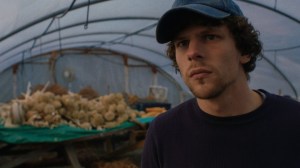
Dena (Dakota Fanning), Josh (Jesse Eisenberg) and Harmon (Peter Sarsgaard) prepare their direct action in Night Moves

Dena (Dakota Fanning), Josh (Jesse Eisenberg) and Harmon (Peter Sarsgaard) prepare their direct action in Night Moves

These themes remain present in Night Moves, in which eco-activists Josh (Jesse Eisenberg), Dena (Dakota Fanning) and Harmon (Peter Sarsgaard), exasperated by the well-meaning rhetoric of their fellow environmentalists, decide to take direct action by buying a boat (called Night Moves), stuffing it full of ammonium nitrate fertiliser and rigging it as a floating bomb to blow up a hydroelectric dam.

This, Josh declares, will finally awaken people to the environmental damage being wrought upon the world. However, an unforeseen consequence of their actions has Dostoevskian ramifications on Josh and Dena especially as guilt, paranoia and fear begin to overwhelm them.

Aboard the boat Nigth Moves in, erm, Night Moves

Aboard the boat Night Moves in, erm, Night Moves

Although this is doubtless Reichardt’s most political film, she is careful to chart a neutral course down what is a challenging river. The director also cleverly edits as if from Josh’s perspective and returns to the character as he reacts to events around him.

In an early scene, an eco-movie is being projected for a group of well-meaning types. Josh is present, although tellingly stood on the sidelines, and looks on with increasing disdain at the rhetoric of his fellow environmentalists, to the extent that the film cuts away mid-speech to reflect the disinterested contempt of its leading character.

Dena (Dakota Fanning) in Night Moves

Dena (Dakota Fanning) in Night Moves

Josh is a man of few words and has a high-minded intensity that cloaks the restless anxiety etched in his eyes. His lofty words have clearly won over the right-on Dena, a rebellious child of wealthy parents whom Josh is using to bankroll the operation; while the military-trained Harmon leads the sort of off-the-grid lifestyle Josh clearly aspires to.

Although angry at the injustice that allows salmon to be killed by the dam “just so you can run your iPod all your life”, Josh’s actions betray his eco-sentiment. A dead, pregnant doe he discovers on the side of the road is treated as an inconvenience, while extraneous parts of the boat are ripped out and discarded at a landfill site. Dena, too, identities the species of a bird through its song at one point, although Josh doesn’t even respond; lost in the statement he perceives his actions will make.

Paranoia creeps into Josh (Jesse Eisenberg) in Night Moves

Paranoia creeps into Josh (Jesse Eisenberg) in Night Moves

Reichardt masterfully turns the screw and invokes a growing sense of stifling suspense in the film’s first half and the central dam-busting sequence has a near-wordless tension reminiscent of the celebrated robbery sequence from Jules Dassin’s Rififi (1955).

Once the dam bursts, the nail-biting pressure gives way to an increasingly paranoid thriller that becomes more suspicious and jittery (soundtracked to perfection by Jeff Grace’s John Carpenter-inflected score) as the film largely jettisons Harmon and Dena and fixes its gaze almost completely on Josh. Never one for showy roles, Eisenberg dials everything down still further to present us with a character lost in his own despair and guilt.

Sarsgaard is subtly effective as the hardcore Harmon, while Fanning impresses as Dena, who is involved in one of the film’s most suspense-fulled scenes as she uses her wiles to try to convince James LeGros’ shop owner to sell her the fertiliser.

Night Moves quietly and assuredly sucks the room out of the air until what you are left with is a vacuum of tension that doesn’t let you breathe until its final shot.

Great Films You Need To See – Seconds (1966)

This is my latest contribution to The Big Picture, the internationally recognised magazine and website that shows film in a wider context. This piece about John Frankenheimer’s 1966 paranoid classic Seconds was written as part of The Big Picture’s Lost Classics strand, although I am including it within my list of Great Films You Need To See.

Paranoia is a commodity rich with cinematic potential, but few pictures have mined it with such bleak and powerful unease as Seconds (1966).

A work of cinema so far ahead of its time, Seconds is as topical now as ever has been

A work of cinema so far ahead of its time, Seconds is as topical now as ever has been

Ostensibly a work of science fiction, John Frankenheimer’s chilling dystopian nightmare addresses themes that, if anything, are more timely now than they were in the so-called Swinging Sixties.

Our fear of aging and irrelevance are front and centre in this adaptation of David Ely’s novel, as are themes of lost identity, unwitting conformity and a belief in the promise of self-entitlement sold by politicians and advertising firms.

Just one of the surreal images from John Frankenheimer's Seconds

Just one of the surreal images from John Frankenheimer’s Seconds

Seconds marked the final pessimistic entry in Frankenheimer’s unofficial ‘paranoia trilogy’ (after The Manchurian Candidate (1962) and Seven Days In May (1964), but rather than reflect the growing political cynicism that was gripping a country still coming to terms with Kennedy’s assassination and the spiralling war in Vietnam, it instead highlighted the growing crisis of masculinity that was unfolding in lock step with the burgeoning feminist movement.

The man in question is Arthur Hamilton (John Randolph), a banker bored with his marriage, job and suburban existence who signs up (after some coercion) to the promise of a new life by a shadowy organisation referred to only as ‘the Company’. Following a faked death and extensive plastic surgery, Hamilton is ‘reborn’ as Antiochus Wilson (Rock Hudson), a successful artist living the American Dream. For all intents and purposes, Wilson can begin again; however, the one thing he can never change is himself.

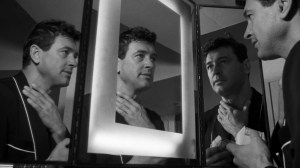
Wilson (Rock Hudson) questions his identity in Seconds

Wilson (Rock Hudson) questions his identity in Seconds

Seconds grabs your attention from the moment Saul Bass’ surreal and unnerving title sequence kicks in with a series of distorted close-ups of a person’s face, accompanied by Jerry Goldsmith’s highly strung organ score.

The seeds of alarm sown by Bass bloom in the hands of James Wong Howe’s deliberately disquieting cinematography (the film’s sole Oscar nomination), which uses all manner of weird camera angles, extreme close-ups and tight tracking shots to keep the viewer on edge.

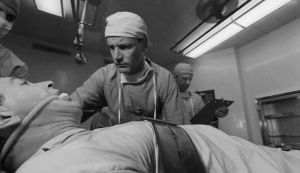
Hamilton (John Randolph) is 'reborn' in Seconds

Hamilton (John Randolph) is ‘reborn’ in Seconds

Meat is a notable theme, the meaning of which becomes clear as the film nears its climax. Hamilton is led through a slaughterhouse filled with carcases to attend  his rendezvous with the mysterious organisation, while in the film’s most blackly comic scene, chirpy Company salesman Mr Ruby (Jeff Greer) tucks into a crispy chicken dinner while explaining matter-of-factly the circumstances of Arther’s ‘death’.

Company employee Davalo (The Manchurian Candidate‘s Khigh Dhiegh) explains to Wilson: “You don’t have to prove anything anymore. You are accepted. You are alone in the world, absolved of any responsibility, except to your own interests.” The blank canvas we later see him staring at  in frustration in his beachside home suggests the interests he thought he had are just as fake as he is, however.

Wilson (Rock Hudson) comes full circle in Seconds

Wilson (Rock Hudson) comes full circle in Seconds

The point is underlined when he encounters the enigmatic Nora (Salome Jones), who describes Wilson as a “key still unturned” and urges him to throw off the shackles and embrace life. Wilson toys with the idea, but the straightjacket he’s sought to free himself from is tighter than he first thought.

Most commonly thought of as a leading man in frothy comedies, Hudson gives arguably his best performance as the tortured Wilson. It’s a canny bit of casting; Hudson was one of the world’s most desirable men at the time and the actor does an admirable job of undermining his pretty boy image, most notably in the shocking final scene.

The film’s influence can be seen in the likes of Total Recall (1990/2012) (based on Philip K Dick’s We Can Remember It For You Wholesale, also released in 1966), Terry Gilliam’s Brazil (1984) and David Fincher’s The Game (1997), while its theme of masculine crisis is the driving force behind a string of serious television shows, from The Sopranos to Mad Men.

A work of cinema so far ahead of its time, Seconds is as topical now as ever has been.