

Decades Blogathon – La Haine (1995)


We’re halfway through the Decades Blogathon, hosted by myself and the peerless Tom from Digital Shortbread! The blogathon focuses on movies that were released in the fifth year of the decade. Tom and I are running different entries each day; and this one comes from Marta over at Ramblings of a Cinephile. If you haven’t checked out Marta’s site yet – why not?! – you’ll find it filled with her thoughts on oldies, new releases, home viewing and more besides.

Mathieu Kassovitz gives us an insight into roughly 20 hours of the lives of Vinz (Vincent Cassel), Said (Said Taghmaoui) and Hubert (Hubert Kounde), three young friends from one of the banlieues (housing projects) in the suburbs around Paris, chronicling the aftermath of a riot.
The viewer witnesses the struggles and alienation of these twenty-somethings living in an impoverished, multi-ethnic environment that seems a world apart from the magical and romantic image of Paris. This contrast is highlighted even more by the stark black and white photography and the expert use of framing and editing.
The three men have a quite different reaction to the event that led to the riot: the brutal beating of one of their friends by a policeman while in custody.

Vinz, unemployed from a Jewish family, is full of rage against all the police and the establishment. Being impulsive with a need to prove himself, he’s ready for retaliation (he mimics the “Are you talking to me?” scene from Taxi Driver while alone in the bathroom).
Hubert, a Afro-French boxer and pot dealer, is more thoughtful and wiser in the ways of the world; he can see that hatred will only breed hatred and dreams to leave all this behind but, sadly, knows that there’s no escape. Said, who is an Arab Maghrebi and unemployed, inhabits a middle ground approach between those of his friends. He sees the injustice and the rampant racism but he wants to avoid troubles and just live quietly.

Following their journey while they wander around the projects or in Paris proper, the viewer is taken on a roller coaster of hectic chases, fights, weird and dangerous encounters and idle conversations. The guys will disagree (mostly Hubert and Vinz), reconcile and always have each other’s backs. Their friendship seems to be the only solace in such a grim life that almost makes you believe that they are going to be alright… so far so good, until it’s not.
After 20 years the story and themes of this film are still very actual; I might venture to say that things are slightly worse nowadays, making its tale of crude brutality and hopelessness even more poignant.
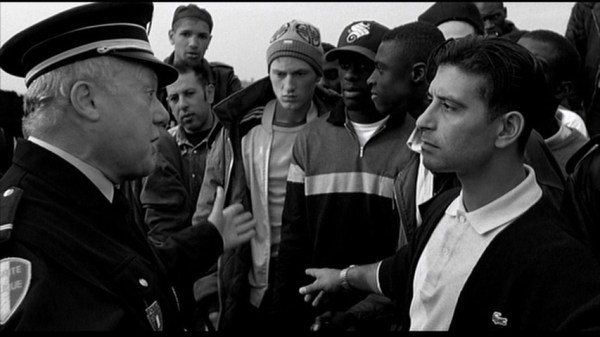
The three leads deliver brilliant performances, giving the audience flawed but sympathetic characters to root for and to follow in their grey world. Kassovitz’s directing and writing skills are impressive and were, well deservedly, recognised in 1995 since he was awarded a Cesar for Best Film and Best Director prize at the Cannes Film Festival.
At the time this film was compared to Spike Lee’s Do The Right Thing and Kassovitz noted with irony: “I don’t know if it’s really important, or intelligent even, when people say to me I’m a white Spike Lee, because they said to Spike Lee, you’re a black Woody Allen.” Gut-wrenching – 9/10
Share

Decades Blogathon – Barry Lyndon (1975)
Share

Decades Blogathon – The Night Of The Hunter (1955)

We’re onto day four of the Decades Blogathon, hosted by myself and the inimitable Tom from Digital Shortbread. The blogathon focuses on movies that were released in the fifth year of the decade. Tom and I are running different entries each day; and this one comes from Jordan over at the smart and sassy Epileptic Moondancer. Jordan’s site has a great mix of film (both old and new) and soundtrack reviews alongside plenty of other stuff to whet your whistle.

Not long ago I read an article in UK film mag Sight & Sound titled Southern Gothic. I am a big fan of old, gothic stories (Edgar Allen Poe is perhaps my favourite writer) and the article cited numerous examples of gothic tales originating from the south.
A quote from Tennessee Williams in the introduction to the article had me hooked, describing these films as being influenced by “an underlying dreadfulness in modern experience”. Hooked, I read on, and read about The Night Of The Hunter. Seeing the screenshot of a man with ‘H-A-T-E’ and ‘L-O-V-E’ tattooed on his fingers was the clincher.
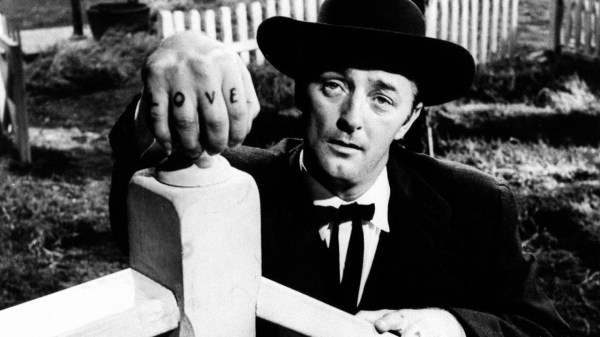
The Night Of The Hunter is an eerie and highly symbolic film; a deceptively simple tale of good versus evil. The ultimate wolf in sheep’s clothing, representing evil is our villain Reverend Harry Powell (Robert Mitchum). He is a con man who plays a preacher to misguide suspicion; however, he also seems to sincerely believe he is a man of God.
Near the beginning of the film, we see his casual attitude to what he has already committed as he speaks to God: “How many has it been? Six?… Twelve? I disremember.” Reverend Harry Powell is the ultimate embodiment of a religious fanatic; taking the bible literally, deciding that if God killed so many people, why can’t he?
After the film’s surreal opening, which is best seen rather than read about, we are misled as we hear the sounds of children playing, but as the camera brings us down we see the children discovering the preacher’s last victim. Not caught for that crime, he is soon caught driving a stolen car and ends up in court.

We then see the fate of another man, Ben Harper (Peter Graves), who after stealing $10,000 dollars gives his secret to his son and doesn’t break when questioned. Sentenced to death, his short time spent in jail is in the same cell as our preacher. We don’t see exactly where Harper decided to stash the money, adding an element of tension to the story as Reverend Harry Powell has decided that God has put him in this cell. Upon release, Powell decides to head to the town where Harper’s widow and two children reside; the children (Billy Chapin and Sally Jane Bruce) representing the good in the story.
What follows is a chilling tale as this con man quickly makes the widow (Shelley Winters) his wife, and doesn’t waste his time in asking about the money. Filled with symbolic imagery that I am sure means something to a religious scholar, the children manage to escape the menacing preacher by sailing up-river – a truly unforgettable sequence as the children become one with nature.
One shot in particular that stuck in my mind was the image of a cobweb placed over the scene of the children sailing downstream, the sort of inventive camerawork that is almost extinct today. The preacher, however, is relentless in following them, often making his presence known by singing a hymn that sounds like a lullaby, but his intentions change the nature of the song entirely.

After watching this I still cannot get those creepy lullabies out of my head. The climax of the movie is fantastic and is filled with suspense, while the ending is unlike too many films of today’s cinema; the meaning of it all is left to the viewer to decide.
Watching this reminded me of how I originally got into cinema – by working from the start through Kubrick’s filmography, followed by Polanski. I will always prefer their older films and they somehow feel more natural to me than recent film do. I was born four decades too late it seems, as older music and film always evokes more emotion from me.
So I feel I must thank to Tom and Mark of Digital Shortbread and Three Rows Back respectively, as watching and writing about this film has truly reminded me that this is the era of film that I love.
Black and white cinema has always fascinated me, and the way shadows are used here looks incredible. I must find more cinema like this. Southern Gothic or not, this is the era of movies that I will always love the most.
Share


 three rows back