As hard as it may be to believe we are entering the home stretch of the Decades Blogathon, hosted by myself and the indubitable Tom from Digital Shortbread! The blogathon focuses on movies that were released in the fifth year of the decade. Tom and I are running different entries each day; and this one comes from Fernando at Committed To Celluloid. Fernando’s site is one of my favourites out there in the blogosphere, so do yourself a favour and take a visit!
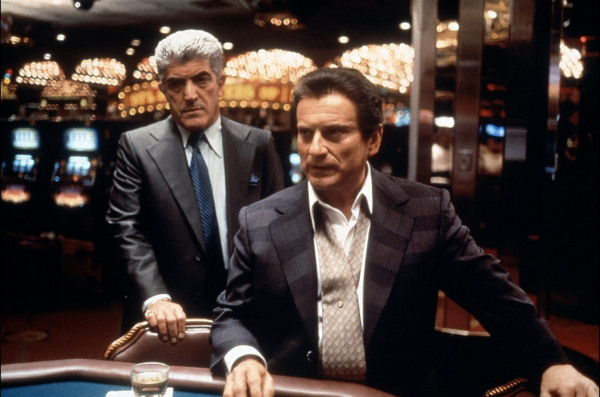
It seems so strange that Casino came out only 20 years ago. Martin Scorsese’s 1995 offering seems much older, and yes, I mean it as a compliment.
Arguably one of ole Marty’s best (or my favorite, anyway), Casino, not just because it’s set in that era, truly feels, looks and carries itself like a film of the seventies.
Riveting, stylish and peppered with bursts of extreme violence – something of a trademark for the director – I have an inkling Goodfellas’ better not-quite-a-sequel wouldn’t feel like the awkward stranger in the decade of timeless classics like Dog Day Afternoon, Chinatown and The Godfather Parts I and II.
High praise? It may be, but it’s not every day that a talky three-hour movie where not a lot goes on happens to breeze by and be totally absorbing, much less upon a second viewing.
The jazzy soundtrack is one tiny, yet pivotal part in the film’s success, which can mainly be attributed to two things: the superb script by Scorsese and Nicholas Pileggi, filled with vibrant dialogue and just the right amount of humour, and the presence of Joe Pesci in a meaty role that called for the Oscar-winner’s brilliant performance.
Pesci’s Nicky throws around f-bombs like nobody’s business (for a while, the film held the record for most uses of the curse, with 435, or 2.4 times per minute on average) and is, at the same time, Casino’s main source of comic relief and its most frightening character. Who knew tiny could be so intimidating?
Despite being overshadowed by Pesci’s flashier performance, Robert De Niro (of course) and Sharon Stone are solid, and they look great in their lavish costumes too. Stone, in particular, looks breathtakingly beautiful during the first hour of the film, before her Ginger loses herself to drugs and booze. Sharon is a sparkly vision in her first scene, which is also Scorsese’s favorite.
Sitting comfortably at #140 in the IMDb Top 250 (at the time of this review), Casino may not be as loved as other Scorsese gems, but it’s a fantastic film that demonstrates why Marty is one of the best directors still in the business.
It’s day seven of the Decades Blogathon, hosted by myself and the singular Tom from Digital Shortbread! The blogathon focuses on movies that were released in the fifth year of the decade. Tom and I are running different entries each day; and this one comes from Anna at Film Grimoire. Anna’s voice is very distinctive and you could do a lot worse than to check out her great looking site.
I love giallo films – a genre defined as a murder mystery style of film, generally Italian-made, which contains a lot of blood, guts, and eroticism.
So when it came time for the Decades Blogathon, and I saw that Dario Argento’s Deep Red (1975) would qualify for it, I knew I had to write about it. Deep Red, along with Suspiria (1977) and Tenebrae (1982), is probably one of Argento’s best known films; and for good reason, as it’s super creepy and probably one of my favourite horror films of all time.
Deep Red, also called Profondo Rosso or The Hatchet Murders, is a brutal giallo with a killer twist at the end that few could predict. Its plot is as follows:
A musician (David Hemmings) witnesses the murder of a famous psychic, and then teams up with a feisty reporter (Daria Nicolodi) to find the killer while evading attempts on their lives by the unseen killer bent on keeping a dark secret buried.
Our film begins with a stabbing murder in front of a Christmas tree, with sing-song, child-like music in the background. We see a child’s shoes and knee-high socks come into view, and the faceless child picks up the knife – did the child kill this as yet unknown victim?
I loved this beginning sequence as it sets the tone for the whole film. It’s such a disturbing thought, particularly as the child-like music from this initial moment is repeated throughout the film whenever a murder is about to occur. Are we watching a horror film where the murderer is a child? Argento excels at these kinds of mind games with his viewers.
It must be said that you cannot fault the direction by Argento. The direction is amazing, with some truly creepy shots where the camera pulls back to reveal a wider scene, with moving shadows that add a new layer of threat. Argento is truly the master of lingering on scenes or objects and making them feel extremely threatening as a result. There were a number of moments that stuck out for me as excellent in terms of their direction; namely, one particular shot that was focused on a single bead of sweat on our protagonist’s forehead, a slow zooming in on the protagonist as he plays the piano as if we are the killer focusing in on him, and overall the camera’s movement steadily throughout the film as if it’s a stalker looking for its victims.
You can say a lot about giallo films being exploitative and cheesy (which most of them are), but Argento’s direction is truly classy; which is often at odds with the film’s gratuitous violence, creating a strange dichotomy within the film. I love it.
As per other giallo films, Argento has made use of cheap actors and then overdubbed them with professional-sounding American and British voices. The dubbing in Deep Red is not as bad as some other giallos I’ve seen and the lips generally match up with the voices, although there were a couple of bad moments. I would say that the performances by our lead actors David Hemmings and Daria Nicolodi are not necessarily great; but honestly, that’s part of the fun with giallo films – the performances aren’t Oscar-worthy, but the overall story and art of the genre is what you watch the films for.
Some interesting trivia tidbits about the film – firstly, it was largely filmed in Turin, Italy, as Argento found out that there were more practicing Satanists living there than in any other European city. I love little facts like this as it shows that Argento is looking for just the right settings for his masterpieces on an ideological level rather than just a visual level.
Another example of Argento’s thoughtfulness is the methods of murders in the film, if that makes sense. Argento knew that a lot of people couldn’t relate to being shot, as many victims in horror films are, but could certainly relate to being cut or being burnt by scalding hot water. It’s this layer of Argento’s understanding of and empathy with his viewers that makes Deep Red a truly effective horror film in terms of its ability to shock and scare.
Creatively, Deep Red is a huge success. The music by progressive rock band Goblin is perfect as usual, this film being their first collaboration with Argento. Argento’s favourite colour red is an ongoing motif, with curtains, furniture, and the regular splashes of blood being different shades of red.
There is amazing set design throughout, as Argento seems to love showing his viewers the insides of gorgeous Italian apartments, mansions and villas. My favourite example of the top-notch set design is within the psychic’s apartment – paintings of ghostlike, creepy faces line the hallway, making it feel as if the killer could pop out at any moment. We regularly see from the killer’s point of view and watch his or her gloved hand reaching out to attack their victims, adding to this creepiness.
One really great question with regards to this film is, why did I choose to watch it alone at night-time? Deep Red is profoundly creepy, particularly certain scenes set in ominous-looking houses where the killer could be anywhere.
I love Deep Red because it’s one of those horror films where I would bet that you won’t be able to pick who the murderer is from the beginning. The ending is a big, brutal surprise, and I love Argento’s method of dropping a plot bomb and then going straight to the credits, giving little to no closure for his viewers.
Deep Red is a classic giallo that must be seen by horror film aficionados everywhere. Creatively, it is a stunner. Above all, it’s a very unsettling film, and that’s exactly why I love Argento’s work.
It’s day six of the Decades Blogathon, hosted by myself and the tremendous Tom from Digital Shortbread! The blogathon focuses on movies that were released in the fifth year of the decade. Tom and I are running different entries each day; and this one comes from Louis at The Cinematic Frontier. Louis’ thoughts and musings on the world of film make for fun and informative reading so why not do yourself a favour and head over there after checking out his review!
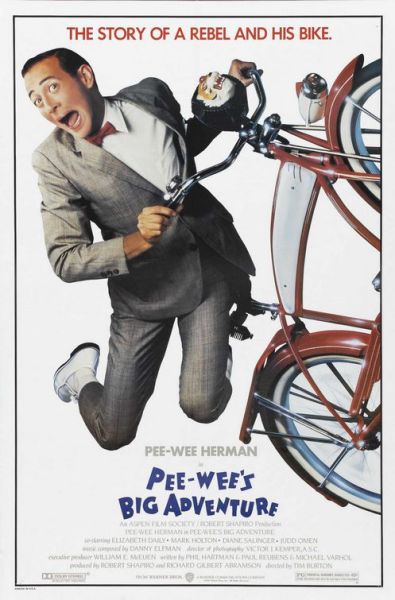
Thirty years ago, a film was released by Warner Bros. that would become an important milestone in the careers of three individuals.
For Paul Reubens, it would mark the big screen debut of his character Pee-Wee Herman; for Tim Burton, it would mark his feature film directing debut; while for Danny Elfman, it would mark the creation of his first Hollywood film score.
To say that Pee-Wee’s Big Adventure is an important film is an understatement (to say that it’s hilarious would also be an understatement). I first saw it on the big screen in January 2003 at the Walter Reade Theater in Lincoln Center. I saw it a second time later that Fall as part of a Tim Burton retrospective at the Museum of the Moving Image, and I saw it a third time on the big screen at a midnight screening at the Landmark Sunshine Cinema five years ago.
It was very enjoyable every time I saw it, and it just seemed to get funnier with every viewing. This 30th anniversary review of Pee-Wee’s Big Adventure is my entry in the Decades Blogathon hosted by Three Rows Back and Digital Shortbread.
1985’s Pee-Wee’s Big Adventure follows the child-like Pee-Wee Herman as he sets off on a road trip across America to find his special bike after he discovers that it was stolen. Burton assembled a terrific cast that includes Reubens (as Pee-Wee Herman), Elizabeth Daily (as Dottie), Mark Holton (as Francis), Diane Salinger (as Simone), Judd Omen (as Mickey), Alice Nunn (as Large Marge), Jon Harris (as Andy), Jan Hooks (as Tour Guide Tina), Carmen Filpi (as Hobo Jack), Jason Hervey (as Kevin), Morgan Fairchild (as Movie Dottie), James Brolin (as Movie P.W.) and Phil Hartman (as Reporter).
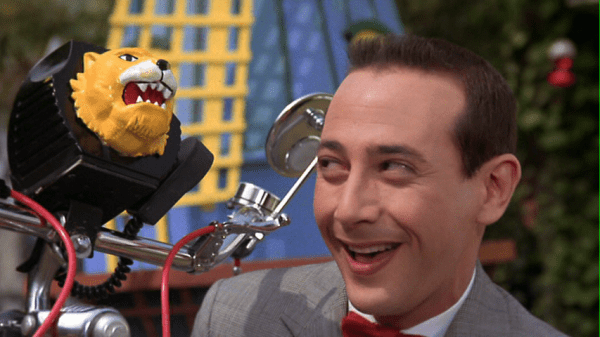
Reubens is a hoot as Pee-Wee, bringing zaniness and child-like innocence to the role. Daily is also wonderful as Dottie, the bike store employee with a huge crush on Pee-Wee. Holton is very entertaining as the villainous (and giant spoiled brat) Francis, bringing just enough zaniness and camp without going too over-the-top.
Burton was a perfect choice to direct this film as he brings order to the beautiful chaos of the world of Pee-Wee Herman (I loved his use of stop-motion animation in the more surreal moments of the film). The screenplay by Reubens, Hartman, and Michael Varhol is just funny throughout the entire film, filled with hilarious dialogue and visual gags (it’s still hard to believe that it was inspired by Vittorio DeSica’s 1948 Italian neorealist film Bicycle Thieves).
The production design by David L. Snyder is incredible, bringing such an odd world to life (Pee-Wee’s house is still my favorite, especially with all those cool gadgets, including the breakfast machine, and over-sized utensils). Victor J. Kemper’s cinematography is first-rate, as is Aggie Guerard Rodgers’ costume designs, while Elfman delivers an outstanding score with creative use of percussion and a memorable theme for Pee-Wee.
Pee-Wee’s Big Adventure is a highly enjoyable comedy that still holds up after 30 years. Its importance cannot be understated, and its success led to greater things for the careers of Burton, Reubens, and Elfman. If you haven’t already seen this comedy classic, then do so as soon as possible!






 three rows back