Review – Spectre

It may well be more than 50 years old, but this barnstorming joyride finds the Bond franchise in rude health and still showing the wannabes how it’s done.

If this is to be Craig's adieu from the Bond franchise, as has been suggested, he could have done a lot worse than make the spec-tacular Spectre his swan song

If this is to be Craig’s adieu from the Bond franchise, as has been suggested, he could have done a lot worse than make the spec-tacular Spectre his swan song

It’s fair to say that 007 is enjoying something of a golden age at present; not seen since Sean Connery foiled Goldfinger and partook in some Pussy Galore.

Daniel Craig and director Sam Mendes’ first collaboration on Bond, 2012’s monster hit Skyfall, is generally regarded as a high watermark for the series and this, the 24th film in the franchise, doesn’t let itself down.

007 (Daniel Craig) and Bond girl Madeleine Swann (Léa Seydoux) in Spectre

007 (Daniel Craig) and Bond girl Madeleine Swann (Léa Seydoux) in Spectre

If anything, Spectre‘s lighter touch makes it more a popcorn-friendly and enjoyable Bond film than Skyfall, although it doesn’t quite match up to its predecessor in terms of character development or emotional heft, while Roger Deakins’ richly atmospheric cinematography was always going to be hard to top in spite of Interstellar DoP Hoyte van Hoytema’s none-too-shabby efforts this time around.

A manic pre-credits sequence set in Mexico City during the Day Of The Dead festival (featuring a bravura opening tracking shot that has attracted favourable comparisons to Welles’ Touch Of Evil) finds Bond going off the reservation to foil a terrorist plot that nevertheless lands him in hot water with M (Ralph Fiennes), who is trying to save the ’00’ programme from being shut down by C (Andrew Scott), a civil servant with plans to form a draconian global intelligence gathering service.

Christoph Waltz plays Franz Oberhauser (or does he..?) in Spectre

Christoph Waltz plays Franz Oberhauser (or does he..?) in Spectre

Ignoring orders to stay put, Bond investigates a cryptic message from his past that leads him to the dark heart of a shadowy cabal run by the mysterious Franz Oberhauser (Christoph Waltz), as well as into the life of Dr Madeline Swann (Léa Seydoux), who reluctantly – at first – goes along for the ride.

The “James Bond Will Return” title at the end of the film aside, Spectre would make both a logical and fitting conclusion to the franchise; such is the neat bow it ties on the Craig era. The typically luxurious credit sequence shows flashes of characters who failed to make it beyond Casino Royale and Skyfall (although not Quantum Of Solace, which underscores just what a write-off that film was); while the opening title “The dead are alive” develops a richer significance beyond the Day Of The Day pre-credits.

Bond (Daniel Craig) and Q (Ben Wishaw) check out a pirated copy of Spectre in... Spectre

Bond (Daniel Craig) and Q (Ben Wishaw) check out a pirated copy of Spectre in… Spectre

What Mendes and the screenwriters (Craig included) have managed more than anything else over the past two films is to get inside the head of our favorite superspy by showing us enough of his back story to keep us wanting more. Both Skyfall and Spectre are, at their heart, richly personal films that just happen to have a whole lot of action.

The tone of Spectre may be more playful and the plotting more conventional in comparison to Skyfall, but that’s not to say it doesn’t light up the screen. The supporting characters add plenty, with Ralph Fiennes’ exasperated M, Naomi Harris’ playful Moneypenny and Ben Wishaw’s drily amusing Q as excellent as ever and Dave Bautista’s deadly Mr Hinx reminiscent of Robert Shaw’s imposing thug in From Russia With Love (with a train bust-up to boot).

Humongous henchman Mr Hinx (Dave Bautista) in Spectre

Humongous henchman Mr Hinx (Dave Bautista) in Spectre

Seydoux oozes sultry charisma as Swann, who clearly knows her own mind and is more than a match for 007 (shame the same can’t be said for Monica Belluci’s widow who submits to Bond’s alpha maleness quicker than you can say “keep the British end up”).

Waltz has an oily threat that reveals itself in increments, while Craig once again fills the shoes of the leading man with a consummate deadpan ease that leaves you wondering what’s left to mine for his successor.

If this is to be Craig’s adieu from the Bond franchise, as has been suggested, he could have done a lot worse than make the spec-tacular Spectre his swan song.

Review – Sicario

The war on drugs may be a cinematic road well-travelled, but never with as much stomach-churning immediacy as Denis Villeneuve’s visceral and suffocating procedural.

Sicario is what cinema is all about - an intelligent and visually arresting exploration of a waking nightmare that grips tight around the throat and doesn't let go

Sicario is what cinema is all about – an intelligent and visually arresting exploration of a waking nightmare that grips tight around the throat and doesn’t let go

There’s a beautiful darkness to Villeneuve’s work that has set him apart in recent years, from his 2011 breakthrough Incendies to his more recent American pictures Prisoners and Enemy (both 2013).

Whilst the surface is often hypnotic, the director’s raison d’être comes from exploring the ugly duality, mistrust and hidden darkness scratching to break free and in Sicario these themes are front and centre.

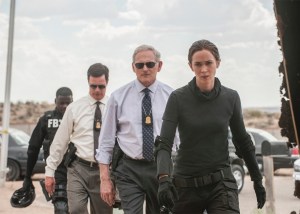
Kate Macer (Emily Blunt), Dave Jennings (Victor Garber) and their fellow agents tackle the war on drugs in Sicario

Kate Macer (Emily Blunt), Dave Jennings (Victor Garber) and their fellow agents tackle the war on drugs in Sicario

Emily Blunt plays Arizona-based FBI agent Kate Macer, whose impressiveness in the field gets her noticed by Matt Grover (Josh Brolin), a Department of Defense operative of murky jurisdiction who recruits Kate to join a special task force aimed at bringing to justice the drug cartel bosses responsible for a charnel house the FBI stumbled onto.

The search very quickly takes Kate across the border to Juárez in Mexico where she discovers she’s in way over her head and is being led a merry dance by Grover and his even shadier partner Alejandro Gillick (Benicio del Toro); a man whose past is the task force’s future.

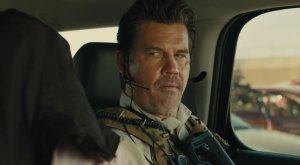
The mysterious Matt Graver (Josh Brolin) in Sicario

The mysterious Matt Graver (Josh Brolin) in Sicario

From the first foreboding strains of Jóhann Jóhannsson’s apocalyptic score, it’s clear Sicario isn’t messing around and Taylor Sheridan’s script refuses to spoonfeed the exposition; challenging you to keep up.

Kate is our way into this unfolding nightmare, challenging those around her to tell her what the hell is going on. However, it soon becomes clear that she – and we – are only going to be told information a need-to-know basis, while the jarheads she’s paired with are riding the wave of death and destruction and following orders.

The Wolfman: Alejandro Gillick (Benicio del Toro) in Sicario

The Wolfman: Alejandro Gillick (Benicio del Toro) in Sicario

Paired with the maestro that is cinematographer Roger Deakins, Villeneuve’s dark vision of a land fit only for wolves is brought stunningly to the screen; whether it be Kate looking out onto a Mexican cityscape tearing itself apart through savage and inhuman violence, or the eerie shot of soldiers slowly disappearing below a darkening sky.

The film occasionally cuts to aerial shots of the tiny shadow of a plane gliding over the Mexican landscape, or of a convoy of cars snaking through the perilous streets of Juárez to underscore just how insignificant an impact the task force are having against the multi-billion dollar industry that is the Mexican drug trade.

Troops disappear into the darkness in Sicario

Troops disappear into the darkness in Sicario

Despite the scale of the war being fought, however, small victories are possible and this is where Grover and Gillick choose to focus their efforts – after all, the tiniest cracks can sometimes bring down the whole dam.

As well as being a procedural drama, Sicario is also an (literally) explosive crime thriller that features some of the most white-knuckle action sequences you’ll see all year. A traffic jam on the Mexican/U.S. border is almost unbearably tense as Kate and the task force try to determine if they are under direct threat, while an ambush on a tunnel partially filmed using night vision and infra-red cameras is a real masterclass (the POV shot of a knife-wielding solider descending into the tunnel is like something out of a horror film).

Tunnel vision: FBI agent Kate Macer (Emily Blunt) in Sicario

Tunnel vision: FBI agent Kate Macer (Emily Blunt) in Sicario

In a superlative cast, Blunt and del Toro are stupendous, with Blunt especially dialling it back and letting the physicality of the part do the job. Blunt has come an awful long way as an actor in the past few years and gives Kate a terrified vulnerability, matched only by a stubbornness to see it through despite her better judgement.

Del Toro, meanwhile, is the best he’s been in years; offering little snippets of what’s going on under the monosyllabic exterior (a trembling hand whilst asleep suggests something’s not right), while being a badass when he needs to be.

Sicario is what cinema is all about – an intelligent and visually arresting exploration of a waking nightmare that grips tight around the throat and doesn’t let go.

Great Films You Need To See – In America (2003)

This is my latest contribution to The Big Picture, the internationally recognised magazine and website that shows film in a wider context and is this month running a series of features and reviews with the theme of ‘migration’. This piece about Jim Sheridan’s 2003 deeply personal drama In America was written as part of The Big Picture’s Lost Classics strand, although I am including it within my list of Great Films You Need To See.

Making a change can be difficult at the best of times, but doing so as a way of beginning again following the tragic loss of a loved one is a challenge that almost breaks the Sullivans; the wounded family at the centre of Jim Sheridan’s achingly moving In America.

In America a real family affair, with a warmth and spirit that won't fail to move even the most stone-hearted cynics

In America a real family affair, with a warmth and spirit that won’t fail to move even the most stone-hearted cynics

The clan – dad Johnny (Paddy Considine), mum Sarah (Samantha Morton) and their two kids Christy and Ariel (real life sisters Sarah and Emma Bolger) – have made the decision to up sticks from Ireland and illegally start a new life in the land of the free via Canada.

The reason becomes clear when Johnny inadvertently responds to a U.S. border guard’s question over how many kids they have by saying “three”; only to be corrected by the softly spoken Sarah. Their young son Frankie, it transpires, has died from a brain tumour and despite moving to New York, the bright lights of the Big Apple can only distract the clan for so long from the cloud that has followed them to their new home.

The Sullivan clan - mum Sarah (Samantha Morton), dad Johnny (Paddy Considine) and kids Christy and Ariel (Sarah and Emma Bolger) in In America

The Sullivan clan – mum Sarah (Samantha Morton), dad Johnny (Paddy Considine) and kids Christy and Ariel (Sarah and Emma Bolger) in In America

They share a rundown tenement block with a ragtag bunch of misfits, most notably “the man who screams”, aka Mateo (Djimon Honsou, an actor whose range has sadly been restricted to stern-faced action movie roles of late); a reclusive Nigerian artist who pours the anger and despair he feels over his worsening health into his painting.

He’s brought out of his self-imposed monasticism by the angelic Christy and Ariel, who love their parents deeply but struggle to recognise their father as the same man who existed before their brother’s death.

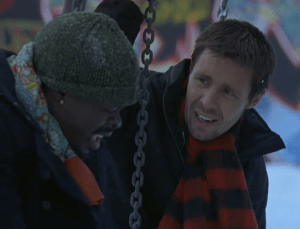
Johnny (Paddy Considine) and Mateo (Djimon Hounsou) form a bond in In America

Johnny (Paddy Considine) and Mateo (Djimon Hounsou) form a bond in In America

Johnny is an actor unable to land a part because he’s been left emotionally numb since Frankie’s death and the desperation eating away at him to make things right spills out during a street carnival when a trivial game of chance takes on high stakes consequences as he puts the family’s limited finances on the line to win a toy for Ariel.

The script can’t resist symbolism, with Sarah’s pregnancy running parallel to Mateo’s worsening illness. The mysterious Mateo, meanwhile, comes dangerously close to fulfilling the ‘magical negro’ stereotype so beloved of American cinema; a noble and principled man who forms a bond with the Sullivans and helps Johnny to finally overcome the pain of Frankie’s death.

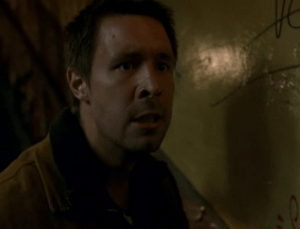
Johnny (Paddy Considine) is a man on the edge in In America

Johnny (Paddy Considine) is a man on the edge in In America

However, such is the heartfelt and convincing bond struck between the Sullivans – the Bolger sisters especially are a revelation – that you never feel manipulated and the shameless sentimentality that could so easily have derailed the picture is avoided by the sincerity of the cast and filmmakers.

Sheridan has spoken openly of how personal the project is to him (the film is dedicated to his brother Frankie, who died aged 10), while the fact the script was co-written by the director and his two daughters Naomi and Kirsten makes In America a real family affair, with a warmth and spirit that won’t fail to move even the most stone-hearted cynics.

Review – Everest

Our insignificance in the face of Mother Nature has claimed many souls over the years and did so again to tragic effect as this often heart-stopping drama based on the events that unfolded on top of the world almost 20 years ago shows.

Whilst it never quite reaches the heights it aspires to, Everest, much like its namesake, is often a sight to behold

Whilst it never quite reaches the heights it aspires to, Everest, much like its namesake, is often a sight to behold

Mountain movies have often been the preserve of the documentarian, perhaps most notably in Kevin Macdonald’s superb Touching The Void (2003). Feature films of this ilk are more thin on the ground and tend to emphasise action over character; Sly Stallone’s Cliffhanger (1993) and 2000’s Vertical Limit being a case in point.

Whilst there’s no denying the spectacle is there on screen in Icelandic director Baltasar Kormákur’s visually stunning Everest, the film’s sombre tone gives way to a growing morbidity as the tragic events it portrays play out.

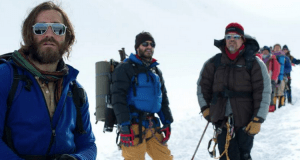
Things start going wrong for Rob Hall (Jason Clarke) and his clients on Everest

Things start going wrong for Rob Hall (Jason Clarke) and his clients on Everest

William Nicholson and Simon Beaufoy’s script also tries to give as much attention to its characters as it does to the mountain, but the sheer abundance of figures on screen, many of whom are virtually indistinguishable from each other as they try to shield themselves from the hostile environment, inevitably dilutes the drama on screen.

Set in 1996, the film follows Rob Hall (Jason Clarke), an experienced and respected mountaineer whose successful Adventure Consultants business aimed at guiding less experienced clients to the top of Everest and back down has spawned rival firms looking to get in on the action; including Scott Fischer’s (Jake Gyllenhaal) Mountain Madness.

Mountaineer Scott Fischer (Jake Gyllenhaal) leads Beck Weathers (Josh Brolin) and others up Everest

Mountaineer Scott Fischer (Jake Gyllenhaal) leads Beck Weathers (Josh Brolin) and others up Everest

Rob leads his latest group of clients, including Beck Weathers (Josh Brolin), mailman Doug Hansen (John Hawkes) and journalist John Krakauer (Michael Kelly) to Everest’s Base Camp only to find it swarming with amateur guides and climbers looking to go for the summit on the same day as he is planning. The expedition turns to disaster as Everest’s notoriously unpredictable weather strikes with full force, leaving Rob and his fellow climbers battling to survive against the elements.

Much has been made of Kormákur’s desire to shoot as much as possible on location and the scenes in Nepal and Base Camp are certainly breathtaking. Whilst the mountain scenes themselves were shot at Val Senales in Italy (with the moments towards the peak shot in a studio wherein real snow was reportedly imported), the fact that many of the cast were nevertheless subjected to freezing temperatures and unforgiving terrain provides an authenticity that’s hard to fake.

Aaaannnddd there. The summit of Everest is reached

Aaaannnddd there. The summit of Everest is reached

In spite of an excellent cast, many of the female actors are given little to do but sit at home and look worried, in particular Keira Knightley as Rob Hall’s wife Jan and Robin Wright as Beck Weathers’ wife Peach. However, Emily Watson shines as she so often does as Helen Wilton, Adventure Consultants’ Base Camp Manager. With often just a radio as a prop in which to communicate with the increasingly stricken group, Watson imbues Helen with a stoicism that flickers with despair as she realises that some of the team aren’t going to make it back down the mountain alive.

Clarke brings a warm grace to Rob, while Hawkes is our way into a world that few of us will fully understand. Gyllenhaal feels underused, however, and the same can be said of numerous other cast members who are all ultimately left in the shadow of the mountain itself.

Whilst it never quite reaches the heights it aspires to, Everest, much like its namesake, is often a sight to behold.

Review – Amy

If there were ever any doubts about the toxic and shameful damage that fame can have once the meat hooks have taken hold then look no further than this profoundly sad and deeply moving documentary about the extinguishing of a unique talent.

Whilst Amy Winehouse's music will remain, so too will this captivating documentary of a singer whose story shines a harsh spotlight on the celeb-baiting world we have created

Whilst Amy Winehouse’s music will remain, so to will this captivating documentary of a singer whose story shines a harsh spotlight on the celeb-baiting world we have created

Anyone who casts their eyes over the mainstream media will likely have formed a preconception about Amy Winehouse.

What Asif Kapadia’s comprehensive and absorbing documentary triumphantly achieves is to read between the lines of the numerous drink and drug-related articles that were written about the hugely successful British singer and instead tell a painstakingly researched story of a flawed woman who found herself lost in a self-destructive spiral as her rare talent became a tool in which to be exploited.

Much like the subject of his debut doc Senna (2011) about Formula 1 driver Ayrton Senna, Kapadia has spoken of his interest in taking Winehouse off her pedestal and casting a human gaze on a profoundly gifted individual. Working from this brief, Kapadia and his team carried out around 100 interview with friends, family, partners and music industry figures who knew and worked with her and, just like in Senna, let’s them do the talking; telling Winehouse’s story through their eyes and mouths.

Amy Winehouse, seen in happier days, in the documentary Amy

Amy Winehouse, seen in happier days, in the documentary Amy

The film follows a chronological path, with certain figures such as ex-manager and friend Nick Shymanksy playing a bigger part early on before falling away to let others take centre stage. The two who come to the fore most in the latter half of the film are her father Mitch and husband Blake Fielder-Civil.

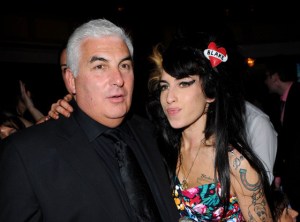
Both speak honestly about their time with Amy, but neither comes out of the film with much sympathy. Fielder-Civil essentially admits to having introduced his wife to heroin, a decision that proved to be catastrophic (a TV interview in which he bigs himself up and ‘reveals’ information about their relationship casts him in a particularly unsavoury light), while the actions of her father, in particular the fact he brought along a reality TV crew to her St Lucia hideaway, have seen him denounced as a gold-digger – something he has strenuously denied in interviews in which he accuses the film of bias.

Singer Amy Winehouse in her element on stage in Asif Kapadia's Amy

Singer Amy Winehouse in her element on stage in Asif Kapadia’s Amy

There’s a telling moment that takes place early in the film during a 2003 interview with a broadsheet journalist when the then up-and-coming singer jokingly states: “I don’t think I’m going to be at all famous… I’d probably go mad.”

It’s one of numerous moments that, inevitably, have a bittersweet weight to them in hindsight and lend the film a heart-rending tragedy as it winds painfully to its endpoint in 2011 when her body was discovered in her London flat; the singer having died from alcohol poisoning.

Amy Winehouse, with her father Mitch, in Asif Kapadia's Amy

Amy Winehouse, with her father Mitch, in Asif Kapadia’s Amy

This journey is none more despairing than when we catch a glimpse of the emaciated figure of Winehouse staring dead-eyed at a camera in her home; her face cast in a ghostly pallor by the light of a laptop screen. It’s a lifetime away from the fresh-faced teenager we see at the start of the film whose rich and sonorous voice is used for pleasure, not profit.

Kapadia’s undoubted intention is to leave you to make your own mind up; for myself it’s difficult to escape the conclusion that too many people close to Winehouse were seemingly more interested in exploiting her talent for their own ends, rather than nurturing both it and her to go on to do even more special things.

Whilst Amy Winehouse’s music will remain, so to will this captivating documentary of a singer whose story shines a harsh spotlight on the celeb-baiting world we have created.