Review – 12 Years A Slave

To do a film about one of the darkest chapters in human history justice, it needs the sort of uncompromising and unflinching directorial stamp that Steve McQueen brings.
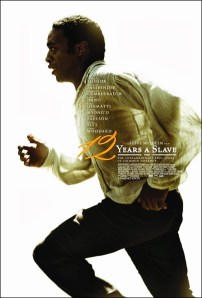
Not for the faint of heart, and neither should it be, 12 Years A Slave is, befittingly considering the director's original vocation, a work of art

Not for the faint of heart, and neither should it be, 12 Years A Slave is, as befits the director’s original vocation, a work of art

The British Turner Prize-winning artist’s two previous films, 2008’s Hunger and Shame (2011) both explored the outer limits of human behaviour and have remained as critically divisive as they are intransigent.

However, McQueen has broken out to a far wider audience with his remarkable adaptation of Solomon Northup’s 1853 autobiography, whilst staying true to his unique filmmaking sensibility.

The torment has only just begun for Solomon (Chiwetel Ejiofor) in 12 Years A Slave

The torment has only just begun for Solomon (Chiwetel Ejiofor) in 12 Years A Slave

Solomon (Chiwetel Ejiofor) is an accomplished violinist living with his wife and children in New York when he is deceived into accompanying two men to Washington, where he is kidnapped, transported to Louisiana and sold into slavery. The next dozen years are a living hell as he’s first ‘bought’ by hypocritical plantation owner William Ford (Benedict Cumberbatch) before being sold on to a different ‘master’ in the form of the psychopathic and paranoid Edwin Epps (McQueen regular Michael Fassbender) to work on his cotton plantation.

Epps, like most of his kind, sees Solomon – renamed Platt – and the other slaves as nothing more than mere possessions which he can do with as he pleases, most sickeningly to the timid Patsey (Lupita Nyong’o) whom he abuses repeatedly. As the brutality the sadistic Epps metes out to the slaves goes on seemingly without end, Solomon’s resolve and spirit gradually erode as despair and hopelessness at the thought of ever seeing his family again eat into his soul.

Solomon Northup's (Chiwetel Ejiofor) first 'master' William Ford (Benedict Cumberbatch) and his cruel carpenter John Tibreats (Paul Dano) in 12 Years A Slave

Solomon Northup’s (Chiwetel Ejiofor) first ‘master’ William Ford (Benedict Cumberbatch) and his cruel carpenter John Tibeats (Paul Dano) in 12 Years A Slave

Certain critics have criticised 12 Years A Slave for straying far too long on the numerous gut-wrenching scenes of violent punishment (some have gone so far as to label the film ‘torture porn’). Similar denunciations were made about Hunger and Shame.

However, what few films about slavery there have been have almost all shied away from what life must have really been like for thousands upon thousands of people who were bought and sold as if they were apples and oranges. As tough as it is to watch (and it can be extremely tough at times), to water it down would have been a far bigger crime.
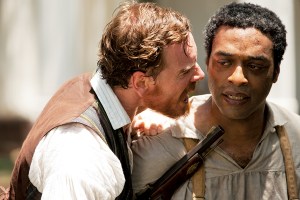
Solomon Northup (Chiwetel Ejiofor) is brutalised at the hands of psychopathic plantation owner Edwin Epps (Michael Fassbender) in 12 Years A Slave

Solomon Northup (Chiwetel Ejiofor) is brutalised at the hands of psychopathic plantation owner Edwin Epps (Michael Fassbender) in 12 Years A Slave

McQueen has cited the dark and bewitching work of Spanish painter Francisco Goya as a major influence on the film’s aesthetic design. It makes sense; just as in Hunger, there’s a hypnotic horror at work here that’s all the more potent for being so masterfully shot (the director’s signature lengthy takes and static shots are both liberally employed). Scenes of unfathomable suffering are bookended with moments of beautiful tranquility worthy of Terrence Malick – a sort of calm before and after the storm.

One of the film’s most distressing scenes comes when Solomon is saved from hanging at the hands of the racist overseer John Tibeats (Paul Dano), but is left for hours on the verge of suffocation with his toes barely touching the muddy ground while other slaves go about their daily work and children play in the background. It’s a quietly chilling evocation of the institutionalism of slavery.

Patsey (Lupita Nyong'o) begs Solomon (Chiwetel Ejiofor) for help in 12 Years A Slave

Patsey (Lupita Nyong’o) begs Solomon (Chiwetel Ejiofor) for help in 12 Years A Slave

Another memorable shot comes early in the film when a chained Solomon stares helplessly out of his Washington cell as the camera pulls up to show The White House – a supposed symbol of justice and equality.

However, perhaps 12 Years A Slave‘s most devastating image comes when Solomon breaks the fourth wall and stares hollow eyed at the audience in hopeless exasperation. For me, it’s the single greatest shot of any film this year.

Ejiofor is simply magnificent is the central role. The horrors he is forced to witness and participate in etch themselves on his face. The actor loses himself in the part and is mesmerising to watch.
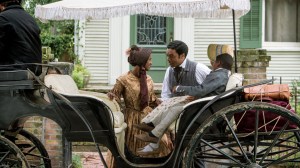
Solomon Northup's (Chiwetel Ejiofor) happy family before being kidnapped in 12 Years A Slave

Solomon Northup’s (Chiwetel Ejiofor) happy family before being kidnapped in 12 Years A Slave

Many of the film’s supporting cast are superb, in particular the incredible Nyong’o as the tragic Patsey and Fassbender, whose bravura performance as Epps is terrifying and genuinely unhinged. While Django Unchained‘s plantation owner Calvin Candie got all the best lines, there’s nothing glamorous to Epps; he’s just a monster whose evil is as ferocious as it is deadly.

It’s not a perfect film; John Ridley’s screenplay is a little too on-the-nose at times, especially in the scenes between Solomon and a noble Canadian labourer played by Brad Pitt, who gets to speechify about the sin of slavery. In addition, the radiance of the scenes with Solomon’s family early in the film tries too hard to exacerbate the darkness that is to come.

These are insignificant quibbles, however, in a film that comes as close to visual poetry as I’ve seen for a long time. Not for the faint of heart, and neither should it be, 12 Years A Slave is, as befits the director’s original vocation, a work of art.

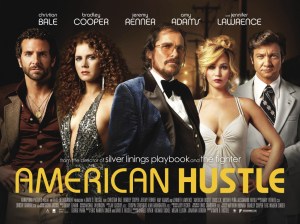
Review – American Hustle

A story about people doing anything to survive may not sound like a laugh riot, but David O. Russell’s wild ride through the hair strewn world of 70s era grifters is irresistibly entertaining.

Featuring performances as crazy as the film is chaotic, American Hustle is a feast for the senses and as much fun as you'll have in front of the big screen this year

Featuring performances as crazy as the film is chaotic, American Hustle is a feast for the senses and as much fun as you’ll have in front of the big screen this year

Russell has a thing for dysfunctional families, from boxer Mickey Ward’s (Mark Wahlberg) mouthy clan in The Fighter to the parents of Pat (Bradley Cooper) in Silver Linings Playbook, who are almost as nuts as he is.

In American Hustle, Russell cranks it up another notch by having Christian Bale’s con artist Irving Rosenfeld married to the deeply unhappy Rosalyn (Jennifer Lawrence), while also having a mistress in the form of ex-stripper Sydney Prosser (Amy Adams), who becomes Irv’s partner-in-crime by posing as an English aristocrat in order to better sell his money-making scams.

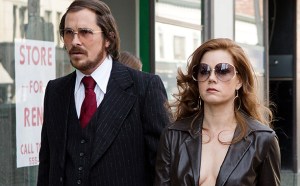
Irving Rosenfeld (Christian Bale) and partner-in-crime/girlfriend Sydney Prosser (Amy Adams) in American Hustle

Irving Rosenfeld (Christian Bale) and partner-in-crime/girlfriend Sydney Prosser (Amy Adams) in American Hustle

When they’re trapped by FBI agent Richie Di Maso (Cooper) they’re forced to help set up an elaborate sting operation (based loosely on the FBI’s Abscam operation) involving a fake Sheikh that at first targets popular New Jersey politician Carmine Polito (Jeremy Renner) before becoming something much bigger, and far more dangerous.

Russell’s affinity for families extends to the repertoire of actors he has formed during his career, with The Fighter‘s Bale and Adams and Silver Linings Playbook‘s Cooper and Lawrence returning, all be it in very different guises.

American HustleIn another Machinist-esque body transformation, Bale’s rotund Irv Rosenfeld (he gained 40 lbs for the role) is arguably his most complete performance to date. The “elaborate” comb over that we see Irv methodically setting in place at the start of the film thanks to plenty of hair glue and spray speaks to the polished act he puts on for the world that’s always a gust of wind away from falling apart.

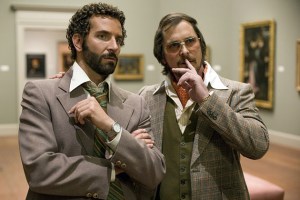
FBI agent Richie Di Maso (Bradley Cooper) and con man Irving Rosenfeld (Christian Bale) in American Hustle

FBI agent Richie Di Maso (Bradley Cooper) and con man Irving Rosenfeld (Christian Bale) in American Hustle

Richie’s tight, manicured perm equally sends out a message of control that is at odds with the character once things start to get heavy. Cooper does his best work with Russell and brings plenty of entertaining tics to the table to make Richie a memorable character.

Russell has spoken publicly of his interest in strong female roles and the work of both Adams and Lawrence is outstanding. Adams especially is a powerhouse and oozes self-confidence and self-loathing in equal measure. Sydney is the smartest person in the room and it’s easy to understand why both Irv and Richie are so drawn to her.

A fantastic ensemble is the key to the success of American Hustle

A fantastic ensemble is the key to the success of American Hustle

Renner, who also sports a hairdo that can best be described as “very 70s”, holds his own as a politician doing the wrong thing for the right reasons, while a brief cameo from an uncredited Robert De Niro is one of the film’s many highlights.

American Hustle is very much the bastard offspring of Martin Scorsese and Paul Thomas Anderson, while Steven Soderbergh could very well be its godfather (pun not intended). It’s impossible to watch the kinetic camerawork and quick zooms and not be reminded of Goodfellas and Casino, while the beautiful squalor of Boogie Nights is also evoked. Likewise, the caper element is very reminiscent of Ocean’s Eleven, all be it without the smugness.

Irving Rosenfeld (Christian Bale) kind-of admires his gut in American Hustle

Irving Rosenfeld (Christian Bale) kind-of admires his gut in American Hustle

At 138 minutes, the film feels too long and could have done with a 20-minute trim to make it truly great instead of very good. On the flip side, we’re treated to more of Russell’s razor-sharp dialogue and amusing vignettes, not least of which the whole “science oven” (aka microwave) sequence and Lawrence’s OTT stab at Paul McCartney’s Live And Let Die in her rubber kitchen gloves.

Featuring performances as crazy as the film is chaotic, American Hustle is a feast for the senses and as much fun as you’ll have in front of the big screen this year.

Review – Frances Ha

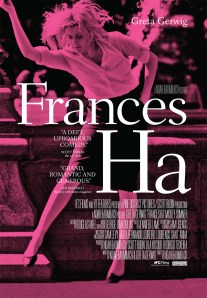
One shouldn’t judge a book by its cover – as Noah Baumbach’s charming tale about arrested development on the too-cool-for-school streets of New York City attests.

Frances Ha can be seen as that last hurrah before the inescapable call of adulthood becomes too loud to ignore. Don't pre-judge it; just go with the flow like Frances and give yourself in to its charms

Frances Ha can be seen as that last hurrah before the inescapable call of adulthood becomes too loud to ignore. Don’t pre-judge it; just go with the flow like Frances and give yourself in to its charms

More respected than cherished, Baumbach has made a habit of shining a harsh light on his liberal WASP-ish characters, none more so than in his last three pictures The Squid And The Whale (2005), Margot At The Wedding (2007) and Greenberg (2010), wherein Ben Stiller’s titular misanthrope stumbles along a fine line between amusing and annoying.

For his latest film, Baumbach softens this harsh gaze by switching his focus away from characters crippled by regret to a protagonist who, in her own words, isn’t “a real person yet”.

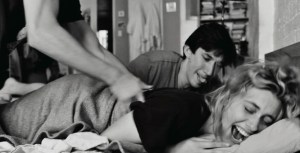
Frances (Greta Gerwig) and best friend Sophie (Mickey Sumner) in Frances Ha

Frances (Greta Gerwig) and best friend Sophie (Mickey Sumner) in Frances Ha

That character is played by Greta Gerwig, whose turn as Violet Wister in Whit Stilman’s ill-judged Damsels In Distress was so irritating as to colour my judgement of the actress. In spite of the near-universal praise lavished on Frances Ha, I consequently approached the film with apprehension.

However, just as Sally Hawkins’ performance as the relentlessly upbeat Poppy in Mike Leigh’s Happy-Go-Lucky won me over in spite of myself, so to does Gerwig as Frances, a struggling dancer in her late twenties who lives day-to-day with her best friend Sophie (Mickey Sumner) in Brooklyn.

Frances' one-time flatmates Lev (Adam Driver) and Benji (Michael Zegen) in Frances Ha

Frances’ one-time flatmates Lev (Adam Driver) and Benji (Michael Zegen) in Frances Ha

Frances compares their relationship to that of “a lesbian couple that doesn’t have sex anymore”, but when Sophie is asked to move into the perfect apartment with her boyfriend the bubble bursts. Frances has a habit of falling on her feet, though, and the film follows her as she moves between apartments, her parent’s home in Sacramento and a spontaneous sojourn in Paris.

Those with a glass-half-empty disposition may find themselves shifting uneasily in their seats during the opening montage which sees Frances and Sophie kookily buzzing around NYC. However, spend some time with Frances and it becomes impossible not to warm to her heart-on-sleeve brio despite regular bouts of self-absorption.

There's more than a hint of François Truffaut in Frances Ha

There’s more than a hint of François Truffaut in Frances Ha

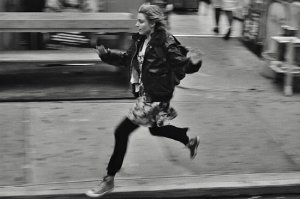
Gerwig, who co-wrote the script with Baumbach, gives the best performance of her career and infuses Frances with an awkwardness and eagerness-to-please that’s set against bursts of shameless exuberance. Her dance through the New York streets to David Bowie’s Modern Love is as joyous a moment of cinema as you’ll see all year. It’s one of several inspired marriages of sound and vision (to borrow another Bowie song title); another being the use of Hot Chocolate’s Every 1’s A Winner over Frances’ impromptu trip to Paris.

Sumner does a fine job as a more toned-down version of Frances; someone who is facing her own doubts about moving on. Sophie’s nostalgia for a life-less-complicated is matched by hipsters Lev (Girls‘ Adam Driver) and Benji (Michael Zegen), who temporarily share their apartment with Frances and find themselves sucked in to her ever-changing life.

Frances (Great Gerwig) hangs out with Lev (Adam Driver) in Frances Ha

Frances (Great Gerwig) hangs out with Lev (Adam Driver) in Frances Ha

Benji shares a particular bond with Frances over their penchant for self-contradiction. By way of example, Benji proudly points to a photo and says: “That’s me with Jay Leno.” When Frances retorts “he’s such a dick”, Benji replies: “I know, but don’t you just love him?”

The film’s stunning black and white photography inevitably brings to mind that other ode to New York, New York; Woody Allen’s Manhattan, although the film’s willful abandon also very consciously nods in the direction of the French New Wave, in particular François Truffaut.

Frances Ha can be seen as that last hurrah before the inescapable call of adulthood becomes too loud to ignore. Don’t pre-judge it; just go with the flow like Frances and give yourself in to its charms.

In Retrospect – Home Alone (1990)

I’ve been enlisted by Tom at the never-less-than-superb Digital Shortbread to take part in his weekly Throwback Thursday segment. Tom came to me to see if I would like to contribute one half of a double-feature evaluation of that festive favourite Home Alone (1990) and its 1992 sequel Home Alone 2: Lost In New York. Needless to say, I was honoured to be invited to take part in what’s always a fun and informative feature and delighted to be able to share my thoughts on Home Alone. Make sure to head on over to Tom’s great site (the quality of writing is something else) and check out his thoughts on Home Alone 2. Thanks again Tom!

Christmas just wouldn’t be Christmas without Home Alone, right?

Criticising Home Alone is like taking candy from a baby; it's easy but you feel bad about doing it. For all its faults - and it has a few - it's a guilty pleasure you don't feel too bad about indulging when the festive season comes around

Criticising Home Alone is like taking candy from a baby; it’s easy but you feel bad about doing it. For all its faults – and it has a few – it’s a guilty pleasure you don’t feel too bad about indulging when the festive season comes around

As much a festive tradition as roasting chestnuts on an open fire and receiving socks from granny, Chris Columbus’ monster box office hit had a seismic impact on Hollywood and helped to usher in a gamut of family friendly flicks hoping to ride the wave.

The home invasion movie was hardly a new concept, but writer and producer John Hughes sought to lighten up this normally dark sub-genre with a pair of bungling burglars and a protagonist whose early years and cutesy smile disguise a natural aptitude for home security and a hunger for sadistic violence.

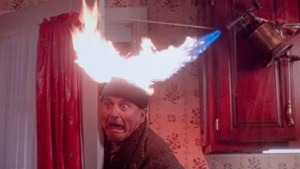
Macaulay Culkin doing what he does best - mock, shock face in Home Alone

Macaulay Culkin doing what he does best – mock, shock face in Home Alone

The kid in question is eight-year-old Kevin (Macaulay Culkin), who’s left to fend for himself in his palatial home after being accidentally left behind by his family when they fly to Paris for a Christmas vacation. While Kevin’s guilt-ridden mom (Catherine O’Hara) tries to get back home by any means necessary, the wee lad goes about protecting his castle from a pair of notorious burglars called the Wet Bandits (Joe Pesci and Daniel Stern).

Although Culkin was a known entity to Hughes, having appeared in his 1989 comedy Uncle Buck opposite John Candy (who gets a cameo here as Gus Polinski – ‘the Polka King of the Midwest’), his casting in Home Alone was nevertheless a considerable gamble due to the demands of having to hold the audience’s attention for long periods with no support. It’s a test for any actor to pull this off, but when that performer is a kid the challenge is immense.

Grrrrrr. The Wet Bandits (Joe Pesci and Daniel Stern) looking mean in Home Alone

Grrrrrr. The Wet Bandits (Joe Pesci and Daniel Stern) looking mean in Home Alone

Culkin didn’t become the biggest child star since Shirley Temple for nothing, though. With a cherubic all-American face, cheeky attitude and natural on-screen confidence, Culkin is a perfect fit for the role of Kevin. He might not have the acting chops of many of today’s child actors, but when all he’s got to do is put his hands to his face and pull that over-the-top shocked expression now and again (and again) he doesn’t need to worry about it.

The film does a nice job early on of showing how an eight-year-old would probably react when left home alone.  When he isn’t tearing around the house and eating big bowls of ice cream Kevin’s making his own entertainment, like sledging down the stairs.

"Kevin!!" Kate (Catherine O'Hara) realises she's left her son Home Alone

“Kevin!!” Kate (Catherine O’Hara) realises she’s left her son Home Alone

Kevin must soon come to realise, however, just how important family is, especially at Christmas time. After wishing they would all just go away (his brother Buzz calls him a “flem-wad” and, when asked by Kevin if he can sleep in his room, is told: “I wouldn’t let you sleep in my room if you were growing on my ass”), he’s soon pining for them. He also learns the importance of not judging books by their covers, especially the slightly odd guy next door who actually turns out to be a kind old man.

Life lessons aside, Home Alone is, for all intents and purposes, a cartoon, with Culkin’s mannered performance complementing the Laurel and Hardy shenanigans of Pesci and Stern (it’s hard to believe this came out just a couple of months after Goodfellas, which saw Pesci portray a rather more unhinged bad guy).

Joe Pesci was on fire back in 1990

Joe Pesci was on fire back in 1990

The film spends a long time teasing the audience before letting rip with Pesci and Stern’s Wacky Races-esque attempt to catch Kevin (instead of the pigeon) in the final act. Needless to say, it’s the most entertaining part of the film, with a gleeful Kevin parading around as the blundering burglars walk into trap after trap and mutter indiscernible obscenities in the same manner as Dick Dastardly’s dog Mutley.

One half of the Wet Bandits (Daniel Stern) about to regret messing with Kevin in Home Alone

One half of the Wet Bandits (Daniel Stern) about to regret messing with Kevin in Home Alone

The violence unleashed is quite nasty in places, in particular when an iron drops on Stern’s head, which in normal circumstances probably would have killed him.

Criticising Home Alone is like taking candy from a baby; it’s easy but you feel bad about doing it. For all its faults – and it has a few – it’s a guilty pleasure you don’t feel too bad about indulging when the festive season comes around.

Review – The Hobbit: The Desolation Of Smaug

We’ve had goblins and Gollum and now it’s time to enter the dragon for this breathless and sure-footed middle slab of Peter Jackson’s second Middle Earth saga.

The Desolation Of Smaug is a major improvement on An Unexpected Journey and, come the cliffhanger ending, you'll be eager to find out how they get there and back again

The Desolation Of Smaug is a major improvement on An Unexpected Journey and, come the cliffhanger ending, you’ll be eager to find out how they get there and back again

The bumpy beginnings of Bilbo Baggins’ unexpected journey were a worrying sign for this elongated adaptation of JRR Tolkien’s children’s novel.

However, just as The Two Towers was an an improvement of The Fellowship Of The Ring (and the best of the The Lord Of The Rings trilogy in this reviewer’s opinion), Jackson has rediscovered his Middle Earth mojo following the relative disappointment of An Unexpected Journey for this hugely enjoyable follow-up.

There's trouble brewing for Bilbo (Martin Freeman) in The Hobbit: The Desolation Of Smaug

There’s trouble brewing for Bilbo (Martin Freeman) in The Hobbit: The Desolation Of Smaug

The now standard near three-hour running time this time doesn’t feel like a slog as the film zips from one frenetic set piece to another, while the introduction of new characters and environments enrich this expansive universe rather than weigh it down.

No concessions are made for the uninitiated as the story picks up where it left off, with Bilbo (Martin Freeman) and the wizard Gandalf (Ian McKellen) accompanying a 13-strong band of Dwarves, led by Thorin Oakenshield (Richard Armitage), to the Lonely Mountain to reclaim their lost treasure from the dragon Smaug. Their journey is made more perilous by the fact they’re being hunted by a bloodthirsty group of orcs, while the identity of the evil Necromancer who has been marshalling the orc forces is revealed.

The dwarves of Erebor, led by Thorin (Richard Armitage) at the door of the Lonely Mountain in The Hobbit: The Desolation Of Smaug

The dwarves of Erebor, led by Thorin (Richard Armitage) at the door of the Lonely Mountain in The Hobbit: The Desolation Of Smaug

In spite of the film’s length, the first thing that’s apparent when watching The Desolation Of Smaug is its urgency. The decision to stretch a 300-page novel into a trilogy that in all likelihood will last close to nine hours still grates with many, but the flab that bloated much of An Unexpected Journey is trimmed down here.

In the time it took Bilbo to leave the Shire in the first film, our not-so merry fellowship has evaded orcs, encountered a mysterious ‘skin-changer’ and made it to the oppressive confines of Mirkwood. If anything, the film zips about too much towards the end and looses its direction as it attempts to juggle too many balls.

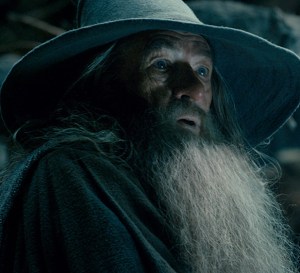
Gandalf (Ian McKellen) comes face-to-face with evil in The Hobbit: The Desolation Of Smaug

Gandalf (Ian McKellen) comes face-to-face with evil in The Hobbit: The Desolation Of Smaug

While the set pieces of An Unexpected Journey were largely underwhelming, The Desolation Of Smaug delivers a breadth of spectacle that reminds you why you fell in love with LOTR. The creepy giant spider sequence in Mirkwood is masterfully done and reminiscent of the nightmarish attack by huge insects in Jackson’s version of King Kong. It also offers Freeman’s one real moment to portray the dehumanising effect of the Ring as a horrified Bilbo recoils at the possessive fury he temporarily succumbs to.

Just as Jackson captures the dark and suffocating mood of the spider sequence, he switches things up in the tremendously entertaining barrel escape from the wood elves. Shot like a roller coaster ride and infused with as much humour as danger, it’s exhilarating stuff.

Tauriel (Evangeline Lilly) and fellow elf Legolas (Orlando Bloom) on the trail of orcs in The Hobbit: The Desolation Of Smaug

Tauriel (Evangeline Lilly) and fellow elf Legolas (Orlando Bloom) on the trail of orcs in The Hobbit: The Desolation Of Smaug

And what of Smaug? As a work of CGI, it rivals Gollum and King Kong for sheer impact. Given voice by an oily Benedict Cumberbatch, Smaug is amusing, arrogant and deadly in equal measure and provides the film with a rousing final act. The interplay between Bilbo, who has been sent by the dwarfs into the dragon’s lair to retrieve a priceless heirloom, and Smaug is laced with tension as the hobbit flatters to deceive in the vain hope the beast will let him leave unscathed.

Freeman has visibly relaxed into the role and gets some lovely moments with his dwarf companions who, by sheer weight of numbers, still struggle to make much of an impact, save for Ken Stott’s Balin and Aidan Turner’s dashing Kíli.

The scenery remains just as lovely in The Hobbit: The Desolation Of Smaug

The scenery remains just as lovely in The Hobbit: The Desolation Of Smaug

The sense of entitlement, as well as the desire for power and its poisonous consequences are themes present in much of Tolkien’s work and are touched on here through a subtle shift in Thorin’s character, nicely played by Armitage.

It’s a shame McKellen’s Gandalf isn’t on screen more as, just as in An Unexpected Journey, he’s the star attraction. That said, the portentous scenes of him investigating the identity of the Necromancer are among the film’s strongest. As well as McKellen, Orlando Bloom also returns as a more impetuous Legolas, who has a personal attachment to Evangeline Lilly’s strong-willed Tauriel (a creation by Jackson and his fellow writers, presumably to balance the male/female scales at least a little bit).

This is a major improvement on An Unexpected Journey and, come the cliffhanger ending, you’ll be eager to find out how they get there and back again. That’s all the middle section of a trilogy can do, right?