Review – Foxcatcher

The desire to win is eclipsed by the aching need for love and acceptance in Bennett Miller’s riveting true life drama that is akin to a light being slowly extinguished.
The American Dream is writ large on many films, but rarely has it been so perverted than in the mesmeric Foxcatcher

The American Dream is writ large on many films, but rarely has it been so perverted than in the mesmeric Foxcatcher

More disquieting than many horror movies, the nauseating dread that Foxcatcher instills grips like a cold and clammy hand around the throat and refuses to let go well after the credits have rolled.

Just as Miller’s previous film Moneyball (2011) uses a sport (baseball) to explore the insecurities and fallibilities of men, the wrestling of Foxcatcher is of a more metaphorical nature.

Mark Schultz (Channing Tatum) brings his A game with brother Dave (Mark Ruffalo) in Foxcatcher

Mark Schultz (Channing Tatum) brings his A game with brother Dave (Mark Ruffalo) in Foxcatcher

While the surroundings of John du Pont’s (Steve Carell) Foxcatcher estate are as grandiose as they are expansive, the dark skies that hang overhead like a guillotine tell a very different and troubling story.

Olympic gold medal-winning wrestler Mark Schultz (Channing Tatum) is flown out to the estate at the behest of du Pont, who announces that he wants Mark to lead his wrestling squad, ‘Team Foxcatcher’, and win gold at the 1988 Seoul Olympics.

John du Pont (Steve Carell) lost in the mist in Foxcatcher

John du Pont (Steve Carell) lost in the mist in Foxcatcher

While they come from opposite ends of the societal spectrum, Mark and du Pont are very alike; each man lives in the shadow of another, lacks a father and has a burning desire to be recognised for their own achievements.

Talk of glory and “making America great again” may strike a chord, but it is a delusion both men are willing to believe for their own sake. Mark has long lived in the shadow of his more popular and charismatic older brother Dave (Mark Ruffalo), who is also a gold medal-winning wrestler, but has a stable family with wife Nancy (Sienna Miller, who has little to do) and their kids; while the sense of entitlement and arrogance inherent in du Pont is undercut by the inadequacy he feels in the presence of his aged mother (Vanessa Redgrave), who views wrestling as a ‘low’ sport.

Dave Schultz's wife Nancy (Sienna Miller) in Foxcatcher

Dave Schultz’s wife Nancy (Sienna Miller) in Foxcatcher

Du Pont’s state-of-the-art facilities and Mark’s natural ability initially make for a formidable team, but Mark’s self-destructive nature and Du Pont’s unpredictability breeds a toxicity that is allowed to fester, especially when Dave is lured to Team Foxcatcher with promises of wealth and greatness.

The impressive Tatum plays Mark as a pathetic, childlike figure ripe for exploitation. From his hunched, shuffling gait to his monosyllabism, the glory of winning gold at the 1984 Los Angeles Olympics has been replaced by an emptiness no amount of medals can fill.

Good times: Mark Schultz (Channing Tatum) and Team Foxcatcher's John du Pont (Steve Carell) in Foxcatcher

Good times: Mark Schultz (Channing Tatum) and Team Foxcatcher’s John du Pont (Steve Carell) in Foxcatcher

An early scene has Mark giving a talk about winning to a bunch of bored and confused schoolkids and upon receiving the cheque we discover it’s his brother the school had originally booked before it cuts to Mark standing in line for a burger which he hides away in his car to eat.

Later in the film, du Pont suddenly gets more hands on with training when he spies his mother being wheeled in. While the team is content to indulge the show, she is soon bored and quickly leaves; with his most important audience gone, du Pont takes a back seat once more.

These moments speak to the fraudulence of both men and subtly shift the ground beneath our feet so we are never certain of what either will do next. Some have cited the film’s slow pacing as being glacial and boring, but that’s to miss the coiling tension that Miller winds up before exploding into acts of random violence.

The wheels come off for Mark Schultz (Channing Tatum) despite his brother Dave's (Mark Ruffalo) help in Foxcatcher

The wheels come off for Mark Schultz (Channing Tatum) despite his brother Dave’s (Mark Ruffalo) help in Foxcatcher

Much has been made of the training session scene between Mark and Dave that speaks volumes about each brother without either barely saying a word. It’s one of a number of examples where the visuals and reactions of characters do more than a thousand lines of dialogue ever can.

Tatum has never been better and holds his own against Ruffalo, who has the more difficult role of a man torn between his family, the love he has for his brother and the temptation of du Pont’s pay cheque. Carell, meanwhile, disappears into the role of du Pont, imbuing him with a Nosferatu-esque stillness and a detachment that only a man of his great wealth could have. Whilst he looks down his considerable nose on those around him, his heavy-lidded eyes disguise an unnerving capriciousness.

The American Dream is writ large on many films, but rarely has it been so perverted than in the mesmeric Foxcatcher.

Review – American Sniper

The dehumanising effects of combat come to the fore in Clint Eastwood’s visually powerful, but ultimately conventional examination of one man’s war.

Eastwood has fashioned an efficient and, at times, muscular war movie, but in spite of its cracking central turn American Sniper just misses its target

Eastwood has fashioned an efficient and, at times, muscular war movie, but in spite of its cracking central turn American Sniper just misses its target

Eastwood made his name playing masculine, violent men and since turning his hand to directing has largely stuck to his guns, to varying degrees of success.

His undisputed masterpiece, 1992’s Unforgiven, was a slow ride to hell as it laid bare the sickening emotional consequences killing someone might actually have on its assorted gunslingers, while his celebrated Gran Torino (2008) found its Dirty Harry protagonist forced to face both his own mortality and the changing face of his country.

The 'most lethal' Chris Kyle (Bradley Cooper) in American Sniper

The ‘most lethal’ Chris Kyle (Bradley Cooper) in American Sniper

In his latest, Eastwood’s stoical leading man is Chris Kyle, a “legend” among his brothers in arms for having chalked up 160 confirmed kills in Iraq and on whose self-explanatory book American Sniper: The Autobiography Of The Most Lethal Sniper In US Military History the film is based.

We are introduced to Kyle (Bradley Cooper) on just another day in Iraq, with a woman and child in his sights. They may be carrying an explosive device or they may not; it’s up to Kyle to make the judgement in order to keep his fellow marines safe.

Chris Kyle's (Bradley Cooper) nemesis in American Sniper

Chris Kyle’s (Bradley Cooper) nemesis in American Sniper

The film flashes back to varying, defining points in his life, from a childhood hunting trip with his father in which he is taught to be a sheep dog to protect the sheep from the wolves, through to his decision to enlist as a US Navy Seal following the 1998 US embassy bombings. The red, white and blue-blooded all-American gets his chance to put his training into practice in the aftermath of 9/11 and the allied invasion of Iraq.

As Kyle racks up kill after kill – men, women and children – over the course of four tours, the cracks begin to show, both on his psyche and his marriage to Taya (Sienna Miller), while his notoriety leads to a bounty being placed on his head by the enemy.

A rare moment of happiness for Chris Kyle (Bradley Cooper) and wife Taya (Sienna Miller) in American Sniper

A rare moment of happiness for Chris Kyle (Bradley Cooper) and wife Taya (Sienna Miller) in American Sniper

Whilst visually arresting and bolstered by a central performance of considerable nuance and intensity by Cooper, American Sniper isn’t anything we haven’t seen before.

Kyle’s back story feels rushed, as if Eastwood is conscious of cutting to the action, while the Iraqis are either faceless enemies, cardboard cutout villains or fodder for Kyle’s sniper rifle.

The most promising character we see from the ‘enemy’ side is a Syrian sniper who incurs Kyle’s wrathful vengeance after shooting one of his friends. Steven Spielberg, who was on board to direct before walking away from the project, wanted to beef up the character and escalate the psychological warfare between the two shooters. It’s a premise that Eastwood, for good or ill, has chosen not to focus on.

The consequences of being a soldier in Iraq takes its toll for Chris Kyle (Bradley Cooper) in American Sniper

The consequences of being a soldier in Iraq takes its toll for Chris Kyle (Bradley Cooper) in American Sniper

Aside from a couple of unnecessary slow motion set pieces and a special effects shot of a bullet flying through the air that belongs in a cheaper movie, the various scenes of sharpshooting are disturbing in the matter-of-fact way they are portrayed. The rifle’s sights add an air of detachment from the death we are witnessing, with the exception of a horribly uncomfortable moment when a distressed Kyle has in his sights a young boy undecided whether to fire at an American convoy.

A particularly evocative sequence comes late on when Kyle and his buddies are engaged in a firefight during a sandstorm. It’s a potent image, loaded with hellish intent.

Miller is excellent, but is hamstrung by unoriginal dialogue (“Even when you’re here, you’re not here!”) and little screen time which undermines the scenes she and Cooper share back home. The director tries to emphasise Kyle’s worsening psychological scarring through these moments, but doesn’t give them the time to breathe.

Eastwood has fashioned an efficient and, at times, muscular war movie, but in spite of its cracking central turn American Sniper just misses its target.

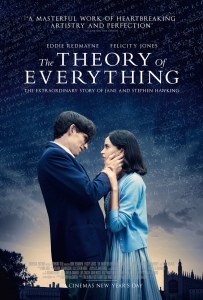
Review – The Theory Of Everything

For a film that could so easily have fallen into a black hole of mawkishness and reverence for its wheelchair-bound genius, The Theory Of Everything is instead a superbly acted study of two people’s remarkable journey through a complicated marriage.

The Theory Of Everything may be too safe at times, but its astronomical cast gives it the big bang it needs to live up to the true story

The Theory Of Everything may be too safe at times, but its astronomical cast gives it the big bang it needs to live up to the true story

Had this not been based on Jane Wilde Hawking’s memoir Travelling To Infinity: My Life With Stephen, you suspect James Marsh’s film would have had a very different – and possibly inferior – slant.

However, Anthony McCarten’s screenplay is careful to remind us there are always two people in a marriage, even if one of them is the world-renowned theoretical physicist Stephen Hawking.

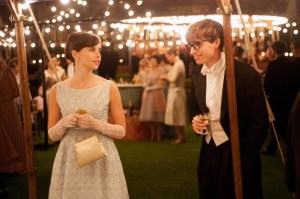
An early moment of happiness for Jane (Felicity Jones) and Stephen Hawking (Eddie Redmayne) in The Theory Of Everything

An early moment of happiness for Jane (Felicity Jones) and Stephen Hawking (Eddie Redmayne) in The Theory Of Everything

While’s Hawking’s stratospheric trajectory from Cambridge University cosmology student to the most famous scientist on the planet is undoubtedly a major focus of the film, The Theory Of Everything is at its heart a story of how two people struggle to hold a marriage together in the face of extraordinary pressures, both physical and emotional.

The film follows the couple (played by Eddie Redmayne and Felicity Jones) from their first encounter at university, through Stephen’s diagnosis with motor neurone disease and their decision to marry and have children in spite of the two-year life expectancy he was initially given. As the two-year mark comes and goes (curiously ignored) and Stephen’s career ascends, the film also focuses on the growing strain put on Jane as she tries to balance her own life against that of raising kids and looking after an increasingly debilitated husband.

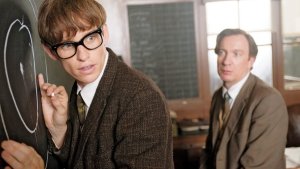
Stephen Hawking (Eddie Redmayne) makes a breakthrough in front of lecturer Dennis Sciama (David Thewlis) in The Theory Of Everything

Stephen Hawking (Eddie Redmayne) makes a breakthrough in front of lecturer Dennis Sciama (David Thewlis) in The Theory Of Everything

Things take a twist with the introduction of Jonathan Jones (Charlie Cox), a widower whom Jane meets when trying out for the church choir. Initially welcomed into the fold as someone who is there to give the frustrated and unhappy Jane much-needed help, the dynamic shifts as Jane and Jonathan become closer while Stephen looks on, undoubtedly aware of their growing attraction but choosing not to say anything.

It’s here where the film skilfully avoids soap opera over-drama and weaves a complex tapestry wherein Jane is torn between the love she has for her husband and the feelings she shares with the quiet and principled Jonathan. During a scene when Jane, Jonathan and her kids are staying at a campsite on their way to see Stephen in France, it cuts between Stephen’s failing health at a classical music concert and Jane going to Jonathan’s tent. The film chooses to remain ambiguous as to whether anything happens between them, but reality bites when she learns of the extent of Stephen’s sudden downturn.

Time is an integral player in the story, be it the two-year life expectancy given to Stephen upon being diagnosed with MND or the decision by Stephen to “wind back the clock” and prove what happened following the Big Bang. The momentum of time, both forwards and backwards, is represented by a clock-like circular motion of the camera that Marsh returns to throughout the film, from milk being poured into a cup of tea, to a spiral staircase or the circular patterns of dancers during the Cambridge University ball.

Jane (Felicity Jones) helps Stephen following the loss of his voice in The Theory Of Everything

Jane (Felicity Jones) helps Stephen following the loss of his voice in The Theory Of Everything

Spanning such a long period (roughly covering the early 1960s to the publication of Hawking’s celebrated book A Brief History Of Time in 1988 and the arrival of his assistant Elaine, played by Maxine Peake, in the early 1990s), it’s inevitable that certain sections of the story are glossed over, but it’s nevertheless a pity that the final act feels so rushed and the fate of characters seen extensively early on, such as Stephen’s parents and his (fictional) roommate and friend Brian (Harry Lloyd), aren’t resolved.

Widower Jonathan Jones (Charlie Cox) in The Theory Of Everything

Widower Jonathan Jones (Charlie Cox) in The Theory Of Everything

One thing that isn’t uncertain is the quality of the central performances. Jones gives a career-best turn in a role that, if overplayed, could have been maudlin; however, the actress imbues Jane with a steely determination that belies her soft English rose exterior.

The chemistry she shares with the Redmayne is captivating. For his part, Redmayne is extraordinary, disappearing into the role so completely you soon forget you’re watching a performance at all, much like Daniel Day-Lewis in My Left Foot.

The Theory Of Everything may be too safe at times, but its astronomical cast gives it the big bang it needs to live up to the true story.

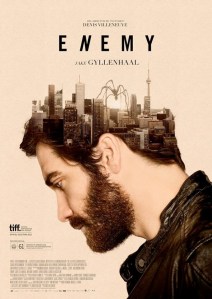
Review – Enemy

There’s double trouble to be had in Denis Villeneuve’s compulsive and uncompromising psychological descent into a world of neurosis, nightmares and arachnids.

Enemy is bold and beguiling filmmaking and a puzzle that will linger in the memory long after the closing credits

Enemy is bold and beguiling filmmaking and a puzzle that will linger in the memory long after the closing credits

Loosely based on José Saramago’s 2002 novel The Double as opposed to Dostoyevsky’s novel of the same name (which Richard Ayoade adapted to moderate acclaim in 2014), Enemy is one of those puzzle box films that reward repeat viewings.

Ostensibly, the movie follows unfulfilled history lecturer Adam Bell (Jake Gyllenhaal) down the rabbit hole following the shock discovery that a bit player in a movie he’s watching is his apparent doppelgänger. Adam seeks out actor Anthony Claire (also Gyllenhaal), who may be his physical duplicate but appears more narcissistic and charismatic than the nervous and emotionally repressed Adam. Their encounter has unforeseen repercussions for both men, as well as for Adam’s girlfriend Mary (Mélanie Laurent) and Anthony’s pregnant wife Helen (Sarah Gadon).

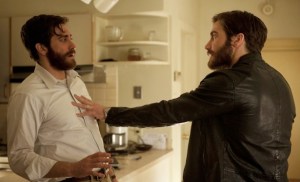
The left hand doesn't know what thr right hand's doing for Adam/Anthony (Jake Gyllenhaal) in Enemy

The left hand doesn’t know what the right hand’s doing for Adam/Anthony (Jake Gyllenhaal) in Enemy

Scratch beneath the surface, however, and Villeneuve’s absorbing picture is a spider’s nest of different interpretations and perspectives in which individuality has become as precarious as one man’s collapsing mind.

The film’s opening intertitle “Chaos is order yet undeciphered” – a line taken from Saramago‘s novel – is given form by the numerous long shots of a city (in this case Toronto); that most chaotic yet fully formed of human creations that here is infected with a yellow, hazy sickliness, beautifully realised by cinematographer Nicolas Bodluc.

Anthony's pregnant wife Helen (Sarah Gadon) in Enemy

Anthony’s pregnant wife Helen (Sarah Gadon) in Enemy

It has been argued (convincingly in my mind) the spiders seen throughout the film are both a visual and subtextual metaphor for a loss of freedom.

Adam teaches his class about the larger impact of this loss of freedom through his lectures on dictatorships, specifically their obsession with control and “censoring any means of individual expression”. On a more personal scale, Villeneuve shows us Adam/Anthony’s fractured psychological state and as the film continues it becomes apparent (at least to this reviewer) that Adam and Anthony are one in the same person, battling it out to see which side of his personality wins out. As a poster for the film implies: “You can’t escape yourself.”

Anthony (or is it Adam?) (Jake Gyllenhaal)  spies on Mary (Mélanie Laurent) in Enemy

Anthony (or is it Adam?) (Jake Gyllenhaal) spies on Mary (Mélanie Laurent) in Enemy

Shots of overhead electrical cables and a cracked window signify a spider’s web and lend extra weight to the suggestion that Adam/Anthony is trapped and must confront his own identity.

In many ways, Prisoners, the title of Villeneuve’s and Gyllenhaal’s other collaboration would be a more fitting title for this film, although the name Enemy, like the rest of the movie, works on more than one level.

Since breaking out with 2001’s Donnie Darko, Gyllenhaal has freed himself from the spider’s web of big budget nonsense like The Day After Tomorrow (2004) and Prince Of Persia: The Sands Of Time (2010) to set himself apart as an actor who commands serious respect. Gyllenhaal has had his fair amount of detractors in the past, but the choices he’s making with the likes of this and Nightcrawler are genuinely exciting.

Double trouble in Enemy

Double trouble in Enemy

Gyllenhaal is tremendous in the dual role of two men both separate and conjoined and, crucially, makes you forget about the novelty factor almost immediately. Laurent and Gadon don’t have an awful lot to do, but lend themselves to the overall sense of disquiet. The influence of Vertigo has been acknowledged by Villeneuve and the fact that both Laurent and Gadon are striking blonds in the picture is presumably a nod to Hitchcock’s preference for women in his movies with that hair colour.

Furthermore, the film’s ominous visual palette is lent extra impact by the disquieting score by Daniel Bensi and Saunder Jurriaans which pulls you around as much as Bodluc’s camera.

Enemy is bold and beguiling filmmaking and a puzzle that will linger in the memory long after the closing credits.

Dr NOOOO!! – The Worst Of Bond

‘Tis the season for end-of-year lists. ‘Tis also the season for James Bond’s filmography to clog up our TV listings.

While this means 007th heaven when it comes to out-and-out Bond classics like From Russia With Love (1963), Goldfinger (1964) and Casino Royale (2006) – as opposed to the 1967 effort starring David Niven and Woody Allen – it usually also means a repeat showing of some of the super spy’s not-so-super offerings.

Following the excellent Skyfall (2012), there is genuine anticipation for Spectre, Craig’s fourth outing in the role. But for now, let’s moonrake over the Bond movies that are a load of thunderballs.

Which are the worst Bond films in your opinion?

1. Die Another Day (2002)

Die Another Day

You have to feel sorry for Pierce Brosnan; a genuinely good actor when given material he can get his teeth into (The Matador (2005) being just one example). But when it came to his tenure as 007 – a role he was born to play – he was ill-served and none more so than in this nadir for the franchise. A strong opening reel wherein Bond gets captured by the evil North Korean army and is tortured and eventually released by a reluctant British government promises much, but the default switch soon gets flipped and before we know it we’re being asked to swallow gubbins involving an ice palace, a space laser and a car with a cloaking device. To make matters worse, Madonna puts in a performance that would insult a piece of wood and a smarmy Toby Stephens is so over-the-top it’s laughable. To top it off we have Bond Kite. Surfing. On. A. Tsunami. A film so bad everyone went away and took a very long and hard look at themselves and came back with Casino Royale.

2. A View To A Kill (1985)

A View To A Kill

After six movies and 12 years in the role, the 57-year-old Roger Moore was looking a little long in the tooth to be playing the walking killing and sex machine that is James Bond. However, in classic ‘one last job’ style, they renewed his license to kill one more time for a film that proved to mark the end of an era. Moore has been quoted as saying that A View To A Kill was his least enjoyable 007 experience and it shows in the uncomfortable expression glued on his face, not least of which during his seducing of Tanya Roberts’ Bond girl, a woman whose mother was younger than Moore. However, it’s the genuinely squirmy bedroom scene between Moore and Grace Jones’ May Day that will have you sitting uncomfortably in your seat. Whoever thought that was a good idea is anyone’s guess. A tired and flabby movie (featuring a half decent villain in Christopher Walken’s Zorin to be fair) that marked a sad end to Moore’s reign.

3.  The World Is Not Enough (1999)

The World Is Not Enough

Only in the world of 007 would Denise Richards be cast as a nuclear physicist – and one called Christmas Jones at that. The rot had been setting into Brosnan’s tenure since Tomorrow Never Dies (1997), but the nudge wink approach adopted throughout Moore’s residence was well and truly back following the Dalton years (the most underrated Bond in my book) and Brosnan’s solid debut GoldenEye (1995). While Robert Carlyle is better than the material he’s given playing international terrorist Francis Begbie… sorry, Renard, the narrative is all over the place, while the stunts merely reheat what we’ve seen before (ski chase? Yep. Helicopter action? You betcha). And let’s not forget that immortal line given by a post-coital Bond to Jones: “I thought Christmas came only once a year.” Wahey!

4. Octopussy (1983)

Octopussy

While Moore’s sixth outing in the tuxedo has its merits – an inclination towards a more serious plot being the most welcome – there’s a point in Octopussy when the cast and crew probably looked at each other and collectively realised that, by being a Roger Moore Bond movie, it therefore should contractually get very silly indeed. Moore must have raised an eyebrow in the way only Moore can when he read in the script that he’d have to get dressed up in a clown outfit to save the day. Maud Adams is at least Moore’s age and is the best thing about the film (the movie is named after her character after all), but Louis Jourdan doesn’t cut the mustard as the villain and tennis pro Vijay Amritraj should probably have stayed on the courts rather than turn up as Bond’s Indian ally Vijay.

5. Quantum Of Solace (2008)

Quantum Of Solace

The fates were against Quantum Of Solace. The back-to-basics Casino Royale had given the franchise the shot in the arm it so desperately needed and the pressure was on from the studio to keep the cash tills ringing. The decision to directly follow the events of Casino Royale certainly made sense as it provided the opportunity to explore the themes thrown up by Bond’s traumatic previous outing. However, the Writers Guild of America strike proved a crippling blow to the script’s development and things got so bad that Craig himself ended up trying to rewrite certain scenes. The script’s lack of cohesiveness shows in the undercooked dialogue, while director Marc Forster’s lack of action credentials revealed itself in the uneven set pieces; many of which tried to emulate the jittery Bourne-style shaky cam, but came off as confused and second-rate. A film that leaves you shaky, but not stirred.