Review – The Master

There are two kinds of ‘tent pole’ movie; one is the derivative, big-budget blockbuster that bankrolls a studio, while the other is less frequent but far more challenging – succour to the film connoisseur.

Paul Thomas Anderson has established himself as one of only a handful of directors whose films are considered must-see events to any self-respecting lover of cinema.
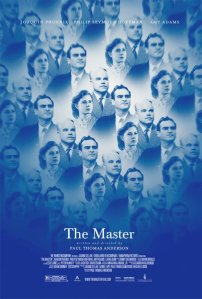
The Master

The Master “will deservedly become regarded as one of this decade’s most enduring classics”

Since his confident debut Hard Eight, Anderson’s career has followed the kind of upward trajectory most film-makers can only dream of, from his brilliant porn industry drama Boogie Nights, through to the epic ensemble piece Magnolia, the marvellously off-kilter romantic comedy-drama Punch Drunk Love and most recently the profound There Will Be Blood.

Anderson treads a similarly bold path with The Master, only his second film in almost a decade. It centres on Freddie Quell (Joaquin Phoenix), a World War Two Navy veteran who gets dumped back into society with little or no prospects, a nervous condition and a serious penchant for his own brand of moonshine, made largely from paint thinner. He seems not to understand social boundaries and is obsessed with sex, an unhealthy mixture shown in an early scene set during the war when he starts dry humping a sand sculpture of a woman his fellow seamen have created on a beach.

Freddie is a powder keg who drawls through a clenched jaw and a sneered lip and resembles a coiled spring in the way he walks, all hunched over like a primate. Constantly escaping his own tortured psyche, he runs away from one unnecessary scrape after another until he takes refuge on a yacht that for all intents and purposes looks like it belongs in another world.

The boat is owned by Lancaster Dodd (Philip Seymour Hoffman), who describes himself to Freddie as “a writer, a doctor, a nuclear physicist, a theoretical philosopher, but, above all, I am a man” and, fascinated with this new arrival, invites him to stay. It emerges that Dodd is the ‘master’ of ‘The Cause’, a Scientology-like movement that believes the Earth is trillions of years old and its inhabitants contain within them countless past lives.

The Master

Lancaster Dodd (Philip Seymour Hoffman) and Freddie Quell (Joaquin Phoenix) in Paul Thomas Anderson’s The Master

Dodd looks upon Freddie as a “silly animal” who has “wandered from the proper path” and decides to help him, akin to a dog and its master. Freddie is at first dubious, but soon embraces Dodd’s unconventional approach to self-improvement and becomes his right-hand man.

Part of this approach is ‘processing’, a psychological question and answer session that Dodd puts Freddie through in the film’s finest moment. Anderson suffocates the viewer, refusing to pull the camera away as we see Freddie’s tortured soul unburden. It’s bravura filmmaking (with mesmerising performance from both actors) and one of the scenes of the year.

A requirement of The Cause is to record everything that is said by Dodd, most revealingly during a scene when a group of young women are writing down a speech in which the Master espouses the pursuit of perfection by rejecting our animal instincts and controlling our emotions. Freddie finds one of the girls attractive and, ignoring Dodd’s words passes her a note saying: “Do you want to fu*k?”

The Master

Freddie Quell (Joaquin Phoenix) joins The Cause in The Master

Dodd comes from the ‘do as I say, not as I do’ school of cult leaders, often allowing his emotions to get the better of him, whether it be envying Freddie’s child-like, unfiltered existence, moments of self-doubt or bouts of rage when his teachings are questioned (most revealingly during a riveting exchange with a skeptic). Although it doesn’t take a genius to see the Master is a fraud, it takes Dodd’s son to scrape off the veneer for Freddie when he tells him: “He’s making all this up as he goes along. You don’t see that?”

Dodd’s wife Peggy (unnervingly played by Amy Adams) reveals herself as the real power behind the throne, tolerating her husband’s love-hate relationship with Freddie, but subtly steering him when the need arrives.

Johnny Greenwood’s mesmeric score amplifies the discordant world these characters exist in, while Anderson also interjects period music to masterful effect (the use of Irving Berlin’s ‘Get Thee Behind Me Satan’ while an attractive, enigmatic woman walks through a shopping mall and eventually encounters Freddie is inspired).

The Master is, in essence, a yin and yang love story between two men from very different backgrounds desperate for what the other has. Whether Anderson intends this meaning or not, one could easily draw parallels to a post-war America at turns equally arrogant and deeply uncertain about its future.

The Master has been pilloried in some quarters for its lack of narrative progression, but these critics are forgetting There Will Be Blood was hardly plot-heavy. Both are studies of entrancing characters whose individual traits are so powerful and entrenched they are bound to them forever. Oil magnate Daniel Plainview is just as alone and consumed by his relentless quest for money and power at the end of There Will Be Blood. Freddie is a broken machine doomed to spend eternity stuck on that beach alongside that pliant, sand sculpture, while Dodd will continue to believe he and The Cause hold all the answers.

Just as There Will Be Blood was one of the great films of this century’s first decade, The Master will deservedly become regarded as one of this decade’s most enduring classics.

Review – Moonrise Kingdom

The excellent ensemble cast of Wes Anderson's Moonrise Kingdom

The excellent ensemble cast of Wes Anderson’s Moonrise Kingdom

Wes Anderson’s movies regularly split their audiences into those who embrace their whimsically eccentric nature or those who find them too smart for their own good.

Although the trademark Anderson-isms are present and correct (methodical, angular camerawork; retro soundtrack; self-referential dialogue), Moonrise Kingdom is his most accessible and warm-hearted work to date; a coming-of-age tale in which childhood sweethearts Sam and Suzy (Jared Gilman and Kara Heywood, both pitch-perfect) turn their small island community upside down when they run away together.

The performances from Anderson regulars (Bill Murray, Jason Schwartzman) and virgins (Edward Norton, Bruce Willis, Frances McDormand) are uniformly excellent in this splendid work that is equal parts sad and optimistic.

Review – The Imposter

The power of persuasion is far more powerful than we would wish to believe.

Psychic mediums are a case in point. The most successful proponents of this brand of entertainment can attract hundreds, sometimes thousands of paying customers to their shows; people who are ready and willing to be told what they want to believe. Providing information that can often generously be described as ‘vague’, they usually allow their participants to fill in the blanks and do the work for them.

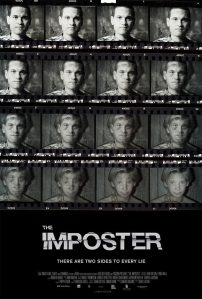
The Imposter

The Imposter is “one of the best documentaries of the year”

Although not claiming to be able to speak to the spirit world, Frédéric Bourdin is no less accomplished when it comes to manipulation, as the riveting documentary The Imposter reveals.

That being said, a con man will never succeed without willing participants and Bourdin lucked out beyond his wildest dreams when he inveigled himself into the family of Texan teen Nicholas Barclay, who went missing aged 13 in 1994.

It’s a story that staggers belief. More than three years after Nicholas disappeared, the grieving family received a phone call saying he had been found in Spain. Nicholas’ dumbfounded sister Carey immediately flew out to collect him. What no-one knew was that the call to the family had been placed by Bourdin, whose only resemblance to Nicholas was that they each had five fingers and toes.

Nicholas was blonde, blue-eyed and American; Bourdin had dark hair, brown eyes and spoke English with a heavy French accent. He was also seven years older than Nicholas. Although convinced he wasn’t going to get away with it, Bourdin nevertheless dyed his hair, got the same tattoos that Nicholas had and presented himself to Carey … who incredibly took him in as her long-lost younger brother without question.

The Imposter

The Imposter uses dramatic reconstructions to engaging effect

Remarkably, the con continued to stick upon their return to Texas, as Nicholas’ mother Beverley and other close family accepted him back into the fold. “He had changed so much it was mind-boggling,” said Beverley, who put his dramatic change of appearance down to his traumatic experiences.

Bourdin also fooled the media and FBI agent Nancy Fisher, who had serious suspicions but was convinced (at least initially) by the incredible story he spun about being abducted by an international vice ring. In fact it wasn’t until private invetigator Charlie Parker got involved and unearthed damning evidence of Bourdin’s fraudulent behaviour that the Frenchman realised the game was up.

It’s an astonishing tale and director Bart Layton, until now best known for his nightmare-in-paradise TV series Banged Up Abroad, is wise enough not to pull a Nick Broomfield and just let his subjects do the talking.

Instead he nods to the great documentarian Errol Morris by splicing reenactments with talking heads footage, at times so flawlessly as to underline just how blurred the line between fact and fiction became during this tangled, sorry mess.

The Imposter

The Imposter himself Frédéric Bourdin

It almost goes without saying that Bourdin is perhaps the ultimate unreliable narrator. A man so consumed by his serial addiction to impersonating other people (he claims to have assumed more than 500 false identities) that he was nicknamed ‘The Chameleon’ by the media, Bourdin is nothing if not fascinating. His selfish single-mindedness (“I care about myself, just about myself and f*ck the rest of it” – this coming from a man who’s since got married and had kids) is matched only by his superhuman intransigence.

Although Layton gives the lion’s share of the screen time to Bourdin, he doesn’t neglect Nicholas’ family, specifically Carey and Beverley who are both given ample time to address the question anyone who watches The Imposter will ask – how could they have been so spectacularly wrong?

Bourdin, as well as Parker and Fisher, claim certain members of the family knew a lot more about Nicholas’ disappearance than they were willing to reveal. Layton doesn’t allow the film to take a firm position on this; instead choosing to concentrate more on the humiliating, tragic subterfuge.

Bourdin feels that Carey (and by extension the rest of the family) probably knew deep down that he wasn’t their loved one, but were willing victims regardless, stating: “She (Carey) decided I was going to be her brother.”

Revealingly, the family recount the web of lies spun to them (speaking to the side of the camera – Bourdin is the only one who speaks straight to the camera) as if they are still facts. At no point do they say “he claimed this…”, rather each part of Bourdin’s story is oddly still taken at face value it seems.

Fifteen years on from those extraordinary events there remains bitterness and hurt within the family and a collective sense of bewilderment that will quite possibly never fully disappear. Carey may as well be speaking for the family (and the rest of us) when she asks: “How could I be so f*cking stupid?”

The Imposter often transcends the documentary format, moving into the realm of psychological thriller, especially in the breathless closing 30 minutes when the house of cards that Bourdin has built starts to collapse. It’s a suitably gripping conclusion, handled superbly by Layton, to what will undoubtedly be seen as one of the best documentaries of the year.

Review – Killing Them Softly

The dreams and promises of politicians are almost invariably exposed as nothing more than venal sales pitches when the cold light of day of reality smacks us round the face.

Andrew Dominik's deeply cynical Killing Them Softly

Andrew Dominik’s deeply cynical Killing Them Softly

This has so rarely been the case than in 2008 when hope and change were being promised while the biggest economic collapse since the Great Depression was unfolding before our eyes.

This particularly grim period of recent history serves as a running backdrop to Andrew Dominik’s deeply cynical third feature Killing Them Softly.

Gutter-level thieves Frankie and Russell (Scoot McNairy and Ben Mendelsohn) are hired to rob a mob-protected poker game run by low-life gangster Markie Trattman (Ray Liotta). Although Trattman is the prime suspect, having previously ripped off his own game, enforcer Jackie Cogan (Brad Pitt) is drafted in to find who is responsible and set things right.

Adapted from George V Higgins’ 1974 novel Cogan’s Trade, Killing Them Softly, as well as being a highly satisfying genre film is also a none-to-subtle metaphor for an America that, according to Cogan isn’t “a country; it’s just a business”.

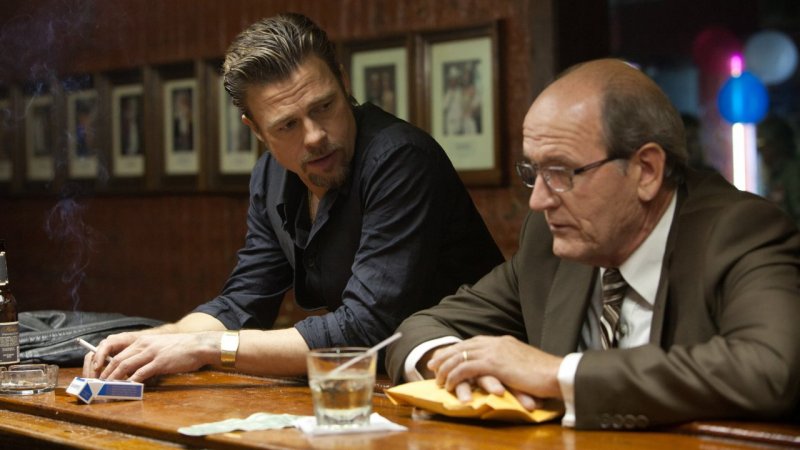
Enforcer Jacki Cogan (Brad Pitt) and mob bean-counter (Richard Jenkins) in Killing Them Softly

Enforcer Jacki Cogan (Brad Pitt) and mob bean-counter (Richard Jenkins) in Killing Them Softly

Although never seen, the mob’s prescence is felt throughout like a corporate version of Big Brother. They are represented by ‘Driver’ (Richard Jenkins), a cheap-suited lackey and glorified accountant who hires Cogan to do their dirty work. The financial cost is paramount, while the human cost is irrelevant as time and again the discussions between Driver and Cogan over what needs to be done (usually killing someone) are reduced to nothing more than dollars and cents.

The social commentary is difficult to chew at times. The opening sequence with Frankie walking through a tunnel filled with newspapers being blown about in the wind intercut with a hope-filled campaign speech by Barack Obama sets out the stall, while George W Bush’s panic-averting presidential address and the subsequent global financial collapse, heard on the radio or seen on TV play throughout like some perverted Greek chorus. Just to underline it all, the movie was shot and set in post-Katrina New Orleans, a city that knows a thing or two about broken promises.

Gutter-level thieves Frankie and Russell (Scoot McNairy and Ben Mendelsohn) in Killing Them Softly

Gutter-level thieves Frankie and Russell (Scoot McNairy and Ben Mendelsohn) in Killing Them Softly

The down and dirty dialogue is a graduate of the David Mamet School of Vicious Language, while the visual flourishes adopted by Dominik lend the film an ugly beauty, most notably in a uncomfortably long scene when one poor schmuck gets an horrendous beating.

Killing Them Softly gives its entirely male cast many a memorable line and the stellar line-up lap up every one. Mendelsohn adds layers to what on paper could have been just another junkie part; Liotta’s Markie Trattman might as well be related to Henry Hill, the part he played in Goodfellas; while James Gandolfini is terrific as a down-at-heels hitman brought in by Cogan to assist with the job but who is unable to get past his own self-pity and the next drink. However, it’s Pitt who stands out, giving a superbly nuanced portrayal of a hitman who has the tools and the pithy conversation to match, but ultimately is in thrall to his paymasters and knows it.

Dominik is clearly fascinated with criminals in all their forms, whether they be the charismatic Australian murderer Mark Read in his debut feature Chopper (2000), or the enigmatic gun-slinger Jesse James is his masterful sophmore film The Assassination of Jesse James by The Coward Robert Ford (2007). Here, they are nothing more than self-serving reprobates, existing in a hellish America where hope and change are nothing more than words on bumper stickers.