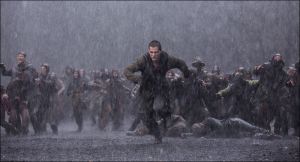
Review – Night Moves

Radical actions have equally radical consequences in Kelly Reichardt’s latest masterclass in gripping, under-the-radar filmmaking.

Night Moves quietly and assuredly sucks the room out of the air until what you are left with is a vacuum of tension that doesn't let you breathe until its final shot

Night Moves quietly and assuredly sucks the room out of the air until what you are left with is a vacuum of tension that doesn’t let you breathe until its final shot

With just five features to her name over the course of a 20-year career, Reichardt has developed into a darling of indie cinema with a unique perspective on the American landscape (mostly Oregon) and the characters who exist on its periphery.

In each of her films, from the little seen debut River Of Grass (1994), through to Old Joy (2006), Wendy And Lucy (2008) and her period western Meek’s Cutoff (2010), Reichardt fixates on characters who are emotionally or physically lost and in pursuit of a better world.

Dena (Dakota Fanning), Josh (Jesse Eisenberg) and Harmon (Peter Sarsgaard) prepare their direct action in Night Moves

Dena (Dakota Fanning), Josh (Jesse Eisenberg) and Harmon (Peter Sarsgaard) prepare their direct action in Night Moves

These themes remain present in Night Moves, in which eco-activists Josh (Jesse Eisenberg), Dena (Dakota Fanning) and Harmon (Peter Sarsgaard), exasperated by the well-meaning rhetoric of their fellow environmentalists, decide to take direct action by buying a boat (called Night Moves), stuffing it full of ammonium nitrate fertiliser and rigging it as a floating bomb to blow up a hydroelectric dam.

This, Josh declares, will finally awaken people to the environmental damage being wrought upon the world. However, an unforeseen consequence of their actions has Dostoevskian ramifications on Josh and Dena especially as guilt, paranoia and fear begin to overwhelm them.

Aboard the boat Nigth Moves in, erm, Night Moves

Aboard the boat Night Moves in, erm, Night Moves

Although this is doubtless Reichardt’s most political film, she is careful to chart a neutral course down what is a challenging river. The director also cleverly edits as if from Josh’s perspective and returns to the character as he reacts to events around him.

In an early scene, an eco-movie is being projected for a group of well-meaning types. Josh is present, although tellingly stood on the sidelines, and looks on with increasing disdain at the rhetoric of his fellow environmentalists, to the extent that the film cuts away mid-speech to reflect the disinterested contempt of its leading character.

Dena (Dakota Fanning) in Night Moves

Dena (Dakota Fanning) in Night Moves

Josh is a man of few words and has a high-minded intensity that cloaks the restless anxiety etched in his eyes. His lofty words have clearly won over the right-on Dena, a rebellious child of wealthy parents whom Josh is using to bankroll the operation; while the military-trained Harmon leads the sort of off-the-grid lifestyle Josh clearly aspires to.

Although angry at the injustice that allows salmon to be killed by the dam “just so you can run your iPod all your life”, Josh’s actions betray his eco-sentiment. A dead, pregnant doe he discovers on the side of the road is treated as an inconvenience, while extraneous parts of the boat are ripped out and discarded at a landfill site. Dena, too, identities the species of a bird through its song at one point, although Josh doesn’t even respond; lost in the statement he perceives his actions will make.
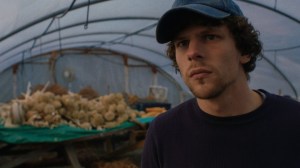
Paranoia creeps into Josh (Jesse Eisenberg) in Night Moves

Paranoia creeps into Josh (Jesse Eisenberg) in Night Moves

Reichardt masterfully turns the screw and invokes a growing sense of stifling suspense in the film’s first half and the central dam-busting sequence has a near-wordless tension reminiscent of the celebrated robbery sequence from Jules Dassin’s Rififi (1955).

Once the dam bursts, the nail-biting pressure gives way to an increasingly paranoid thriller that becomes more suspicious and jittery (soundtracked to perfection by Jeff Grace’s John Carpenter-inflected score) as the film largely jettisons Harmon and Dena and fixes its gaze almost completely on Josh. Never one for showy roles, Eisenberg dials everything down still further to present us with a character lost in his own despair and guilt.

Sarsgaard is subtly effective as the hardcore Harmon, while Fanning impresses as Dena, who is involved in one of the film’s most suspense-fulled scenes as she uses her wiles to try to convince James LeGros’ shop owner to sell her the fertiliser.

Night Moves quietly and assuredly sucks the room out of the air until what you are left with is a vacuum of tension that doesn’t let you breathe until its final shot.

Review – Locke

On paper not the most enticing or exciting of prospects, it says a lot about the powerhouse performance of its sole operator that Locke is such an impressive feature.

The film's visual signature is understandably sparse (there's only so many ways you can film the inside of a car) but that only serves to focus attention further on one of the performances of the year. Locke is a long dark night of the soul you won't forget

The film’s visual signature is understandably sparse (there’s only so many ways you can film the inside of a car) but that only serves to focus attention further on one of the performances of the year. Locke is a long dark night of the soul you won’t forget

In recent years we’ve seen a growing number of experimental films based solely within a single location; movies that offer a welcome divergence from what is normally drip fed via the studios.

Standouts include the excellent Rodrigo Cortés nail-biter Buried (2010), the little seen psychological thriller Exam (2009) and zombie movie Pontypool (2008) and Steven Knight’s claustrophobic road movie is a strong addition to this micro-genre.

In the case of Locke, the restrictions it places on itself are particularly constraining. Its singular location is a BMW car being driven by construction foreman Ivan Locke (Tom Hardy), whose decision one evening to drive to London from Birmingham has far-reaching consequences not only on his professional career but also his marriage and family.

A long dark night of the soul awaits Ivan Locke (Tom Hardy) in Locke

A long dark night of the soul awaits Ivan Locke (Tom Hardy) in Locke

As Ivan makes his fateful drive, we see the consequences of his actions play out through the increasingly fraught telephone conversations he has with wife Katrina (Ruth Wilson), son Eddie (Tom Holland), work colleague Donal (Andrew Scott) and boss Gareth (Ben Daniels); as well as with another woman Bethan (Oliva Colman). Never has the cooly automated message “you have a call waiting” had such charged overtones.

It’s no surprise Hardy jumped at the chance to flex his acting muscles following a number of physically intimidating turns in the likes of The Dark Knight Rises (2012) and Warrior (2011) and he delivers a bravura performance of a man whose methodical existence is ripped asunder as the pressure mounts.

Tom Hardy gives a mesmerising performance in the central role of Locke

Tom Hardy gives a mesmerising performance in the central role of Locke

Shot in real-time, Hardy visibly ages and deteriorates. Even his body works against him as the effects of a cold virus take hold. Hardy’s Welsh accent and tightly coiled stoicism brings to mind early Richard Burton and it’s a testament to the strength of his presence on screen that the comparison is entirely appropriate.

Such a performance therefore doesn’t need a script that can’t help trowelling on the metaphor. We learn very early on that concrete plays a big part of Locke’s life and Knight doesn’t shy away from laying on the symbolism as the foundations begin to crumble under his character’s feet.

The foundations begin to crumble in Locke

The foundations begin to crumble in Locke

By using the wrong concrete, Locke informs Donal, “cracks appear and they will grow and grow until they collapse”.  And as if we haven’t deduced the analogy, he goes to say: “You make one little mistake and the whole world comes crashing down around you.”

As the walls close in, Locke’s fractured psyche reveals itself through one-way conversations he has with his neglectful dad through the rear view mirror. He’s determined not to repeat the sins of the father, but events seem to suggest otherwise and, tellingly, he subconsciously looks into the same mirror as he talks to his son.

The film’s visual signature is understandably sparse (there’s only so many ways you can film the inside of a car), but that only serves to focus attention further on one of the performances of the year. Locke is a long dark night of the soul you won’t forget.

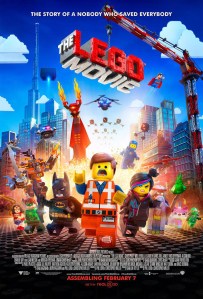
Review – The Lego Movie

As chaotic as it is clever and comedic, this gloriously absurd tale about the “highly sophisticated interlocking brick system” should be required watching for Michael Bay to see how movies about toys should be made.

As cunningly catchy as the signature awesome tune that plays throughout, The Lego Movie is that rarest of Hollywood gifts - a genuine and delightful surprise

As cunningly catchy as the signature awesome tune that plays throughout, The Lego Movie is that rarest of Hollywood gifts – a genuine and delightful surprise

It doesn’t happen very often, but every once in a while a film comes along that goes some way to make amends for the many wasted hours long-suffering cinemagoers spend sat in popcorn-encrusted multiplexes being force-fed creatively bankrupt Tinseltown trash.

For all intents and purposes The Lego Movie shouldn’t be that film. What should (read: normally) have happened is that it burst into cinemas and made a pot of cash before anyone realised it was rubbish. However, Phil Lord and Christopher Miller chose instead to take the road travelled most recently by Disney’s Frozen of making a well-written, funny and charming movie that appeals to young and old alike and attracts repeat viewings.

Simple, ordinary Emmet (Chris Pratt) is about to have his world rocked in The Lego Movie

Simple, ordinary Emmet (Chris Pratt) is about to have his world rocked in The Lego Movie

Lord and Miller’s previous animated flick, 2009’s Cloudy With A Chance Of Meatballs, was weirdly anarchic in itself, but the crazy juice is in full flow here.

We all have something that makes us something, but construction worker Emmet Brickowski (voiced by Chris Pratt) is the definition of ordinary. That is until he inadvertently stumbles across The Piece of Resistance which, according to the prophecy set down by wonky wizard Vitruvius (Morgan Freeman), makes him The Special; the person capable of stopping the evil Lord Business (Will Ferrell) from using a superweapon called the Kragle to freeze the world and preserve perfect order.

Wonky wizard Vitruvius  (Morgan Freeman) faces evil Lord Business (Will Ferrell) in The Lego Movie

Wonky wizard Vitruvius (Morgan Freeman) faces evil Lord Business (Will Ferrell) in The Lego Movie

Emmet suddenly finds himself in a strange new world and is helped on his quest by the feisty Wyldstyle (Elizabeth Banks), her boyfriend Batman (Will Arnett) and an army of Master Builders, recognisable from the world of comic books, movies and real life. However, they must all contend with Business and his relentless right clawed man Bad Cop (Liam Neeson).

The chaos of The Lego Movie is, aptly enough, exactly why the film works. As the makers of Minecraft would no doubt agree, the beauty of Lego is that it can be anything its builder wants it to be; whether that be an elaborately designed world (Bricksburg), a free-for-all (as depicted in the movie by the visually bonkers Cloud Cuckoo Land), a pirate ship, or simply two blocks randomly stuck together (the height of my Lego creativity as a youngster).

Batman (Will Arnett) prepares to "wing it" with Emmet (Chris Pratt) in The Lego Movie

Batman (Will Arnett) prepares to “wing it” with Emmet (Chris Pratt) in The Lego Movie

Taking Toy Story and The Matrix as building blocks, Lord and Miller’s knowing and subversive script weaves in everything from the unhealthy ties between politics and big business to cultural dumbing down (the TV show Where’s My Pants?), overpriced coffee, good old-fashioned satire and plenty of jokes.

By way of example, there’s the throwaway parody of Batman via the lyrics of a self-penned song he plays through the Batmobile’s new subwoofers: “Darkness… No parents… More darkness… Get it?… The opposite of light… Super rich… Kinda makes it better.”

The Lego Movie gang

The Lego Movie gang

To achieve this level of chaos without the film imploding in on itself takes some doing, while the animation itself is ingeniously rendered. Even water is fashioned from Lego blocks and somehow fits in with everything else that’s happening on screen.

The film also deftly underscores the cross-generational appeal of Lego and the different outlook that kids have (build whatever, deconstruct and start again) and adults (build something elaborate, stick it together with glue, remove the fun out of it) have when it comes to the little blocks.

As cunningly catchy as the signature awesome tune that plays throughout, The Lego Movie is that rarest of Hollywood gifts – a genuine and delightful surprise.

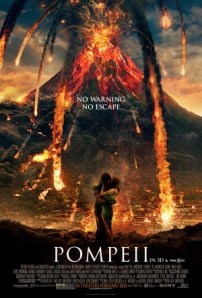
Review – Pompeii

If imitation is the sincerest form of flattery, then Paul W.S. Anderson’s CGI-fuelled swords and sandals disaster flick really ain’t fooling around in its obsequiousness.

There's a potentially exciting and engaging film to be made about the tragic events that befell the city of Pompeii in AD79. This isn't it

There’s a potentially exciting and engaging film to be made about the tragic events that befell the city of Pompeii in AD79. This isn’t it

Although written by human beings, Pompeii‘s script and narrative structure could just as easily have been the product of a computer algorithm generated from the storylines of Gladiator, Spartacus, Quo Vadis and about a dozen other Roman epics, as well as Titanic and Romeo and Juliet (and a raft of others no doubt).

That in itself isn’t necessarily a death sentence, but when you’ve got Kiefer Sutherland putting on the worst English accent since Kevin Costner gave a stab in Robin Hood: Prince Of Thieves then it’s time to pour molten lava on proceedings.

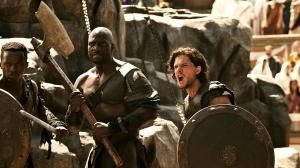
Milo, aka The Celt (Kit Harrington) forms a firm friendship with fellow slave Atticus (Adewale Akinnuoye-Agbaje) in Pompeii

Milo, aka The Celt (Kit Harrington) forms a firm friendship with fellow slave Atticus (Adewale Akinnuoye-Agbaje) in Pompeii

In fact, it says rather too much about Pompeii that the most convincing character in the movie is angry old Mt Vesuvius, which can’t blow its top quickly enough, frankly.

The film follow Milo, aka ‘The Celt’ (Kit Harrington), who as a young lad witnessed the murder of his parents and fellow villagers by Roman General Corvus (Sutherland) before being kidnapped by slave traders and transported years later from Britannia (where it’s always raining – how original) to Pompeii.

Slave Milo (Kit Harrington) embarks on a forbidden romance with Roman girl Cassia (Emily Browning) in Pompeii

Slave Milo (Kit Harrington) embarks on a forbidden romance with Roman girl Cassia (Emily Browning) in Pompeii

There he befriends fellow slave Atticus (Adewale Akinnuoye-Agbaje) and catches the eye of the rebellious Cassia (Emily Browning), daughter of city ruler Severus (Jared Harris) and his wife Aurelia (Carrie-Anne Moss). When Corvus – now a Roman Senator – sails into Pompeii, Milo senses an opportunity to finally realise his long held desire for revenge. However, the small matter of an erupting volcano threatens to spoil everything.

Anderson is best known for directing the Resident Evil franchise, which is appropriate because Pompeii effectively turns into a computer game once Vesuvius erupts. The film could hardly be credited with depth, but it truly jumps the shark during a ridiculous chase scene involving a horse and chariot that would have had Charlton Heston spinning in his gun-lined coffin.

Pantomime villain Corvus (Kiefer Sutherland) in Pompeii

Pantomime villain Corvus (Kiefer Sutherland) in Pompeii

The romance between Milo and Cassia simply doesn’t work, which is a shame as Harrington and Browning at least try to inject some chemistry. A better bond is created between Milo and Atticus, whose initial rivalry and subsequent friendship is the best part of the film, especially during the gladiatorial scenes which allow Milo the opportunity to exact some humiliation on the evil Corvus.

Much like any other disaster film, you’re left twiddling your thumbs before the money shot finally arrives (just in case we’ve forgotten it’s coming, we have Atticus to helpfully point out that the regular pre-eruption tremors are just “the mountain” and nothing to worry about).

Mt Vesuvius gets angry in Pompeii

Mt Vesuvius gets angry in Pompeii

When Vesuvius finally does erupt, it at least does so with impressive style, but it doesn’t take long before boredom sets in once again and you’re hoping a fireball will take out most of the cast. Besides, anyone who’s seen the overly extended trailer will know exactly what to expect.

One suspects that Anderson’s tongue was wedged firmly in his cheek judging by the film’s histrionic tone and Sutherland’s pantomime performance, but that doesn’t forgive the sheer tedium of what’s on display here.

There’s a potentially exciting and engaging film to be made about the tragic events that befell the city of Pompeii in AD79. This isn’t it.

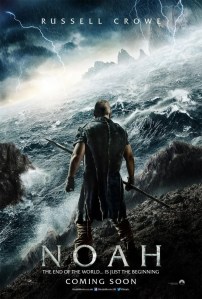
Review – Noah

Bonkers, bizarre and brilliant in equal measure, it’s fair to say there won’t be another film quite like Darren Aronofsky’s Noah this – or perhaps any – year.

In an age of identikit blockbusters, Noah should be applauded for having the courage of its convictions to offer an experience you won't soon forget

In an age of identikit blockbusters, Noah should be applauded for having the courage of its convictions to offer an experience you won’t soon forget

The Bible’s many film adaptations have invariably been of the epic variety; overblown ‘event’ movies that are as extravagant as they are huge.

While Noah doesn’t skimp on the computer-generated bombast, it’s also the product of a singular vision – one that both captivates and infuriates.

Throughout his career, Aronofsky’s films have centred on obsessively driven characters; whether they be the cast of Requiem For A Dream (2000) seeking the next fix, Natalie’s Portman’s ballet dancer going to any lengths to reach the top of the pile in Black Swan (2010), or Hugh Jackman’s various incarnations of the same character searching for the tree of life in The Fountain (2006).

The 'Creator' gets angry in Noah

The ‘Creator’ gets angry in Noah

Noah represents his most fanatical character yet – a husband and father whose response to an apocalyptic vision received from ‘the Creator’ is to spend years building a giant ark to save the animal kingdom from the impending flood.

The world Noah (Russell Crowe) and his family inhabit has been ravaged by mankind’s greed and corruption. They eke out a nomadic life away from the rest of humanity in a shattered, lunar landscape (Iceland in reality) ruled by Tubal-Cain (Ray Winstone), descendant of Adam and Eve’s murderous son Cain.

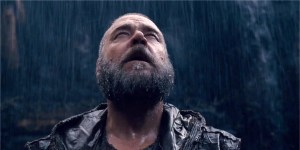
Noah (Russell Crowe) finally feels the rain in Noah

Noah (Russell Crowe) finally feels the rain in Noah

A fearful Tubal-Cain is determined to seize the ark, but must first build an army to overcome the Watchers; crazy-looking fallen angels encrusted in rock who aid Noah in his mammoth task and come across as the craggy cousins of the talking trees from The Lord Of The Rings.

When it finally does come, the flood is impressively staged. The sense of chaotic desperation among Tubal-Cain and his followers to fight their way onto the ark as Noah and the Watchers try to keep them back is both unnerving and edge-of-the-seat stuff. However, the most chilling and indelible image comes later as the last vestiges of mankind cling hopelessly to a rapidly submerging rock, wailing in vain at the nearby ark as Noah blanks out their screams.

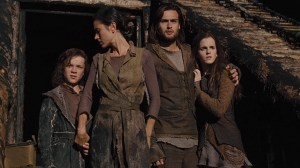
Noah's family, son Japheth (Leo McHugh Carroll), wife Naameh (Jennifer Connelly), son Shem (Douglas Booth) and adopted daughter Ila (Emma Watson) in Noah

Noah’s family, son Japheth (Leo McHugh Carroll), wife Naameh (Jennifer Connelly), son Shem (Douglas Booth) and adopted daughter Ila (Emma Watson) in Noah

It’s a truly nightmarish moment that sets up the film’s final act as an increasingly dogmatic Noah turns his wife Naameh (Jennifer Connelly), sons Shem (Douglas Booth) and Ham (Logan Lerman) and adopted daughter Ila (Emma Watson) against him when he declares his work won’t be finished until the ultimate sacrifice is made.

Just as with The Fountain, Noah is predominately a spiritualist film rather than an overtly religious one (reflective of Aronofsky’s personal beliefs). It also carries an urgent environmental message – as global warming brings with it rising sea levels, scorched earth and dwindling resources, may we too be forced to start again when the proverbial crap hits the fan?

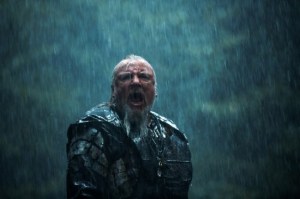
"Take the ark!!" - Tubal-cain (Ray Winstone) gets mad in Noah

“Take the ark!!” – Tubal-cain (Ray Winstone) gets mad in Noah

The film has a curious mix of the fantastical (a strange, dog-like beast being hunted by Tubal-Cain’s men; the Watchers; huge stars shining brightly in the daytime) and the grittily authentic. In spite of the larger-than-life connotations of the source material, Aronofsky never lets us forget these are human beings making stomach-churning decisions.

The anger and bewilderment expressed by Shem and Ham towards their merciless father when the screams of those left outside the ark are heard is entirely believable. At one point, a sickened Shem pleads to Noah to let them in, pointing out that not everyone can be ‘guilty’. Noah’s response is to state that every human has a darkness inside of them, a point given form earlier in the film when Noah sneaks into Tubal-Cain’s sin-laden camp and sees a vision of himself giving into his base instincts in order to survive.

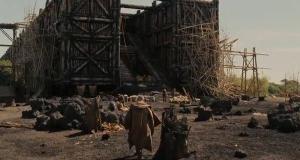
Have ark, will travel - Noah and co prepare for the storm in Noah

Have ark, will travel – Noah and co prepare for the storm in Noah

By staging the flood halfway through the movie, one imagines Aronofsky aimed for the real drama to take place within the confines of the ark. However, rather than being the dramatic cannonball he was hoping for, this final act curiously fails to engage and ends up going off the deep end. Perhaps it’s Noah’s incessant reiteration that everyone must accept their punishment that ultimately proves the biggest turn off.

Whatever misgivings one may have here are counterbalanced by the much talked about ‘creation sequence’, reinterpreted by Aronofsky’s time-lapsed visuals as the journey of evolution from the big bang (“Let there be light”) to man’s inhumanity to man. It’s a bravura scene that’s worth the price of admission alone.

Noah's son Ham (Logan Lerman) runs for his life in Noah

Noah’s son Ham (Logan Lerman) runs for his life in Noah

In his best performance for years, Crowe gives a truly affecting performance of a man being pushed beyond his limits while carrying the weight of the world on his shoulders. While a very physical performer, Crowe does his best work with his eyes by showing the terrible emotional pain he endures in order to carry out the Creator’s work.

Connelly’s Naameh is the crux both we and her family lean on to navigate our way through these turbulent waters and her performance is excellent. Winstone does what he does best as the unhinged Tubal-Cain, who appears to be history’s first Cockney, while an ancient-looking Anthony Hopkins has a twinkle in his eye as Noah’s grandfather Methuselah.

In an age of identikit blockbusters, Noah should be applauded for having the courage of its convictions to offer an experience you won’t soon forget.