Review – Boyhood

Long hijacked – and cheapened – by the marketing spiel of a multitude of schlocky blockbusters, the true meaning of the word ‘epic’ is hereby reclaimed by this modern masterpiece that’s as grand in its ambition as it is intimate in its emotional spirit.
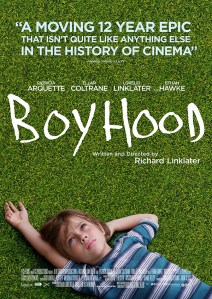
Linklater's masterpiece is a film that will become regarded as one of the defining pieces of cinema of this decade. To borrow the title of the late Roger Ebert's autobiography, Boyhood is simply 'life itself'

Linklater’s masterpiece is a film that will become regarded as one of the defining pieces of cinema of this decade. To borrow the title of the late Roger Ebert’s autobiography, Boyhood is simply ‘life itself’

The most beautifully simple concepts are often the best and the 12-year project that led to Richard Linklater’s Boyhood is sublime and unique indeed.

Setting aside the hoo-ha over the film’s time-spanning audaciousness, however, Boyhood must still be judged for what it is – a film. And what a film it is; not just a powerful and enrapturing coming-of-age drama, but also a remarkable portrait of America seen through the eyes of a boy, his sister and estranged parents living through a tumultuous decade.
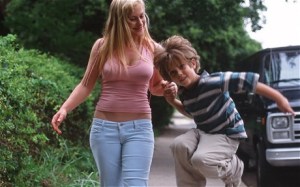
Mason Jnr (Ellar Coltrane) aged six with his mom Olivia (Patricia Arquette) in Boyhood

Mason Jnr (Ellar Coltrane) aged six with his mom Olivia (Patricia Arquette) in Boyhood

The film follows the trials and tribulations of Mason Jr (Ellar Coltrane) as he matures from a six-year-old boy, through adolescence to the age of 18 as he leaves for college and an independent life. Along the way he experiences love and heartbreak, as well as pure and damaged souls, but the constants in his life remain his older sister Samantha (Linklater’s daughter Lorelei), single mother Olivia (Patricia Arquette) and father Mason Snr (Ethan Hawke).

Mason is shaped, like the rest of us by the events and people he experiences and Linklater, rather than inserting titles telling us what year it is, chooses instead to structure the film around cultural touchstones (the war in Iraq, Harry Potter, the 2008 US election) and technological advancements (iPods, Facebook, Wii, smart phones).

Mason Jnr (Ellar Coltrane) growing up in Boyhood

Mason Jnr (Ellar Coltrane) growing up in Boyhood

This is not just Mason Jnr’s story, though. Olivia’s journey is given as much care and attention and is powerfully realised by Arquette in a career-best turn. Olivia stumbles and falls from one bad relationship to the next, but with each knock down she picks herself up and moves on, discovering first and foremost that happiness must come from within.

Paralyzed by a serious case of arrested development, Mason Snr must first learn what it is to be a father and then an adult. It’s startling at first seeing the fresh-faced Hawke of the early Before… chapters, but as the years wear themself on the actor’s face a gradual evolution takes place in his character. Mason Snr isn’t a bad guy, he’s just a little lost and learns to find his way with the benefit of time.
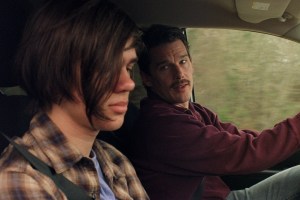
Mason Snr (Ethan Hawke) has a spot of father-son time with Mason Jnr (Ellar Coltrane) in Boyhood

Mason Snr (Ethan Hawke) has a spot of father-son time with Mason Jnr (Ellar Coltrane) in Boyhood

It’s understandable that Coltrane has described finishing the film as like losing a limb. This is all he has known for a large part of his life and it’s fascinating observing the way he changes, both physically (at one point he visibly ages between heading upstairs one night and coming downstairs in the morning, such is Linklater’s canny editing) and emotionally.

The film is full of beautifully observed moments that stay with you – Mason’s best friend waving goodbye on his bike when the family move to Houston; the look on Mason Snr’s face when he realises his son has become a man; the quiet devastation Olivia feels when Mason is packing to leave for college. All these are bookended by the look of hope, contemplation and wonder Mason gives at the start and end of the film.

Mason Jnr looks forward to life in Boyhood

Mason Jnr looks forward to life in Boyhood

The magic that Linklater has found in Boyhood is that these are people we all know. Just as a programme like The Simpsons works on multiple levels and can be appreciated in different ways over the course of time, so to will Boyhood. Personally, I recognised myself both in Mason Jnr as a lad wondering what the world held in store and in Mason Snr through my struggle to accept the limitations life sometimes imposes.

Linklater’s masterpiece is a film that will become regarded as one of the defining pieces of cinema of this decade. To borrow the title of the late Roger Ebert’s autobiography, Boyhood is simply ‘life itself’.

Review – The Expendables 3

They may be old enough to know better, but try telling that to Sly and the Family Crone as the Geriaction poster boys dispense more old school justice.

Quite how much steam is left in this franchise, or its stars, (don't be fooled by the 'one last ride' tagline) is highly debatable, but The Expendables 3 remains a diverting enough way to spend two hours with the oldies

Quite how much steam is left in this franchise, or its stars, (don’t be fooled by the ‘one last ride’ tagline) is highly debatable, but The Expendables 3 remains a diverting enough way to spend two hours with the oldies

The 80s was a pretty naff decade for many reasons, but it did deliver a new kind of action film featuring a new kind of action star; one that didn’t ask you to think too much about what it was you were watching, rather to trust in the knowledge that the good guy would always win and kill a lot of people along the way.

They may not have been blessed with matinée idol looks, but that didn’t matter to the box office generated by the likes of Sylvester Stallone, Arnold Schwarzenegger and, to a lesser extent, Jean-Claude Van Damme, Dolph Lundgren, Steven Seagal, Chuck Norris et al.

Sly Stallone reprises his role as Barney Ross in The Expendables 3

Sly Stallone reprises his role as Barney Ross in The Expendables 3

The ‘one-man-war-machine’ genre largely disappeared to the DVD shelves during the late 90s and early 2000s, but made a big screen comeback in the latter half of the decade, most notably in the fun Liam Neeson flick Taken (2008). Not wanting to miss out, Stallone wrote and directed the insane Rambo (2008), in which the monosyllabic Vietnam vet turns the Burmese army into a giant hamburger with the aid of a massive machine gun.

Taking screenwriter David Callaham’s pitch and running with it, Sly co-wrote and directed The Expendables in 2010, essentially The Dirty Dozen (1967) and The Wild Geese (1978) featuring 21st century stunts and hardware in the hands of guys who should be lining up for their weekly pension.

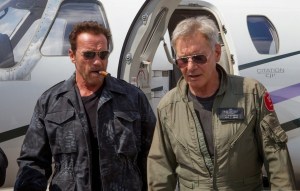
Arnold Schwarzenegger with trademark cigar as Trench Mauser opposite Harrison Ford's CIA operative Max Drummer in The Expendables 3

Arnold Schwarzenegger with trademark cigar as Trench Mauser opposite Harrison Ford’s CIA operative Max Drummer in The Expendables 3

Although hardly earth shattering, it more than wiped its face at the box office and instigated the inevitable follow-ups. The team this time faces that old action cinema trope – one of their own who’s gone rogue and is out for vengeance, in this case Conrad Stonebanks (Mel Gibson).

Barney Ross (Stallone), Lee Christmas (Jason Statham) and the rest of the Expendables are tasked by CIA operative Max Drummer (Harrison Ford) to track down Stonebanks, who has become a highly successful arms dealer. However, when things don’t go as planned Barney decides it’s time to inject some younger, fresher blood and recruits a quartet of new faces (including Ronda Rousey’s Luna) into the team.

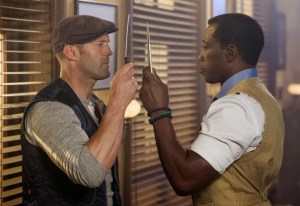
Lee Christmas (Jason Statham) and Doctor Death (Wesley Snipes) get knives out in The Expendables 3

Lee Christmas (Jason Statham) and Doctor Death (Wesley Snipes) get knives out in The Expendables 3

Anyone expecting anything apart from more of the same will be in for a disappointment with The Expendables 3. Stallone previously indicated he wanted more humour in this latest escapade but, if anything, it has even fewer chuckles than the previous two films. Part of the reason is the arc surrounding Gibson’s character, whose bloodthirsty quest for revenge isn’t the sort of plotline that gets played for laughs.

Director Patrick Hughes keeps things zipping along and knows his way around an action set piece, especially the final firefight that takes place in and around a wrecked building (he’s clearly getting practice in for his English language remake of The Raid). The stunt work is also well handled, in particular an awesome motorcycle stunt in which one of the team bypasses the stairs to get several floors up on the building and a moment early on when Wesley Snipes’ Doctor Death flings himself from a train as it’s about to hit a prison (you’d think Snipes would have had enough of prisons by now).

The boys (and girl) are back in town in The Expendables 3

The boys (and girl) are back in town in The Expendables 3

With such a hefty cast it’s not always easy to remember who’s doing what (aside from just killing people) and the new recruits don’t really add enough to warrant their inclusion. Schwarzenegger looks like he’s at least not phoning it in this time, although Ford has that usual I’m-too-good-for-this look on his face and Banderas tries too hard to be zany as sharpshooter Galgo.

Of the rest, Gibson relies on his mad-eyed schtick to play the villain and Grammer adds a dose of humour as deadpan mercenary Bonaparte. Meanwhile, Stallone, Statham et al do what they do best.

Quite how much steam is left in this franchise, or its stars, (don’t be fooled by the ‘one last ride’ tagline) is highly debatable, but The Expendables 3 remains a diverting enough way to spend two hours with the oldies.

Review – Guardians Of The Galaxy

The Marvel Cinematic Universe lives up to its name in this star-spanning space opera that puts the fun back into a genre that had disappeared up its black hole.

A genuine pleasure, Guardians Of The Galaxy should give JJ Abrams something to think about for the next installment of  that other well known space opera

A genuine pleasure, Guardians Of The Galaxy should give JJ Abrams something to think about for the next installment of that other well-known space opera

The fact that Guardians Of The Galaxy is drawing so many comparisons to Star Wars is not only a testament to the high esteem it’s being held in by so many critics, but also to the fact that it’s so refreshing to watch a film of this ilk that resolutely refuses to take itself too seriously.

Too often, sci-fi filmmakers get bogged down in blindsiding their audience with Midi-chlorians, flibbertigibbets and unnecessary solemnity at the expense of an intriguing narrative and engaging characters. Although Guardians… isn’t averse to a spot of Basil Exposition (understandable considering it’s the first in what will undoubtedly become another Marvel franchise), it does so with a light and breezy air that avoids spoon-feeding the audience.

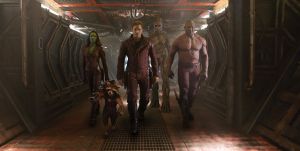
The A Team - Gamora (Zoe Saldana), Rocket (Bradley Cooper), Peter Quill (Chris Pratt), Groot (Vin Diesel) and Drax the Destroyer (Dave Bautista) in Guardians Of The Galaxy

The A Team – Gamora (Zoe Saldana), Rocket (Bradley Cooper), Peter Quill (Chris Pratt), Groot (Vin Diesel) and Drax the Destroyer (Dave Bautista) in Guardians Of The Galaxy

Abducted from Earth as a young boy following the death of his mother, intergalactic thief Peter Quill, aka Star-Lord, (Chris Pratt) incurs the wrath of the super-evil Ronan (Lee Pace) when he steals a mysterious orb. With Ronan’s henchmen, and women, hot on the trail of the orb, including his lieutenant Nebula (Karen Gillan), Peter forms an uneasy accord with assassin Gamora (Zoe Saldana), genetically engineered racoon Rocket (voiced by Bradley Cooper), the tree-like Groot (Vin Diesel) and warrior Drax the Destroyer (WWE star Dave Bautista).

When the extent of the orb’s power becomes clear, and Ronan’s diabolical plan reveals itself, Peter must turn his ragtag associates into a full-on fighting force to save the galaxy from destruction.

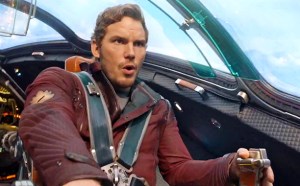
The heroic Peter Quill/Star Lord (Chris Pratt) in Guardians Of The Galaxy

The heroic Peter Quill/Star Lord (Chris Pratt) in Guardians Of The Galaxy

Marvel’s policy of trusting its multi-million dollar products to leftfield directors (Edgar Wright’s departure from 2015’s Ant Man notwithstanding) once again pays off. The edgy comic touch of James Gunn’s previous flicks Slither (2006) and Super (2010) is a perfect fit for Guardians‘ tongue-in-cheek sensibility.

The film takes great pleasure in sending up the clichés of the genre, such as the team’s slow motion walk towards the camera in which Gamora can be seen yawning. Gunn and Nicole Perlman’s meta script goes off on tangents, some funny, others less so, and concentrates on the relationships between the lead characters. This is a bunch of misfits we can believe in and the bond they gradually form is convincingly handled by the cast.

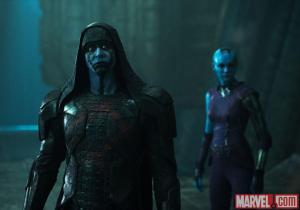
The evil Ronan the Accuser (Lee Pace) and his loyal lieutenant Nebula (Karen Gillan) in Guardians Of The Galaxy

The evil Ronan the Accuser (Lee Pace) and his loyal lieutenant Nebula (Karen Gillan) in Guardians Of The Galaxy

One of the more successful elements of Guardians… is its soundtrack of 70s and 80s classics, ingeniously crowbarred into the film as they form part of Peter’s beloved mix tape from his mother. Setting aside the fact that his Walkman wouldn’t probably survive 26 years and that AA batteries would likely be a little hard to come by in outer space, the music serves as a reminder that Peter, like Buck Rogers and John Carter, is a human in an alien environment and our way into this universe.

Gamora (Zoe Saldana) learns more about the mysterious orb in Guardians Of The Galaxy

Gamora (Zoe Saldana) learns more about the mysterious orb in Guardians Of The Galaxy

Despite trying a bit too hard at times to be Han Solo’s slightly less cool brother, Pratt is a good fit for Peter and proves a likeable lead. Saldana may look like a character from Star Trek, but she kicks ass and is proving a formidable presence in the world of big budget sci-fi, what with the Trek and Avatar franchises already in place. Cooper’s energetic, fast-talking voice work for Rocket is nicely played, while Diesel manages to give a new meaning to each new utterance of his singular phrase “I am Groot” and even non-actor Bautista does some solid work as meathead Drax.

Elsewhere, Gillan is impressively alien as Nebula, while Gunn makes sure to give his other supporting cast members something to do, especially Michael Rooker’s blue-skinned alien Yondu and John C Reilly’s corpsman Rhomann Dey.

A genuine pleasure, Guardians Of The Galaxy should give JJ Abrams something to think about for the next installment of  that other well-known space opera.

Review – Dawn Of The Planet Of The Apes

You absolutely know you’ve bought into this hugely ambitious blockbuster sequel when the sight of an ape riding a horse while firing machine guns with each hand makes perfect sense rather than looking ridiculous.

In a year of mostly superior blockbuster fare, Dawn Of The Planet Of The Apes could just be the most genetically superior of the lot

In a year of mostly superior blockbuster fare, Dawn Of The Planet Of The Apes could just be the most genetically superior of the lot

The world built by Rupert Wyatt’s Rise Of The Planet Of The Apes (2011)  is impressively expanded upon here, while the astonishing visual effects service, rather than drive an engaging story of Shakespearean proportions.

The fact that the lead ape is called Caesar is entirely fitting to a tale of brotherhood, betrayal and tragedy that beats its chest in appreciation of the Bard’s Julius Caesar, just as Rise… took elements of Henry V in its depiction of Caesar’s ascent to leadership. Although Dawn‘s lofty aspirations don’t always hit the mark, the zeal in which it goes about it is something to applaud.

Caesar (Andy Serkis) in battle mode in Dawn Of The Planet Of The Apes

Caesar (Andy Serkis) in battle mode in Dawn Of The Planet Of The Apes

It’s been 10 years since the so-called Simian Flu has reduced the human race to the point of extinction and, inversely, led to a growing utopian society of genetically evolved apes, led by Caesar (Andy Serkis). This idyll is turned upside down by the sudden and unexpected arrival of a group of humans, including Malcolm (Jason Clarke), his son Alexander (Kodi Smit-McPhee, who’s making a habit of appearing in apocalyptic dramas following The Road) and Ellie (Keri Russell).

The encounter reignites old enmities in Caesar’s second-in-command Koba (Toby Kebbell), who believes the humans pose a direct threat, while in the human colony this mutual suspicion is shared by uneasy leader Dreyfus (Gary Oldman). Caesar and Malcolm, meanwhile, try to build a shaky détente in the hope that war can be averted.

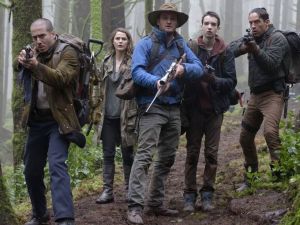
The human survivors, including Malcolm (Jason Clarke), Ellie (Keri Russell) and Alexander (Kodi Smit-McPhee) are told to "Goooooooo!!!" in Dawn Of The Planet Of The Apes

The human survivors, including Malcolm (Jason Clarke), Ellie (Keri Russell) and Alexander (Kodi Smit-McPhee) are told to “Goooooooo!!!” in Dawn Of The Planet Of The Apes

The devastating effect of the Simian Flu, introduced during Rise‘s post-credits sequence is dealt with in the film’s efficient opening credits, which skilfully weave in real life news footage to establish how Charlton Heston’s astronaut could come to his horrific realisation at the end of Planet Of The Apes (1968).

The 10 years separating the two films are written on the faces of the protagonists. Caesar has grown into a responsible, benevolent leader; a husband and father who espouses the central rule of an orderly society: ‘ape do not harm ape’. On the other side of the divide, desperation is etched on the human survivors, who unwittingly traverse into ape territory in the search of a much-needed power source.

The human survivors seriously underestimate Koba (Toby Kebbell) in Dawn Of The Planet Of The Apes

The human survivors seriously underestimate Koba (Toby Kebbell) in Dawn Of The Planet Of The Apes

As soon as humans and apes come into contact, we know that war is inevitable, but the journey to get there is effectively handled by director Matt Reeves and scriptwriters Rick Jaffa, Amanda Silver and Mark Bomback, who get us to empathise with each character’s motives.

Dawn… has been criticised for too neatly presenting the different factions as mirror images of each other – Koba and Dreyfus represent the hawkish shoot-first-ask-questions-later approach bred by a combination of antipathy and fear; while Caesar and Malcolm are the peacemakers who see diplomacy as the way forward rather than conflict.

The benevolent Maurice (Karin Konoval) in Dawn Of The Planet Of The Apes

The benevolent Maurice (Karin Konoval) in Dawn Of The Planet Of The Apes

Watch the film, however, and this approach makes perfect sense; the apes and humans are far more alike than either might wish to admit, something acknowledged in a wry observation by Caesar late in the film to his conflicted son Blue Eyes (Nick Thurston). This is a direct nod to the original Apes series and underlines how this most unique of franchises is forever adaptable to the times in which we live.

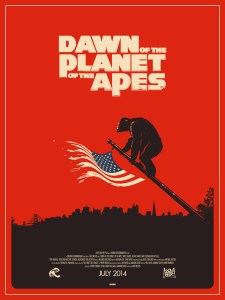
With so many apes on screen, the action scenes could easily have descended into disengaged confusion; however, we’re never left high and dry and there is even room for a number of bravura shots, including one in which the camera positioned on a slowly revolving tank turret shows us the full-scale of the battle and a startling shot (achieved on the spur of the moment, apparently) of Koba perched atop a battered American flagpole staring at his enemy.

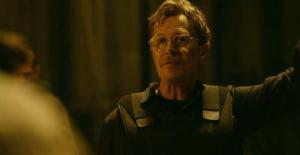
Human leader Dreyfus (Gary Oldman) in Dawn Of The Planet Of The Apes

Human leader Dreyfus (Gary Oldman) in Dawn Of The Planet Of The Apes

Serkis further rubber stamps his standing as cinema’s motion capture godfather with a sublime turn as Caesar, while Kebbell is equally expressive as the tortured Koba. On the other side, Oldman invests Dreyfus with an all-too-human frailty and Clarke is efficient without setting off too many fireworks. Meanwhile, Russell’s thankless turn only serves to underline the dearth of decent female parts.

In a year of mostly superior blockbuster fare, Dawn Of The Planet Of The Apes could just be the most genetically superior of the lot.

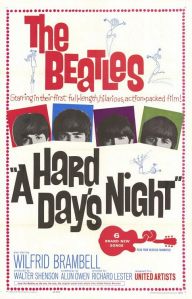
In Retrospect – A Hard Day’s Night (1964)

Anarchy in the UK may have been more than a decade away, but the Fab Four’s debut big screen feature must have felt like a shot of joyous adrenaline to the youth of a country still recovering from the war.

A Hard Day's Night may be a product of its time, but its infectious energy and immortal songbook means it remains as fab today as it did 50 years ago

A Hard Day’s Night may be a product of its time, but its infectious energy and immortal songbook means it remains as fab today as it did 50 years ago

The Beatles were in the right place at the right time to exploit the cultural revolution that had been bubbling away and, through a mix of catchy songs, natural charisma and clever marketing created a phenomenon.

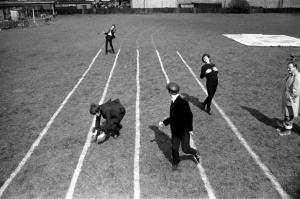
The giddy chaos of the opening few minutes (still one of cinema’s great credit sequences) as John, Paul, George and Ringo leg it from a horde of screaming girls and guys over the film’s title track can be seen as a visual metaphor for a generation of young people hungrily going after something they can claim as their own.

It's a Hard Day's Night and the boys have working like dogs...

It’s a Hard Day’s Night and the boys have working like dogs…

A Hard Day’s Night is light on plot (the band travel by train to a TV gig in London, sit around in a hotel and get involved in various scrapes), but rich in character, satire and great tunes. They entrusted their feature debut to American director Richard Lester, primarily for his work in bringing the spectacularly successful Goons radio show to the small screen and his collaboration with Peter Sellers and Spike Milligan on The Running Jumping & Standing Still Film (1960).

Lester’s love of Buster Keaton also married well with the band’s natural wit, while Merseyside-based screenwriter Alun Owen was brought on board to exploit their dry sense of humour and character traits.

George gives road manager Shake (John Junkin) a 'shave' in A Hard Day's Night

George gives road manager Shake (John Junkin) a ‘shave’ in A Hard Day’s Night

Widely regarded as having invented the music video, the film is clearly influenced by the French New Wave and fills the space in between the musical numbers with often surreal interludes that bring to mind Luis Buñuel; such as when George gives road manager Shake (John Junkin) a ‘shave’ by spraying foam on the mirror where Shake’s stubble should be and gliding the razor along its surface.

Another turn for the quirky comes when, having got on the nerves of a stuffy city gent who grumpily exclaims that he “fought the war for you sort”, the band ask him for their ball back, only to suddenly appear running and cycling alongside the train a second later asking the same question.

Paul hides out with 'Grandfather' (Wilfrid Brambell) in A Hard Day's Night

Paul hides out with ‘Grandfather’ (Wilfrid Brambell) in A Hard Day’s Night

Get past the cartoonish exterior of this scene, however, and there’s plenty more going on; particularly a two-fingered salute to the establishment in the way four working class lads sit merrily in the first class carriages and ignore the hectoring of their supposed peers.

A Hard Day’s Night is careful not to laugh at the Fab Four’s hysterical fans; rather its satire is targeted more at the nonsense that goes with superstardom. A scene in which the band take part in a fast and loose press conference descends into a merry-go-round of inane questions and increasingly ridiculous answers, most amusingly when Paul responds conspiratorially “no, we’re just good friends” to whatever question he’s posed.

The Fab Four in full-on lark mode in A Hard Day's Night

The Fab Four in full-on lark mode in A Hard Day’s Night

The film also takes a swipe at the homogenising impulse of marketing, as symbolised by Kenneth Haigh’s cynical publicist Simon, who tries to use George as a mouthpiece for some new clothing he’s planning to flog to the masses. Simon sees the band as nothing more than fresh meat on a conveyor belt and responds to George’s failure to play ball by derisively saying: “Here’s this kid trying to give me his utterly valueless opinion when I know for a fact within a month he’ll be suffering from a violent inferiority complex and loss of status if he isn’t wearing one of these nasty things.”

They’re not shy about sending themselves up either; Ringo especially, who endorses George’s observation that he has “an inferiority complex” by responding: “Yeah, that’s why I play the drums.”

The one and only John Lennon in A Hard Day's Night

The one and only John Lennon in A Hard Day’s Night

In spite of Ringo’s inferiority complex, the film is pretty equitable in the screen time it gives to each of the Beatles as well as those around them, the inimitable Wilfrid Brambell in particular who has plenty of fun playing Paul’s Irish ‘Grandfather’. Famous at the time for his role as cantankerous “dirty old man” Albert Steptoe in BBC sitcom Steptoe and Son, there’s a running gag throughout that his character always looks so clean.

A Hard Day’s Night may be a product of its time, but its infectious energy and immortal songbook means it remains as fab today as it did 50 years ago.