Review – Beasts Of The Southern Wild

New Orleans and the wider gulf coast of Louisiana have been forced to endure more than their fair share of disaster, grief and suffering since the terrible devastation wrought by Hurricane Katrina.

The impact of the hurricane has been the foundation of numerous documentaries, including Spike Lee’s exhaustive When the Levees Broke and the superb TV series Treme.

Beasts of the Southern Wild

Beasts of the Southern Wild – “a gothic fairytale of real beauty”

The city was front and centre of Werner Herzog’s The Bad Lieutenant: Port of Call New Orleans, while other films have used the area’s devastated locations as backdrops to the story they are telling, whether it be the moral decay that permeates the Brad Pitt-starring Killing Them Softly or the apocalypse in The Road.

However, none have found such beauty in decay as Benh Zeitlin’s Beasts of the Southern Wild, a beguiling, magical fairytale that must count as one of the most striking directorial debuts of recent years.

The film follows Hushpuppy (Quvenzhané Wallis), a strong-willed six-year-old girl who lives with her ailing, hard-drinking fisherman father Wink (Dwight Henry). The two live hand-to-mouth in separate rickety shacks that look like they’re about to collapse, surrounded by a menagerie of animals.

They live in a tiny bayou community of eccentric souls called the ‘Bathtub’, so called because it has been cut off from the outside world by a levee, with the “dry world” as Hushpuppy calls it on the other side. Hushpuppy and the other children are taught by the charismatic Miss Bathsheba on how to survive in the face of impending global warming, a consequence of which, little do they realise, will be the release of the giant prehistoric boar-like Aurochs from the melting ice caps.

Beasts of the Southern Wild

Hushpuppy (Quvenzhané Wallis) out-guns her daddy (Dwight Henry) in Beasts of the Southern Wild

Miss Bathsheba points to her cave painting tattoos of the Aurochs, something that inspires Hushpuppy to draw her own images so that “in a million years, when kids go to school, they’re gonna know once there was a Hushpuppy and she lived with her daddy in the Bathtub”.

When a giant Katrina-style storm floods the Bathtub, the resilient Hushpuppy realises the universe as she knows it has been thrown off balance and she must do all she can, including searching out her mother, to save her dying father.

Beasts of the Southern Wild is as beloved to some as it is infuriating to others. Although entitled to hold their opinions, the naysayers are missing the point.

Beasts of the Southern Wild

Hushpuppy (Quvenzhané Wallis) comes face-to-face with a prehistoric Auroc in Beasts of the Southern Wild

Any film featuring a child as the protaganist and narrated by that same youngster will instrinsically be equal parts illogical and fantastical. In the wrong hands, a film such as this can bury itself under an avalanche of too-cute whimsy, but Zeitlin admirably walks the tightrope and produces a gothic fairytale of real beauty.

The world of the Bathtub is so convincingly realised by Zeiltlin, you can almost smell the cajun spices and feel the water lapping under your feet. When you’re removed from it, as the characters are against their will by the authorities following the storm (evacuated to the ironically-titled Open Arms shelter), you feel as desperate to get back as they do.

Wallis is a force of nature as the headstrong, enchanting Hushpuppy, more adult than the grown-ups at times, in other moments a needy child who wants nothing more than to be held by her father, or mother if she can find her. You accept without reservation the father-daughter relationship she has with Henry, a non-professional actor who owned the bakery Zeitlin would use for breakfast while casting the film. Henry gives a raw, heart-breaking performance as the weakening Wink who loves his daugher dearly but struggles to find the proper words or deeds.

Credit must also be given to the wondrous score, heavily influenced by Michael Nyman and Philip Glass, which serves as another way into this magical kingdom.

Does everything work here? No; the whole side narrative involving the Aurochs feels like a step too far, while some of the characters are a little too eccentric for their own good.

However, Beasts of the Southern Wild remains a bewitching, poetic fable, a real one-off that, as Hushpuppy puts it is a “little piece of a big, big universe, and that makes things right”.

Review – Cockneys vs Zombies

Cockneys vs Zombies

Cockneys vs Zombies – Probably the most entertaining British zombie film since Shaun of the Dead

It might be about as subtle as a boot in the Jacobs, but Cockneys vs Zombies is far more than its attention-grabbing title and probably the most entertaining British zombie film since Shaun of the Dead.

Brothers Andy (Harry Treadaway) and Terry (Rasmus Hardiker) and their ragtag gang are half way through robbing a bank to save their granddad Ray’s retirement home when a zombie apocalypse strikes London’s East End. Meanwhile, Ray (Alan Ford in full-on “Laaandan” mode) and his friends (including stalwarts Honor Blackman and Richard Briers) fight to keep the walking dead out of the home.

More often than not, films like this can be all title and no substance. While Cockneys vs Zombies can hardly be considered genre-defining it knows its strengths and plays to them. Writer James Moran isn’t afraid to have a laugh at the expense of East End clichés and stereotypes, be they Dudley Sutton’s ridiculously convoluted cockney rhyming slang, football hooligans (despite them being dead) or Lock, Stock… gangsterisms. Hell, even ex-EastEnders actress Michelle Ryan gets a major part.

Cockneys vs Zombies

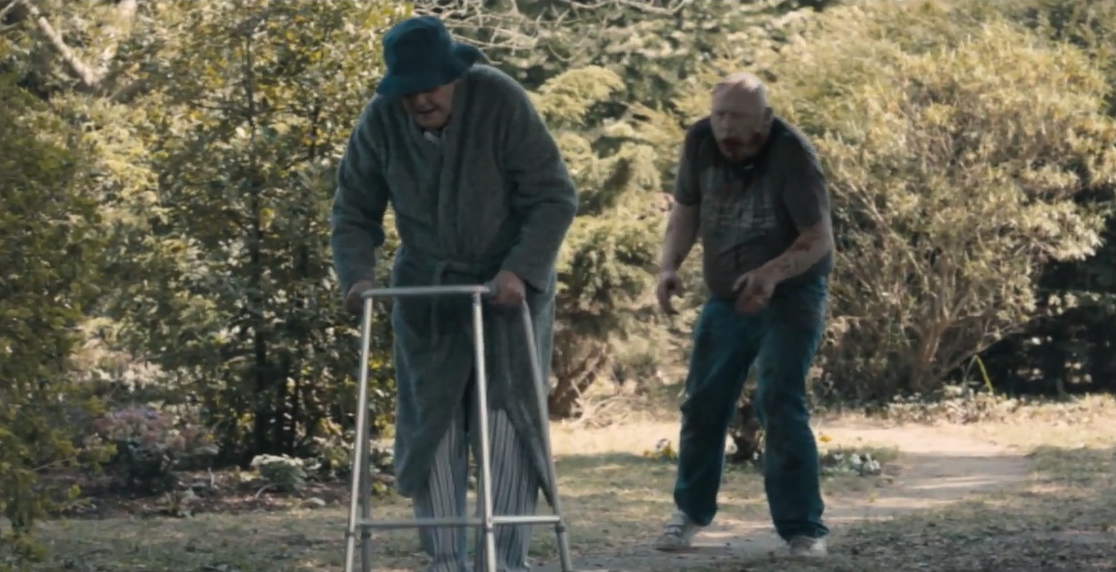
Hamish (Richard Briers) outwalks the undead in Cockneys vs Zombies

Moran and director Matthias Hoene subtly subvert the perception of the elderly in our society as being more than people waiting to die, while also giving us one of the most amusing scenes of the year when a zimmer-framed Briers tries to outrun a zombie.

You’d have to be dead not to find this ‘zomedy’ funny.

Review – The Hobbit: An Unexpected Journey

After so spectacularly scaling his own personal Mount Doom with his revered Lord of the Rings trilogy, could Peter Jackson somehow capture lightning in a bottle again with this second epic excursion into Middle Earth?

From the moment Rings was wrapped, Jackson was being called upon to sprinkle that same magic on J.R.R Tolkien’s earlier, much leaner children’s book The Hobbit.

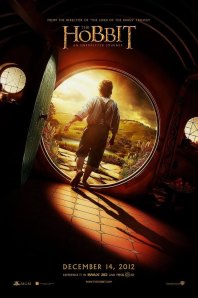
The Hobbit

The Hobbit: An Unexpected Journey – very good, but not without its faults

The New Zealander originally wanted Guillermo del Toro to direct, but after the Mexican horror maestro left the project (he’s down as a co-writer), Jackson took it upon himself to oversee the mammoth undertaking. While it would have been fascinating to see Del Toro’s vision realised on screen, Jackson’s pedigree was irrefutable.

That The Lord of the Rings was made as a trilogy made perfect sense – three books, three films. However, when it emerged that Jackson was turning The Hobbit into not two, but three movies eyebrows were raised and questions asked as to whether this was a bridge too far. Now that An Unexpected Journey is finally here in all its many guises (3D, Imax, 24 or 48 frames per second, take your pick) does it succeed? Yes, but with reservations.

An Unexpected Journey walks a similar path to Fellowship of the Ring; a CGI-heavy prologue lays out the stakes, a hobbit is chosen to go on an adventure, a small band of diminutive people is forged and a life or death quest begins to achieve something bigger than all of them.

Watching An Unexpected Journey is akin to slipping on a well-worn pair of slippers; the restless, swooping camerwork, the stirring Howard Shore score and the jaw-dropping New Zealand locations (seriously, Jackson is a one-man NZ Tourism Board) are all present and accounted for and when the Shire appears on screen it’s like being reuinted with an old friend after a decade apart.

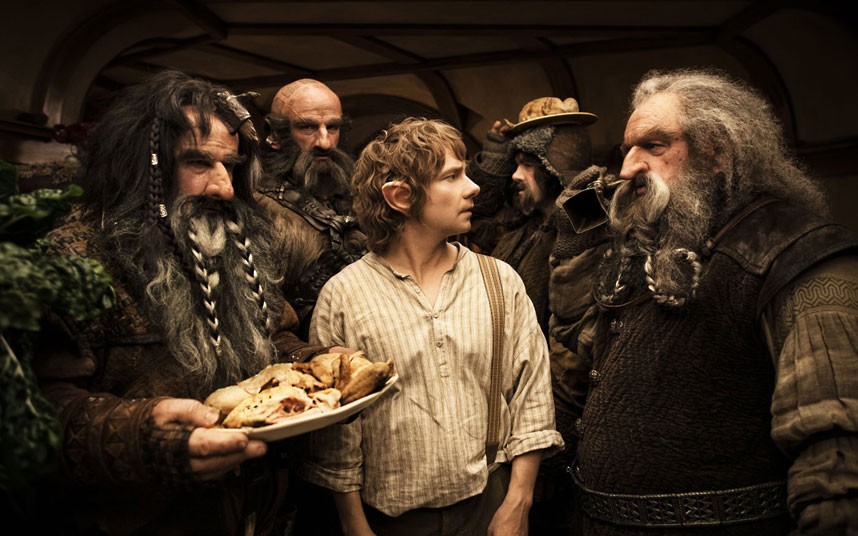
However, even old friends can get annoying as Jackson languishes in the Shire for what seems like an eternity. To be fair, a major reason for this is to introduce us to the 13-strong company of dwarves, led by the heroic Thorin Oakenshield (Richard Armitage), who come calling at the home of hobbit Bilbo Baggins (Martin Freeman) at the request of the wizard Gandalf (Ian McKellen). Bilbo is urged by Gandalf to join the dwarves on a perilous journey to reclaim their home and treasure from the dragon Smaug and, after much toing and froing belatedly embraces the opportunity.

Bilbo (Martin Freeman) reluctantly hosts a gang of dwarves in The Hobbit: An Unexpected Journey

Bilbo (Martin Freeman) reluctantly hosts a group of dwarves in The Hobbit: An Unexpected Journey

This overly-prolonged first act smacks of indulgence on Jackson’s part and has you wondering if three films really was a sensible idea. But once the gathering hit the road the film finally moves up the gears until a breathless last hour that promises much for next year’s The Desolation of Smaug.

As with his Rings trilogy, Jackson proves he’s no slouch when it comes to the big set pieces. The  stone giant battle in which Bilbo and co unwittingly become a part of is genuinely thrilling and underlines the dangers inherent on their quest, while the dwarves’ and Gandalf’s dizzyingly elaborate escape from the Great Goblin’s cave lair (amusingly voiced by Barry Humphries) and his sizeable CGI army is reminiscent of, though not as impressive as the Mines of Moria/Balrog scene from Fellowship.

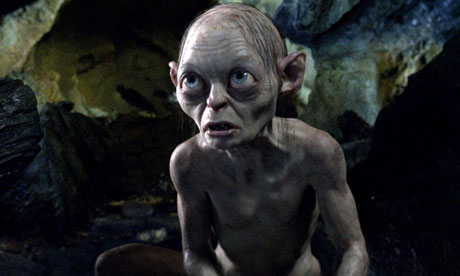
However, An Unexpected Journey‘s finest spectacle is saved for the game of riddles between an uneasy Bilbo and the pathetic, wretched Gollum; a masterclass in building tension that pivots the whole film and is the hobbit’s true turning point. The wonderful Andy Serkis dons the motion-capture suit once more to reprise his role as Sméagol/Gollum, whose split personality is equal parts humourous, childlike and disturbing , not least of which when he realises his “precious” ring has been stolen.

Gollum (Andy Serkis) is the star of the show in The Hobbit: An Unexpected Journey

Gollum (Andy Serkis) is the star of the show in The Hobbit: An Unexpected Journey

The moment when Bilbo, invisible after wearing the ring, holds a sword to the unknowing Gollum’s throat and exercises mercy is really something. It’s at this point that Jackson’s faith in Freeman must have paid off. Freeman, previously best known for his TV work in The Office and Sherlock, shows his acting chops by conveying pity, disgust and humanity in a single look and affirming that this little hobbit is the part he was born to play. Bilbo is our Everyman and Freeman delivers just the right mix of self-doubt, wonder and fortitude.

McKellen is clearly having the time of his life revisiting the mischievous and good-hearted wizard and it’s good to see Christoper Lee and Cate Blachett reprising their roles as, respectively, Saruman and Galadriel; however, Ken Stott’s Balin and James Nesbitt’s Bofur are the only dwarves to make any major impact, while Armitage has yet to fully convince as this tale’s rugged hero in the way Viggo Mortensen managed with Aragorn.

An Unexpected Journey is very good, but it’s not without its faults and fails to match the heights of Fellowship. For many that will be more than enough, but Jackson still has some work to do if he hopes this trilogy will earn its place in cinema’s valhalla alongside his previous fantasy epic.

Review – Compliance

The defence “I was only following orders”, christened by panicked Nazis at the Nuremberg trials has become synonymous with those looking to absolve themselves of guilt or responsibility.

It’s a mitigation that runs through writer-director Craig Zobel’s deeply unsettling examination of the powers of authority and our  willingness to blindly obey it.

Compliance – a “deeply unsettling examination of the powers of authority”

Compliance centres on a prank phone call to an American fast food restaurant from someone claiming to be a police officer. The ‘officer’ swiftly convinces manager Sandra that young female employee Becky is responsible for stealing money from a customer’s purse. Not wishing to get into trouble and all too willing to accept her supposed guilt for the sake of an easier day, the caller convinces Sandra and then others to subject Becky to increasingly dehumanising and humiliating treatment.

Incredibly, the film is inspired by true events, specifically a 2004 incident when a man masquerading as a cop called a suburban McDonald’s and told the manager to imprison an employee he claimed was a thief and strip search her. The confused manager agreed and even drafted in her fiancé to guard her. Depressingly, this was not the only incident of its type; more than 70 similar cases were reported in 30 U.S states before someone was arrested.

If Compliance achieves nothing else, it is sure to have you shaking your head in disbelief that something like this could have been allowed to happen. Some have reacted so strongly to the film that they have walked out of screenings.

Zobel’s matter-of-fact directorial style lets the narrative play out and invites us to make our own minds up. The use of tight close-ups lends the film a fetid, claustrophobic tension; however, the decision to reveal the caller’s identity feels like a mistake. The film would have worked even more effectively, been even more stifling had it not strayed outside of the restaurant and let the audience deduce for themselves that the caller’s increasingly outrageous demands were the result of a sick prank.

Compliance

Dreama Walker as the terrified Becky in Craig Zobel’s Compliance

The caller pulls the strings of his unwitting puppets from the very beginning and gets off on how far he can go. Giving only the vaguest description of the thief, Sandra does the work for him by assuming he’s talking about Becky and promising “to do everything that you need”. Meanwhile, the young victim is coerced into agreeing to the strip search when he theatens her with jail if she doesn’t comply, even going so far to persuade her to be “a good actress” to make the other staff feel more comfortable.

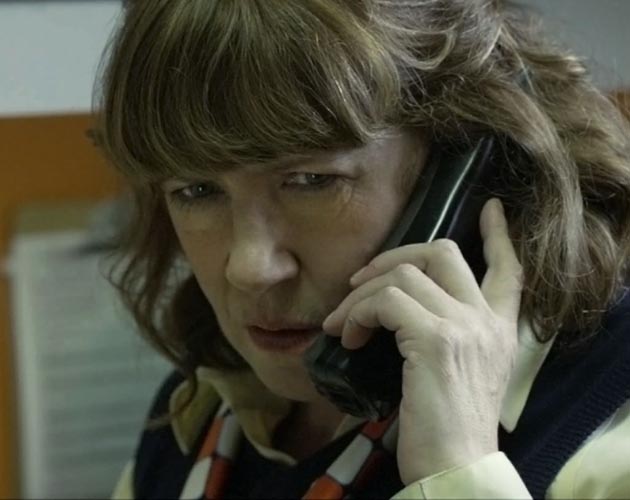
Ann Dowd gives a fantastic performance as the sad, weak and compliant Sandra. We can see the confusion and fear in her eyes, while still trying to exert her own authority on her young, largely apathetic workforce and keep them on side. In a society where we are told to respect our peers, Sandra believes she isn’t doing anything wrong; quite the opposite in fact, in her mind she’s doing what anyone else would do under similiar circumstances.

Fast-food restaurant manager Sandra (Ann Dowd) makes a very bad decision in Compliance

Fast-food restaurant manager Sandra (Ann Dowd) makes a very bad decision in Compliance

Zobel also draws strong performances from Dreama Walker as the terrified Becky who, like Franz Kafka’s K in The Trial is overwhelmed by circumstances of which she has no knowledge, and Bill Camp as Sandra’s acquiescent and eager-to-please boyfriend Van, who comes to realise he “did a bad thing” way too late.

Compliance, without resorting to histrionics or lectures, raises serious and worrying questions about the ease in which we can do horrible things with the best of intentions, the power of intimidation and our willingness to let someone else be the victim if it means we avoid trouble ourselves.

When the die is cast and the players believe they understand the rules, Zobel’s challenging and uncomfortable film leaves us to wonder just how long we’d be willing to let the game go on.

Review – End of Watch

Once the preserve of horror, the found footage film has spread its wings to encompass that other staple Hollywood genre; the cop thriller.

It was only a matter of time; our TV screens have been clogged up for years with such police-friendly ‘reality’ shows as Cops and Police, Camera, Action. All the while, fictional cop shows have endeavoured to become ever more authentic (minus the fruitier language), with arguably the most successful example of recent times being the acclaimed Southland.

End of Watch

End of Watch – enjoyable, but won’t stay long in the memory

In one episode of Southland, a patrolman must deal with the ramifications of punching a member of the public after it is caught on camera and broadcast online. As the episode’s opening narration states, “it’s a new age – a video age. People are always watching us [the police]. Everywhere”.

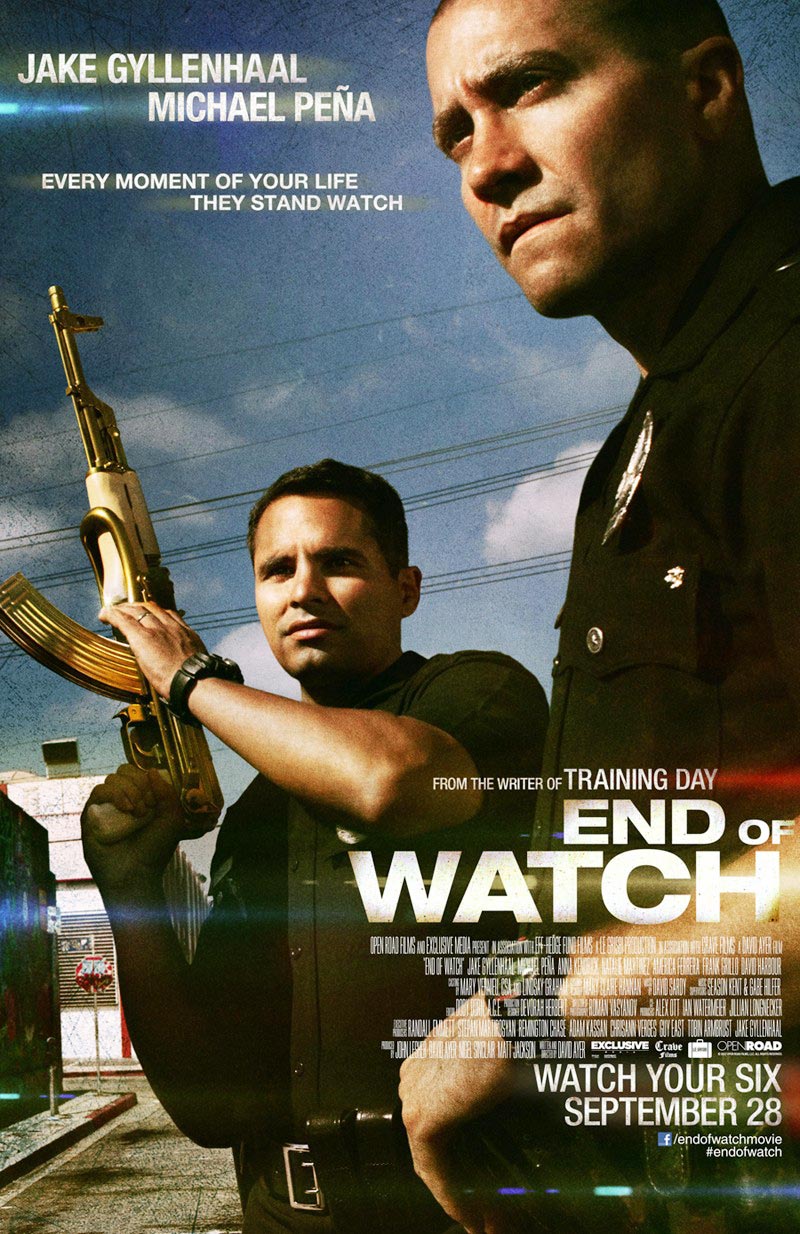
Writer-director David Ayer addresses this “new age” head-on in End of Watch. LAPD officer Brian Taylor (Jake Gyllenhaal) is filming his day-to-day official activities for a project, to the annoyance of his partner and close friend Mike Zavala (Michael Peña). To assist with this Taylor fixes tiny cameras to each of their shirts to allow for first-person filming.

Following an arrest which turns up a stash of cash and a gold-plated AK-47 (“two of the major food groups – money and guns”, Taylor states), the two investigate a Mexican drug cartel. Although urged to let it go, Taylor persuades Zavala to stay the course, but little do they realise they’ve made themselves the cartel’s most wanted.

Ayer has made a speciality of hard-bitten cop dramas, from writing stints on the Oscar-winning Training Day (2001) and under-rated Dark Blue (2002), to penning and directing the less successful Street Kings (2008); all of which dealt with police corruption, something that’s absent in End of Watch. Here the hook is the first-person filming style, described by Ayer as being akin to “watching YouTube — where something in your mind tells you this is real”.

It’s an interesting notion that at times works very effectively, especially during an edge-of-the-seat scene where Taylor and Zavala enter a burning building to save some kids. However, Ayer undermines these moments of found footage (and, in turn, the whole film) by sprinkling traditionally filmed shots in along the way (including that now ubiquitous ‘soaring above skyscrapers’ shot). You’re never sure whether you’re watching ‘real’ footage or not, which has the effect of pulling you out of the film. To make matters more confusing, when the camera is attached to the front of a gun, End of Watch resembles a first-person shooter computer game.

LAPD’s finest Brian Taylor (Jake Gyllenhaal) and partner Mike Zavala (Michael Peña) in David ‘Training Day’ Ayer’s End of Watch

When you strip away all the pseudo-realism and gimmicks, this is a good old-fashioned buddy movie, akin to Lethal Weapon, and it’s the hugely entertaining camaraderie between Gyllenhaal and Peña that really drives the film forward.

In his most high-profile role to date, Peña is magnetic. Sure, his character fits the Latino stereotype we’ve come to expect, all hot-blooded, street smart and full of attitude, but Peña is a smart enough actor not to overplay it and instead gives a raw and entirely believable performance.

Gyllenhaal is a hard actor to pin down, but is usually at his best when dialling it down in such films as Zodiac and Brokeback Mountain. Here he delivers the full range, from bug-eyed hot-shot to measured introspection and just about carries it off. He gives as good as he gets when playing opposite Peña and it’s in the scenes when they are riding in the patrol car where both actors bring their A-game and really ignite the film. Here the dialogue really fizzes in spite of its somewhat clichéd nature (the differences between white and Mexican culture).

Brian Taylor (Jake Gyllenhaal) gets up-close-and-personal in End of Watch

Brian Taylor (Jake Gyllenhaal) gets up-close-and-personal in End of Watch

Much like the over-rated Training Day, character development is sorely missing from End of Watch. Ayer deals in black and white simplicity here, chiefly in the way the Mexican cartel gang is portrayed. With absolutely no redeeming traits, we’re left to wait patiently until they can be chalked off. Indeed, when the shifty-eyed head honcho Big Evil responds to why he’s called that by stating “’cause my evil’s big”, it’s clear Ayer isn’t exactly straining himself to make his villians memorable.

By adopting the found footage approach, Ayer has delivered a fresh take on the police drama and in Gyllenhaal and Peña has found one of its most likeable partnerships. However, like much of the content on YouTube, End of Watch won’t stay long in the memory.