Decades Blogathon – Deep Red (1975)

Decades Blogathon Banner

1975

It’s day seven of the Decades Blogathon, hosted by myself and the singular Tom from Digital Shortbread! The blogathon focuses on movies that were released in the fifth year of the decade. Tom and I are running different entries each day; and this one comes from Anna at Film Grimoire. Anna’s voice is very distinctive and you could do a lot worse than to check out her great looking site.

I love giallo films – a genre defined as a murder mystery style of film, generally Italian-made, which contains a lot of blood, guts, and eroticism.

Deep Red Poster

So when it came time for the Decades Blogathon, and I saw that Dario Argento’s Deep Red (1975) would qualify for it, I knew I had to write about it. Deep Red, along with Suspiria (1977) and Tenebrae (1982), is probably one of Argento’s best known films; and for good reason, as it’s super creepy and probably one of my favourite horror films of all time.

Deep Red, also called Profondo Rosso or The Hatchet Murders, is a brutal giallo with a killer twist at the end that few could predict. Its plot is as follows:

Deep Red

A musician (David Hemmings) witnesses the murder of a famous psychic, and then teams up with a feisty reporter (Daria Nicolodi) to find the killer while evading attempts on their lives by the unseen killer bent on keeping a dark secret buried.

Our film begins with a stabbing murder in front of a Christmas tree, with sing-song, child-like music in the background. We see a child’s shoes and knee-high socks come into view, and the faceless child picks up the knife – did the child kill this as yet unknown victim?

I loved this beginning sequence as it sets the tone for the whole film. It’s such a disturbing thought, particularly as the child-like music from this initial moment is repeated throughout the film whenever a murder is about to occur. Are we watching a horror film where the murderer is a child? Argento excels at these kinds of mind games with his viewers.

Deep Red

It must be said that you cannot fault the direction by Argento. The direction is amazing, with some truly creepy shots where the camera pulls back to reveal a wider scene, with moving shadows that add a new layer of threat. Argento is truly the master of lingering on scenes or objects and making them feel extremely threatening as a result. There were a number of moments that stuck out for me as excellent in terms of their direction; namely, one particular shot that was focused on a single bead of sweat on our protagonist’s forehead, a slow zooming in on the protagonist as he plays the piano as if we are the killer focusing in on him, and overall the camera’s movement steadily throughout the film as if it’s a stalker looking for its victims.

You can say a lot about giallo films being exploitative and cheesy (which most of them are), but Argento’s direction is truly classy; which is often at odds with the film’s gratuitous violence, creating a strange dichotomy within the film. I love it.

As per other giallo films, Argento has made use of cheap actors and then overdubbed them with professional-sounding American and British voices. The dubbing in Deep Red is not as bad as some other giallos I’ve seen and the lips generally match up with the voices, although there were a couple of bad moments. I would say that the performances by our lead actors David Hemmings and Daria Nicolodi are not necessarily great; but honestly, that’s part of the fun with giallo films – the performances aren’t Oscar-worthy, but the overall story and art of the genre is what you watch the films for.

Some interesting trivia tidbits about the film – firstly, it was largely filmed in Turin, Italy, as Argento found out that there were more practicing Satanists living there than in any other European city. I love little facts like this as it shows that Argento is looking for just the right settings for his masterpieces on an ideological level rather than just a visual level.

Deep Red

Another example of Argento’s thoughtfulness is the methods of murders in the film, if that makes sense. Argento knew that a lot of people couldn’t relate to being shot, as many victims in horror films are, but could certainly relate to being cut or being burnt by scalding hot water. It’s this layer of Argento’s understanding of and empathy with his viewers that makes Deep Red a truly effective horror film in terms of its ability to shock and scare.

Creatively, Deep Red is a huge success. The music by progressive rock band Goblin is perfect as usual, this film being their first collaboration with Argento. Argento’s favourite colour red is an ongoing motif, with curtains, furniture, and the regular splashes of blood being different shades of red.

There is amazing set design throughout, as Argento seems to love showing his viewers the insides of gorgeous Italian apartments, mansions and villas. My favourite example of the top-notch set design is within the psychic’s apartment – paintings of ghostlike, creepy faces line the hallway, making it feel as if the killer could pop out at any moment. We regularly see from the killer’s point of view and watch his or her gloved hand reaching out to attack their victims, adding to this creepiness.

One really great question with regards to this film is, why did I choose to watch it alone at night-time? Deep Red is profoundly creepy, particularly certain scenes set in ominous-looking houses where the killer could be anywhere.

I love Deep Red because it’s one of those horror films where I would bet that you won’t be able to pick who the murderer is from the beginning. The ending is a big, brutal surprise, and I love Argento’s method of dropping a plot bomb and then going straight to the credits, giving little to no closure for his viewers.

Deep Red is a classic giallo that must be seen by horror film aficionados everywhere. Creatively, it is a stunner. Above all, it’s a very unsettling film, and that’s exactly why I love Argento’s work.

4.5/5

Decades Blogathon – Pee-Wee’s Big Adventure (1985)

Decades Blogathon Banner

1985

It’s day six of the Decades Blogathon, hosted by myself and the tremendous Tom from Digital Shortbread! The blogathon focuses on movies that were released in the fifth year of the decade. Tom and I are running different entries each day; and this one comes from Louis at The Cinematic Frontier. Louis’ thoughts and musings on the world of film make for fun and informative reading so why not do yourself a favour and head over there after checking out his review!

Thirty years ago, a film was released by Warner Bros. that would become an important milestone in the careers of three individuals.

For Paul Reubens, it would mark the big screen debut of his character Pee-Wee Herman; for Tim Burton, it would mark his feature film directing debut; while for Danny Elfman, it would mark the creation of his first Hollywood film score.

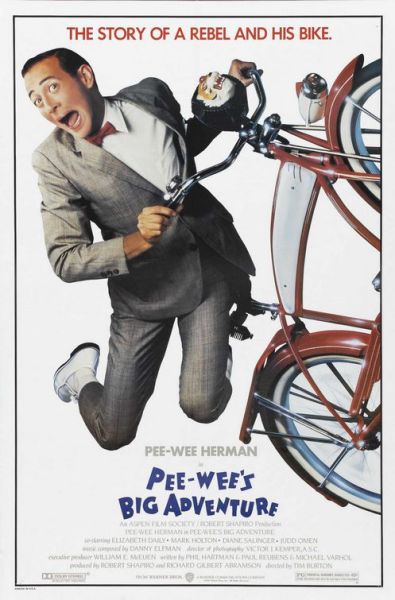
Pee-Wee's Big Adventure Poster

To say that Pee-Wee’s Big Adventure is an important film is an understatement (to say that it’s hilarious would also be an understatement). I first saw it on the big screen in January 2003 at the Walter Reade Theater in Lincoln Center. I saw it a second time later that Fall as part of a Tim Burton retrospective at the Museum of the Moving Image, and I saw it a third time on the big screen at a midnight screening at the Landmark Sunshine Cinema five years ago.

It was very enjoyable every time I saw it, and it just seemed to get funnier with every viewing. This 30th anniversary review of Pee-Wee’s Big Adventure is my entry in the Decades Blogathon hosted by Three Rows Back and Digital Shortbread.

Pee-Wee's Big Adventure

1985’s Pee-Wee’s Big Adventure follows the child-like Pee-Wee Herman as he sets off on a road trip across America to find his special bike after he discovers that it was stolen. Burton assembled a terrific cast that includes Reubens (as Pee-Wee Herman), Elizabeth Daily (as Dottie), Mark Holton (as Francis), Diane Salinger (as Simone), Judd Omen (as Mickey), Alice Nunn (as Large Marge), Jon Harris (as Andy), Jan Hooks (as Tour Guide Tina), Carmen Filpi (as Hobo Jack), Jason Hervey (as Kevin), Morgan Fairchild (as Movie Dottie), James Brolin (as Movie P.W.) and Phil Hartman (as Reporter).

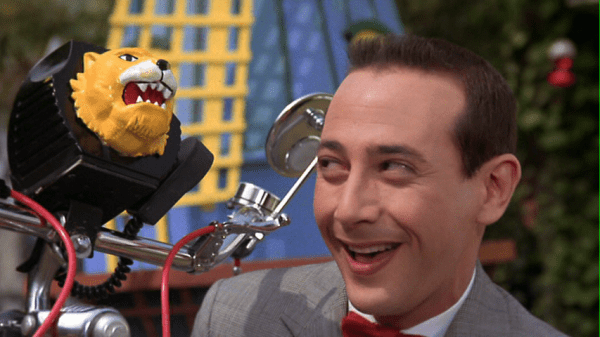
Reubens is a hoot as Pee-Wee, bringing zaniness and child-like innocence to the role. Daily is also wonderful as Dottie, the bike store employee with a huge crush on Pee-Wee. Holton is very entertaining as the villainous (and giant spoiled brat) Francis, bringing just enough zaniness and camp without going too over-the-top.

Pee-Wee's Big Adventure

Burton was a perfect choice to direct this film as he brings order to the beautiful chaos of the world of Pee-Wee Herman (I loved his use of stop-motion animation in the more surreal moments of the film). The screenplay by Reubens, Hartman, and Michael Varhol is just funny throughout the entire film, filled with hilarious dialogue and visual gags (it’s still hard to believe that it was inspired by Vittorio DeSica’s 1948 Italian neorealist film Bicycle Thieves).

The production design by David L. Snyder is incredible, bringing such an odd world to life (Pee-Wee’s house is still my favorite, especially with all those cool gadgets, including the breakfast machine, and over-sized utensils). Victor J. Kemper’s cinematography is first-rate, as is Aggie Guerard Rodgers’ costume designs, while Elfman delivers an outstanding score with creative use of percussion and a memorable theme for Pee-Wee.

Pee-Wee’s Big Adventure is a highly enjoyable comedy that still holds up after 30 years. Its importance cannot be understated, and its success led to greater things for the careers of Burton, Reubens, and Elfman. If you haven’t already seen this comedy classic, then do so as soon as possible!

Decades Blogathon – La Haine (1995)

Decades Blogathon Banner

1995

We’re halfway through the Decades Blogathon, hosted by myself and the peerless Tom from Digital Shortbread! The blogathon focuses on movies that were released in the fifth year of the decade. Tom and I are running different entries each day; and this one comes from Marta over at Ramblings of a Cinephile. If you haven’t checked out Marta’s site yet – why not?! – you’ll find it filled with her thoughts on oldies, new releases, home viewing and more besides.

La Haine Poster

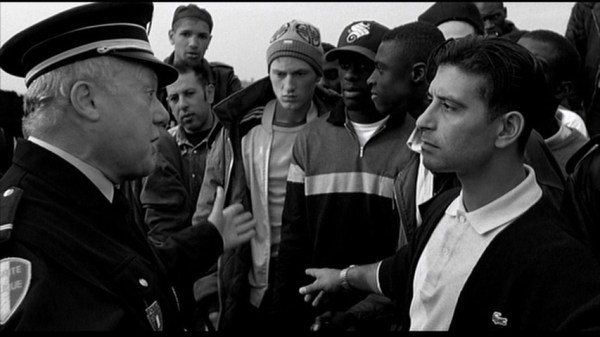
Mathieu Kassovitz gives us an insight into roughly 20 hours of the lives of Vinz (Vincent Cassel), Said (Said Taghmaoui) and Hubert (Hubert Kounde), three young friends from one of the banlieues (housing projects) in the suburbs around Paris, chronicling  the aftermath of a riot.

The viewer witnesses the struggles and alienation of these twenty-somethings living in an impoverished, multi-ethnic environment that seems a world apart from the magical and romantic image of Paris. This contrast is highlighted even more by the stark black and white photography and the expert use of framing and editing.

The three men have a quite different reaction to the event that led to the riot: the brutal beating of one of their friends by a policeman while in custody.

La Haine

Vinz, unemployed from a Jewish family, is full of rage against all the police and the establishment. Being impulsive with a need to prove himself, he’s ready for retaliation (he mimics the “Are you talking to me?” scene from Taxi Driver while alone in the bathroom).

Hubert, a Afro-French boxer and pot dealer, is more thoughtful and wiser in the ways of the world; he can see that hatred will only breed hatred and dreams to leave all this behind but, sadly, knows that there’s no escape. Said, who is an Arab Maghrebi and unemployed, inhabits a middle ground approach between those of his friends. He sees the injustice and the rampant racism but he wants to avoid troubles and just live quietly.

La Haine

Following their journey while they wander around the projects or in Paris proper, the viewer is taken on a roller coaster of hectic chases, fights, weird and dangerous encounters and idle conversations. The guys will disagree (mostly Hubert and Vinz), reconcile and always have each other’s backs. Their friendship seems to be the only solace in such a grim life that almost makes you believe that they are going to be alright… so far so good, until it’s not.

After 20 years the story and themes of this film are still very actual; I might venture to say that things are slightly worse nowadays, making its tale of crude brutality and hopelessness even more poignant.

La Haine

The three leads deliver brilliant performances, giving the audience flawed but sympathetic characters to root for and to follow in their grey world. Kassovitz’s directing and writing skills are impressive and were, well deservedly, recognised in 1995 since he was awarded a Cesar for Best Film and Best Director prize at the Cannes Film Festival.

At the time this film was compared to Spike Lee’s Do The Right Thing and Kassovitz noted with irony: “I don’t know if it’s really important, or intelligent even, when people say to me I’m a white Spike Lee, because they said to Spike Lee, you’re a black Woody Allen.” Gut-wrenching  – 9/10

Decades Blogathon – The Night Of The Hunter (1955)

Decades Blogathon Banner

1955

We’re onto day four of the Decades Blogathon, hosted by myself and the inimitable Tom from Digital Shortbread. The blogathon focuses on movies that were released in the fifth year of the decade. Tom and I are running different entries each day; and this one comes from Jordan over at the smart and sassy Epileptic Moondancer. Jordan’s site has a great mix of film (both old and new) and soundtrack reviews alongside plenty of other stuff to whet your whistle.

The Night Of The Hunter Poster

Not long ago I read an article in UK film mag Sight & Sound titled Southern Gothic. I am a big fan of old, gothic stories (Edgar Allen Poe is perhaps my favourite writer) and the article cited numerous examples of gothic tales originating from the south.

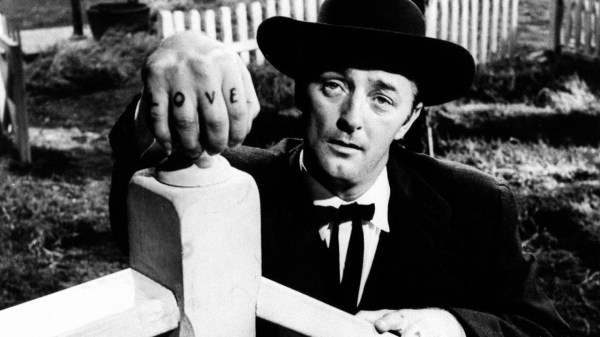
A quote from Tennessee Williams in the introduction to the article had me hooked, describing these films as being influenced by “an underlying dreadfulness in modern experience”. Hooked, I read on, and read about The Night Of The Hunter. Seeing the screenshot of a man with ‘H-A-T-E’ and ‘L-O-V-E’ tattooed on his fingers was the clincher.

The Night Of The Hunter is an eerie and highly symbolic film; a deceptively simple tale of good versus evil. The ultimate wolf in sheep’s clothing, representing evil is our villain Reverend Harry Powell (Robert Mitchum). He is a con man who plays a preacher to misguide suspicion; however, he also seems to sincerely believe he is a man of God.

Near the beginning of the film, we see his casual attitude to what he has already committed as he speaks to God: “How many has it been? Six?… Twelve? I disremember.” Reverend Harry Powell is the ultimate embodiment of a religious fanatic; taking the bible literally, deciding that if God killed so many people, why can’t he?

After the film’s surreal opening, which is best seen rather than read about, we are misled as we hear the sounds of children playing, but as the camera brings us down we see the children discovering the preacher’s last victim. Not caught for that crime, he is soon caught driving a stolen car and ends up in court.

The Night Of The Hunter

We then see the fate of another man, Ben Harper (Peter Graves), who after stealing $10,000 dollars gives his secret to his son and doesn’t break when questioned. Sentenced to death, his short time spent in jail is in the same cell as our preacher. We don’t see exactly where Harper decided to stash the money, adding an element of tension to the story as Reverend Harry Powell has decided that God has put him in this cell. Upon release, Powell decides to head to the town where Harper’s widow and two children reside; the children (Billy Chapin and Sally Jane Bruce) representing the good in the story.

What follows is a chilling tale as this con man quickly makes the widow (Shelley Winters) his wife, and doesn’t waste his time in asking about the money. Filled with symbolic imagery that I am sure means something to a religious scholar, the children manage to escape the menacing preacher by sailing up-river – a truly unforgettable sequence as the children become one with nature.

One shot in particular that stuck in my mind was the image of a cobweb placed over the scene of the children sailing downstream, the sort of inventive camerawork that is almost extinct today. The preacher, however, is relentless in following them, often making his presence known by singing a hymn that sounds like a lullaby, but his intentions change the nature of the song entirely.

The Night Of The Hunter

After watching this I still cannot get those creepy lullabies out of my head. The climax of the movie is fantastic and is filled with suspense, while the ending is unlike too many films of today’s cinema; the meaning of it all is left to the viewer to decide.

Watching this reminded me of how I originally got into cinema – by working from the start through Kubrick’s filmography, followed by Polanski. I will always prefer their older films and they somehow feel more natural to me than recent film do. I was born four decades too late it seems, as older music and film always evokes more emotion from me.

So I feel I must thank to Tom and Mark of Digital Shortbread and Three Rows Back respectively, as watching and writing about this film has truly reminded me that this is the era of film that I love.

Black and white cinema has always fascinated me, and the way shadows are used here looks incredible. I must find more cinema like this. Southern Gothic or not, this is the era of movies that I will always love the most.

Decades Blogathon – The Stepford Wives (1975)

Decades Blogathon Banner

Screen Shot 2015-05-17 at 10.14.45 PM

Welcome to day three of the Decades Blogathon, hosted by myself and the incomparable Tom from Digital Shortbread. The blogathon focuses on movies that were released in the fifth year of the decade. Tom and I are running different entries each day; and this one comes from Mark at the never-less-than-awesome Movie Man Jackson. Mark’s site really is worth a chunk of your time; it’s amusing and intelligent at the same time. Take a look.

“I’ll just die if I don’t get this recipe"

“I’ll just die if I don’t get this recipe”

What is the perfect woman like? And does she know she is ‘perfect’?

In the state of Connecticut, a quiet and secluded suburb known as Stepford exists. Stepford is a place that photographer Joanna Eberhart (Katharine Ross), her lawyer husband Walter (Peter Masterson) and their two kids will make life relocating from the bustling New York state. On the surface, it is everything one would think a family desires: a safe community, clean air, respectable neighbors and the like.

Things can sometimes be too perfect, though. For a free spirit and nonconformist like Joanna, an uneasy feeling manifests itself immediately and only grows larger as the days move on; and it is not like she can vent to anyone else.

Men are no help, and the other wives in town are the main reason for Joanna’s uneasiness. They want to be nothing more than perfect housewives. The only person she can trust is fellow newbie Bobbie (Paula Prentiss) and together, these two will have to try uncover the mystery of what exactly is going on.

The Stepford Wives 1

The decade of the 1970s is known for a lot of things, but perhaps the key thing it is known for is the women’s liberation movement. I am not a historian, but I’ll take an educated guess and say if the 1960s served as the world’s introduction to feminist ideals, the 1970s period served as the point in time where the movement really gained steam.

The Stepford Wives novel came along in 1972, and three years later spawned the film adaptation. While the film adaptation may not hold up completely today, mainly because of the different foci feminism fights today, the relevance hasn’t completely been lost either. And just on a more basic sense it is a watchable, oddly funny and entertaining little horror-thriller.

The Stepford Wives is very much a satire; a reflection of the world during its release. The core of the plot, and essentially the whole movie, is the clashing of the two differing beliefs of what women should be, and how they should behave.

All of the men serve as the establishment; the group in power that seeks to keep its dominance over the opposite sex, either due to fear of the unknown or some other, purely indulgent, reasons. Joanna and Bobbie are the resistance, representing the ideals of second wave feminism, the reluctance to accept what a male-driven society expects them to do in being docile, stay-at-home, and the quintessential 1950s housewife.

Over 40 years later, the discussion of gender roles in particular is still a fight being fought today by activists, but maybe not in the rudimentary way shown in this movie. Look at the recent controversy surrounding the madness of Gamergate and the uproar regarding the Black Widow character in Avengers: Age of Ultron. This keeps The Stepford Wives from being terribly dated, but there is a sense had by yours truly that this is sort of period piece not necessarily made to stand the test of time (do filmmakers always go into a production hoping to achieve that? Who knows).

The Stepford Wives 2

Simplistic as the struggle may be, seeing these two opposing viewpoints play out throughout the movie is very intriguing… at least for the first time it is viewed. It is hard and maybe a little bit wrong to bring this up, but on subsequent views the mystery, not impossible to figure out even if one has never read the book as ‘Stepford’ is pretty much part of the English lexicon, is less hooking than it is on the first watch. However, a scene that doesn’t lose its impact after endless watches is the final one, chilling all the way up through the final lingering image, and a nice bold decision taken by director Bryan Forbes to end on something uneasy.

Success also has to be given to Forbes for being able to create a level of tension primarily in the day. Unlike other thrillers where all of the juicy stuff happens in the dark, The Stepford Wives goes the other way and features all of its story bathed in sunlight. And it works, whether in a living room, parking lot, or daytime party. These are all settings that don’t scream creepiness, but work more than well conveying it within the confines of the story.

Still, some dirty spots on the linoleum exists. A wealth of hilarious quotables exist throughout, but at times, the rest of the dialogue feels like it is going nowhere, compounded by the film’s somewhat meandering first half. This is where the movie could use some better production values; the music and cinematography can be, to yours truly at least, kind of amateurish.

And even with the engaging plot, the leads in Katharine Ross, Paula Prentiss, and Peter Masterson are pretty one-note in their performances (aside from an excellent argument scene between Ross and Masterson later in the film). Honestly, the side characters end up making more of an imprint than the stars do, especially Patrick O’Neal as Dale Coba; a man who surely knows more than he lets on.

The Stepford Wives 3

Perfect for its time, but perhaps a little duller in impact now, The Stepford Wives can still be seen in many respects as a semi-blueprint for similar, later works such as Invasion Of The Body Snatchers, The Faculty, and other like-minded films. If watching women doing little domestic chores is your hobby, you’ll find plenty of it in Stepford.

Grade: B

Photo credits: filmfanatic.org, IMDb.com and pinterest.com.

Follow the Movie Man on Twitter @MovieManJackson