In Retrospect – The Room (2003)
This is my latest contribution to The Big Picture, the internationally recognised website that shows film in a wider context. Throughout January, The Big Picture has been running a series of articles on ‘bad but good’ movies. My focus is the ultimate ‘bad but good’ flick – Tommy Wiseau’s The Room.
If cinema is an ‘escape’ from real life, then Tommy Wiseau’s cult calamity is a feature-length detachment from reality itself.
It’s unlikely there could ever be enough drugs in the world to fully comprehend a film that, for all intents and purposes, resembles something made by an alien trying to recreate about a hundred different types of movie junk spewed out across the celestial airwaves.
The cult infamy afforded what is widely regarded as one of the worst films ever made has led to The Room gaining a second life that shows no signs of checking out. Indeed, the James Franco-led The Disaster Artist (based on Greg Sestero’s book about his experiences of working on the movie) has led to Wiseau’s work being embraced by the multiplex crowd.
The stories surrounding the film, and its enigmatic and eccentric writer/director are legion; not least of which the reported $6m budget that Wiseau apparently spent on the picture – a remarkable feat in so much as The Room resembles a movie made for about 0.5% of that cost.

The plot, what there is of it, centres on high-flying banker Johnny (Wiseau), who is due to marry the sociopathic Lisa (Juliette Danielle); however, Lisa has other ideas and pursues Johnny’s weak-willed best friend Mark (Sestero).
It’s difficult to know where to begin with The Room, although its mind-f***ing plot jumps, hilariously overwrought dialogue and insanely bad acting aren’t bad places to start.

We get not one, not two, but three veeeeery long sex scenes in the first 20 minutes, featuring plenty of Wiseau on display (in case you were wondering whether the film was a vanity project) alongside elaborate candelabra and water features that mysteriously disappear when the montages finally end. The R&B slow jams accompanying the rumpy-pumpy are comical enough, but the wildly OTT orgasmic sound effects are something else.
The film’s supporting cast are so wooden they make Steven Seagal look like Daniel Day-Lewis, none more so than the truly terrible Philip Haldiman as Denny, an orphan who Johnny has taken under his wing. When he’s not resembling a creepy serial killer we discover in one scene that Denny has a serious problem with drugs, a socially hard-hitting hot potato that gets forgotten about quicker than you can say “Oh, hi Denny!”.
Johnny may be cool with Denny’s later confession of love for Lisa, but our hero is distraught when his fiance truly starts messing him around. It’s difficult to know whether Wiseau is trying to paint his female lead as anything but evil incarnate, but needless to say the acting and dialogue aren’t selling it as much else.
When he’s not trying to channel Marlon Brando or James Dean (“You’re tearing me apaaaart, Lisa!”), Wiseau’s bizarre performance belongs on an American soap opera, pivoting from laughing inanity (oh boy, that laugh) to impersonations of chickens.
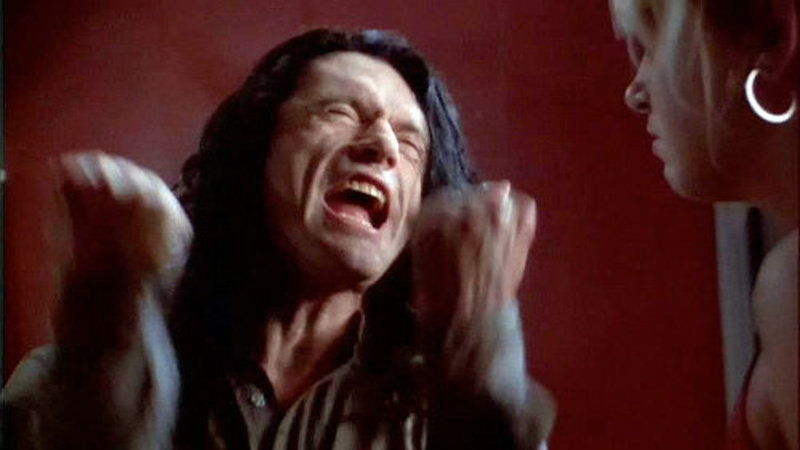
Just as Denny’s drug problems get cast aside in a heartbeat, so too does any definable logic. Conversations between characters that are emotive one moment veer off into goofiness the next, while scenes often look like they’ve been crowbarred in from other, equally terrible movies. As for all the spoons, who the hell knows what that’s about?
Having presumably watched too many life insurance adverts, Wiseau regularly features the guys playing catch, even having them all dressed up in tuxedos for some unfathomable reason. Likewise, the interplay between Lisa and her mother (Carolyn Minnott) spins on its head, throwing in dramatic revelations before moving on to something equally bonkers moments later.

That said, you never get the sense that any of the cast are winking at the audience, which only adds to the unintentional hilarity. Wiseau has spoken often of how he considers the film a black comedy, although this is no doubt a defence mechanism of a someone whose real ambition was to craft a dramatic chamber piece that Tennessee Williams would have been proud of.
Are there movies as bad as The Room? Most definitely yes. But whilst those flicks can often be made with a cynical heart, Wiseau’s unforgettable debut is the product of genuine artistic aspiration – however misguided.

 That three-year wait is finally over for Johnson and the result should not only put to rest any lingering doubt he may have had, but also gives this beloved space opera its most daring and emotionally satisfying chapter since the Empire struck back.
 Abrams faced criticism in some quarters for playing it too safe when he gave us The Force Awakens; however, without the foundations set in place by Episode VII, Johnson would never have been able to play so gleefully in the sandbox created for him. That said, it’s unlikely anyone expected he would empty the contents of that sandbox all over the place and, to paraphrase Luke, give us a Star Wars film that “is not going to go the way you think”.
 Star Wars has never been short of memorable characters, but they have often not been best served by emotionally mature dialogue. Johnson clearly had other ideas, though and never lets us forget these are people first who are flawed and impulsive and do what they think is best. The history of past actions weighs heavily, while the uncertainty of what comes next has never been more palpable.
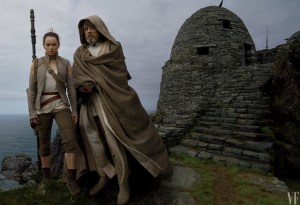 Hamill, thankfully given plenty more to do than in The Force Awakens (which wouldn’t have been hard), is excellent and offers us a side of Luke that’s a galaxy away from the naive, golly gosh farm boy we met all those years ago. Equally great is Ridley, who makes us think twice at one point about where she could be headed, and Driver, who has fully settled in to what is this new trilogy’s most complex role and delivers a performance that sees him break free of the past while still holding on to some of his more immature impulses.
 While Marvel hasn’t perfected the superhero genre, with often underwhelming villains and a penchant for slam-bang finales that can feel overly familiar, it does boast a well-drawn gallery of central and supporting characters and plenty of crisp dialogue.
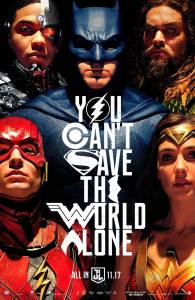
 The same can no doubt be said for Justice League. The insistence by cast and crew that this was always going to be a far lighter affair than Batman vs Superman smacks of “the lady doth protest too much”. Besides, what jocularity there is falls mostly into the lap of Ezra Miller’s Barry Allen, who rattles off lines as fast as his Flash alter-ego can handle, leaving the audience as little time as possible to absorb the fact that 99% of them simply aren’t amusing.
 Wonder Woman‘s focus on luminous positivity in the face of the great darkness of World War One, as well as the ease in which its central team play off each other stands out even more when its lead character stars in something as flat-footed as this. It’s also fair to say that film’s director Patty Jenkins wouldn’t have focused her camera on the parts of Gadot’s body Snyder regualrly chooses to stray on.



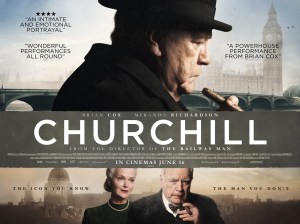 Gary Oldman will be the latest to give the ‘victory’ sign when he stars in Joe Wright’s Darkest Hour later this year, but getting there first is Brian Cox, who gained considerable weight and shaved his head to achieve the physical embodiment of the former British Prime Minister. However, it is the way he humanises a man still regarded as one of the United Kingdom’s greatest figures that has won him particular acclaim.
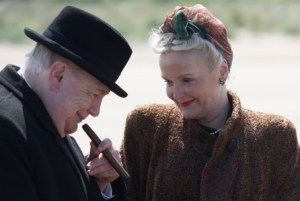 Set in the final days and hours leading up to Operation Overlord, otherwise known as D-Day on 6 June 1944, the film portrays Churchill as a man haunted by the slaughter that claimed the lives of tens of thousands of men at Gallipoli almost 30 years earlier and convinced the Allied invasion of France will be equally catastrophic.
 There’s no doubt the angle taken by the film in chronicling the lead-up to one of the defining events of the 20th century is an interesting one, based as it is on the diaries of Brooke as well as other historical sources. It’s a shame therefore that Alex von Tunzelmann’s one-note script and Jonathan Teplitzky’s stagy direction fail to get away from the fact that Churchill would have worked better on television rather than in cinemas.
 There are some nice moments here and there; in particular a beautifully played scene between Cox and Purefoy in which the King gently breaks his friend’s heart in an effort to save Churchill from himself. The crushing weight on the shoulders of Einsenhower and his senior military staff as they weigh up a decision that will ultimately decide the fate of the war is also effectively handled – lest we forget that D-Day was a leap into the unknown with potentially devastating consequences.
 three rows back